The debate over online child safety is just as heated abroad as it is here in the States. Over in the UK yesterday, according to this London Times article, Conservative Shadow Home Secretary David Davis…
attacked the Government for not doing enough to raise awareness among children of the dangers posed by cyber-crime, at a time when the threat was growing and criminals were using increasingly sophisticated methods to target their victims. “From e-mail to file-sharing, social networking to shopping, the internet is part of our lives. But we’re not the only ones to have migrated to this new communication platform,” Mr Davis told delegates at an e-crime conference in London. “The internet is a shopping mall for criminals, and for many of us it’s in the home that cyber-crime strikes. These days our real valuables are the personal details that are measured in megabites, rather than our belongings.”
Apparently, Mr. Davis and fellow conservatives have also argued that children as young as 5 years of age should be taught about the dangers of putting their personal details on the internet.
A few thoughts on this… First, I’m all for online safety education and media literacy, but shouldn’t we be teaching our kids basic literacy first? My six year old doesn’t even know how to spell “Internet” yet!
Continue reading →
The rural broadband debate has been in the news a lot lately. Yesterday, DSL Reports ran a story sharply criticizing a report released by the US Internet Industry Association (an ISP lobbyist firm). But as Ars pointed out, the report actually offers some facts revealing that broadband availability in the U.S. isn’t nearly as bad some have suggested.
79 % of homes with a phone line can now get DSL, and 96 % of homes with cable can get broadband. Considering just about every home has a phone line, and most people have cable, these numbers suggest the main reason for the lack of rural broadband users isn’t the lack of availability, but the lack of adoption. Of course, rural areas have slower speeds and higher prices than urban areas. This makes sense, because building out a network in low-density areas costs more per subscriber versus urban areas, where a single apartment complex can house hundreds of users.
Still, groups argue that massive government subsidies are needed to promote broadband deployment in rural areas. ConnectedNation (a Washington-based non-profit) released a report a couple weeks ago, “The Economic Impact of Stimulating Broadband Nationally”, which concluded that accelerating broadband could pump $134 billion into the U.S. economy.
Continue reading →
Google’s recent announcement that it is creating a home for personal health records online is a natural outgrowth of Silicon Valley’s Web 2.0 consumer Internet focus. The question this raises is whether a market-driven system is better for keeping health records than one run by the government. Here is my column discussing it.
I’m a big fan of Chris Anderson and his magazine Wired. So I eagerly read his new cover story and preview of his forthcoming book, both entitled “Free!”
Anderson begins with the story of King Gillette, famous for his give-away-the-razor-and-sell-the-blades business model. Anderson classifies this form of “free” as a cross-subsidy.
Over the past decade, however, a different sort of free has emerged. The new model is based not on cross-subsidies — the shifting of costs from one product to another — but on the fact that the cost of products themselves is falling fast. It’s as if the price of steel had dropped so close to zero that King Gillette could give away both razor and blade, and make his money on something else entirely. (Shaving cream?)
You know this freaky land of free as the Web.
But why are digital and information technologies fundamentally different than massy goods? And why do they make “free” business models far more widespread, or even dominant?
To explain, Anderson goes to the source — of both the technology, literally, and of the imaginative economic concept that propelled the technology far beyond its initial potential. You see, Carver Mead not only did the research behind Gordon Moore’s Law, and named it, but he also (1) created the VLSI manufacturing and design methodology to make very large scale integrated circuits possible and (2) envisioned that Moore’s Law could mean entirely new products, new industries, and even a new quantum digital economy.
Continue reading →
Since I’m new here and since this is the Technology Liberation Front, I’m earnestly reposting some recent thoughts about how technology is driving political evolution in China.
In a long and thoughtful article in the Jan/Feb 08 issue of Foreign Affairs, John Thornton, a former head of Goldman Sachs and now professor at Beijing’s Tsinghua University, details the evolution of democracy in China. Along the way, Thornton describes two striking examples of the way “technologies of freedom” (in my colleague Adam Thierer’s phrase) are making a big difference.
In the past several years, the Internet and cell phones have started to challenge traditional media by becoming channels for the expression of citizen outrage, at times forcing the government to take action. One celebrated instance was the “nail house” incident in the sprawling metropolis of Chongqing, in central China. For three years, a middle-class couple stubbornly refused to sell their house to property developers who, with the municipal government’s permission, planned to raze the entire area and turn it into a commercial district. The neighbors had long ago moved away. The developer tried to intimidate the couple by digging a three-story canyon around their lone house, but the tactic backfired spectacularly. Photos of their home’s precarious situation were posted on the Internet, sparking outrage among Chinese across the country. Within weeks, tens of thousands of messages had been posted lambasting the Chongqing government for letting such a thing happen. Reporters camped out at the site; even official newspapers took up the couple’s cause. In the end, the couple settled for a new house and over $110,000 in compensation. The widely read daily Beijing News ran a commentary that would have been inconceivable in a Chinese newspaper a decade ago: “This is an inspiration for the Chinese public in the emerging age of civil rights. . . . Media coverage of this event has been rational and constructive. This is encouraging for the future of citizens defending their rights according to the law.”
Continue reading →
 I’ve started to force myself to use Twitter to see if I can discover why people find it so compelling. Well, yesterday, after UPS delivered Clay Shirky’s new book, “Here Comes Everybody: The Power of Organizing Without Organizations,” I decided to subscribe to Shirky’s tweets. Lo and behold, a few hours later I get this tweet from Shirky: “Getting ready for a talk tomorrow at New America Foundation in DC.” I had no idea he would be in town. Twitter is actually useful.
So, I attended the talk at the New America Foundation. It was based on his book, which looks at the how new online tools of conversation and collaboration (like Twitter) are affecting society. I took notes and thought I’d share them here. Be warned they’re more or less chicken scratch, but they should give you a flavor for his ideas. They’re after the jump.
Continue reading →
Tom is absolutely right that the manipulative use of graphical filters has a long (if not exactly proud) pedigree in politics. What he’s forgetting, however, is that hysterical over-reaction to political advertising also has a long pedigree. Does no one remember RATS? Or Michael J. Fox’s exaggerated Parkinsons symptoms? Making mountains over molehills is the whole point of a political campaign. This campaign has had its stupid moments, but they’re no stupider than past contests.
For all its wonders, technology is not something policymakers can sprinkle on deep-seated economic and social problems to make them go away. Electronic employment eligibility verification – the idea of automated immigration-background checks on all newly hired workers – illustrates this well.
A national EEV program would immerse America’s workers and businesses in Kafkaesque bureaucracy and erode the freedoms of the American citizen, even as it failed to stem illegal immigration.
Ultimately, there is no alternative but for Congress to repair the broken immigration system by aligning legal immigration with our nation’s economic demand for labor.
Read about it in my new paper, “Electronic Employment Eligibility Verification: Franz Kafka’s Solution to Illegal Immigration.”
A podcast on it can be found here.
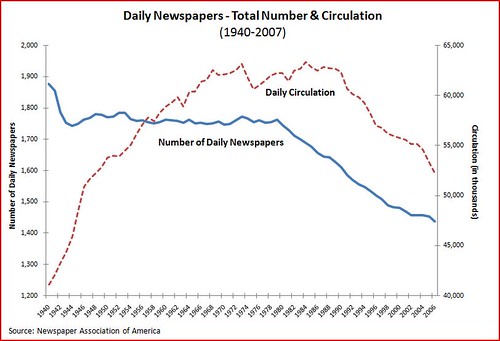
If we were to believe the rhetoric of some in Washington and various pro-regulatory groups like Free Press, you’d think we still lived in the 1800s and that a handful of newspaper barons like William Randolph Hearst and Joseph Pulitzer still dominated our media landscape. Just today, in fact, Sen. Byron Dorgan (D-ND) introduced a “Resolution of Disapproval”–largely at the urging of Free Press and other regulatory advocates like Parents Television Council–that would overturn a half-hearted media liberalization effort undertaken by the Federal Communications Commission last December.
That FCC effort dealt with just one of the myriad regulations governing media structures in this country: the newspaper/broadcast cross-ownership rule. The newspaper/broadcast cross-ownership rule, which has been in effect since 1975, prohibits a newspaper owner from owning a radio or television station in the same media market. “No changes to the other media-ownership rules [are] currently under review,” FCC Chairman Martin noted at the time, leaving many TV and radio broadcasters wondering when they will ever get regulatory relief.
In a
New York Times op-ed released at the same time as his December proposal, Martin argued that “in many towns and cities, the newspaper is an endangered species,” and that “if we don’t act to improve the health of the newspaper industry, we will see newspapers wither and die.” Moreover, he wrote, “The ban on newspapers owning a broadcast station in their local markets may end up hurting the quality of news and the commitment of news organizations to their local communities.” In other words, newspapers need the flexibility to change business arrangements and ally with others to survive.
Exhibit 1
Continue reading →
What he said:
Personally, I couldn’t care less whether Jimbo is sleeping with Rachel Marsden (other than the fact that she appears to be insane), or what they say to each other in their IM chats. I don’t care whether Jimbo has had marital problems, or whether he’s had disagreements with the foundation over his expenses. All that says to me is that he’s human, and has made mistakes.
But the implication is that because he’s made some mistakes in his personal life, that somehow Wikipedia itself is demeaned or invalidated in some way, as though someone had discovered that Mother Theresa was skimming money, or running drugs through the orphanage. To me, Jimmy Wales is nothing more than the guy who set Wikipedia in motion; it has become much more than a one-man show, if it ever was. What he does in his personal life is of no interest to me, nor do I think it’s particularly relevant to what matters about Wikipedia.
I think this is roughly akin to the argument that because Enron was cooking its books, capitalism is fatally flawed. Wikipedia is a large community of people that’s fundamentally defined by its decentralized decision-making process. Jimmy Wales has more influence than anyone else in that community, but his benevolent dictatorship is sharply constrained by the need to keep the foot soldiers happy. Whether he’s personally corrupt (and just to be clear, none of the dirt that’s been dug up thus far proves anything of the sort) or not is beside the point, he’s grown the site to the point where it could easily carry on without him.

 The Technology Liberation Front is the tech policy blog dedicated to keeping politicians' hands off the 'net and everything else related to technology.