Just minutes after writing this post, which relied on Valleywag’s recounting of a paywalled WSJ story, I came across a link to the actual case.
The actual case says (at page 12): “There was no error in excluding the classified information.” Valleywag’s version: “The appeals court agreed that classified documents related to those negotiations were improperly excluded.” (For you non-lawyers, that is the opposite.)
But the circuit court’s analysis is awfully interesting, and I think it’s wrong. I’ll copy the whole thing because it’s so brief and then run it past some analysis of insider trading law:
Continue reading →
Via Valleywag – and unbelievably I’m relying on Valleywag for hard news – former Qwest CEO Joe Nacchio will get a new trial after the 10th Circuit Court of Appeals ruled that evidence was properly excluded from his trial. Nacchio claims that he expected income from government contracts but the contracts were canceled when his company declined to comply with government demands for customer information. The trial court didn’t allow this allegation into evidence.
As I speculated last October, the administration is probably working so assiduously on immunity for telecom firms because the telecoms have information about yet more administration surveillance activities than has been revealed to date. Nacchio’s new trial may bring some of this information to light.
Update: Sure enough, Valleywag is not reliable.
Chris Soghoian has an important post on the C|Net News blog examining a Google statement to him about whether it has facilitated or participated in government surveillance.
In response to Chris’ question, “Is Google sharing ‘huge volumes’ of search records with the government?”, a Google spokesperson said, “Google was not part of the NSA’s Terrorist Surveillance Program.”
That’s answer that should peg anyone’s non-denial denial detector. Google should be more direct and forthcoming.
Ironically, despite writing about technology for a living, I have a bad track record when it comes to adopting new web tools. I only joined the Facebook and RSS bandwagons last year for example. At Jerry’s virtual urging, though, I’ve broken down and joined the Twitter revolution. Now you, too, can read all the interesting things I have to say in 140 characters or less.
One of the things that annoyed me about the sign-up process is that it asked me for my GMail/Yahoo!/whatever password in order to add all of the people in my address book to my Twitter watchlist. This is a Bad Idea, and especially now that sites are starting to offer dedicated APIs for this purpose, there’s no excuse for demanding peoples’ passwords.
I’ve got a Mac. Any recommendations for good Twitter-related software I should be checking out?
The Project for Excellence in Journalism has released its latest “State of the News Media” (SOTNM) report. As a journalism junkie and a student of information history, I always look forward to these reports, especially because they are jam-packed full of very useful information and statistics about the health of various media sectors, something I have spent a lot of time discussing here in my ongoing “Media Metrics” series of essays.
This year’s SOTNM report contains some conclusions that are sure to provoke controversy and criticism. I thought I would just mention the one conclusion that is sure to be the most controversial. Namely, the report concludes (this is from the Executive Summary):
The verdict on citizen media for now suggests limitations. And research shows blogs and public affairs Web sites attract a smaller audience than expected and are produced by people with even more elite backgrounds than journalists. [p. 1]
[…]
The prospects for user-created content, once thought possibly central to the next era of journalism, for now appear more limited, even among “citizen” sites and blogs. News people report the most promising parts of citizen input currently are new ideas, sources, comments and to some extent pictures and video. But citizens posting news content has proved less valuable, with too little that is new or verifiable. … The array of citizen-produced news and blog sites is reaching a meaningful level. But a study of citizen media contained in this report finds most of these sites do not let outsiders do more than comment on the site’s own material, the same as most traditional news sites. Few allow the posting of news, information, community events or even letters to the editors. And blog sites are even more restricted. In short, rather than rejecting the “gatekeeper” role of traditional journalism, for now citizen journalists and bloggers appear for now to be recreating it in other places. [p. 3]
I suppose my fundamental problem with this conclusion is that it is simply too early to be making sweeping conclusions about the impact of user-generated media and Web 2.0 reporting on the overall health of the news media.
Continue reading →
Over at Techdirt, I disagree with Jerry’s point (and Mike Linksvayer’s) about the concept of ad-supported Wikipedia. While the organization could certainly do some worthwhile things with the money, I think there’s a significant danger that fighting over the money could begin to overshadow the Wikimedia Foundation’s important mission of ensuring the integrity of the Wikipedia editing process itself.
Superficially, this might seem at odds with libertarians’ general inclination to view profit-making as a benign phenomenon. But I think the essential point here is actually one that libertarians make a lot: money generally matters less than institutions. Increased spending—on schools, narcotics control, wars, whatever—will only have beneficial effects if the underlying institutional framework is designed to use that money effectively. If your institutions aren’t designed to utilize resources effectively—if, say, you’ve got a bureaucratic monopoly school system or a hopelessly confused military strategy—then injecting additional resources into those institutions isn’t going to produce any positive results. Those additional resources will simply be dissipated into pointless rent-seeking.
There’s nothing dysfunctional about Wikipedia, viewed as an institution for editing an encyclopedia. But there’s no reason to think an institution built to edit an encyclopedia is going to have any special competence to oversee the spending of millions of dollars of free money. And given that arguments about money could easily distract and divide the already-fractious Wikipedia community, I think it’s probably smart to avoid that quagmire entirely.
Look at that. Another example of the “so-called ‘libertarians’ and their complete and total absence during our FISA fight.” Seriously, Julian’s got a great piece in the LA Times:
In the FISA debate, Bush administration officials oppose any explicit rules against “reverse targeting” Americans in conversations with noncitizens, though they say they’d never do it.
But Lyndon Johnson found the tactic useful when he wanted to know what promises then-candidate Richard Nixon might be making to our allies in South Vietnam through confidant Anna Chenault. FBI officials worried that directly tapping Chenault would put the bureau “in a most untenable and embarrassing position,” so they recorded her conversations with her Vietnamese contacts.
Johnson famously heard recordings of King’s conversations and personal liaisons with various women. Less well known is that he received wiretap reports on King’s strategy conferences with other civil rights leaders, hoping to use the information to block their efforts to seat several Mississippi delegates at the 1964 Democratic National Convention. Johnson even complained that it was taking him “hours each night” to read the reports.
Read the whole thing; Julian describes similar abuses in the Harding, Truman, Kennedy, and Nixon administrations. While I certainly hope that Presidents Obama, Clinton, or McCain wouldn’t do anything like this, it would be naive to enact legislation that requires us to simply trust them.
H.R. 2341, the Stop Trading on Congressional Knowledge Act, would prohibit securities and commodities trading based on nonpublic information relating to Congress, and it would require additional reporting by Members and employees of Congress on their securities transaction.
The motivations behind it are utterly pure. It’s would be unfair for Members of Congress and staff to use inside knowledge of Congress for pecuniary gain.
But how a law like this would be effectively enforced is beyond me. A bar on congressional-insider trading would most likely cause one of the following results:
- It would be honored in the breach;
- It would lead to endless (perhaps politically motivated) investigations of our representatives and their staffs; or
- It would force many or most congressional employees to withdraw from investing as a prophylactic against 2.
Regarding yesterday’s secret session of Congress:
Democrats said very little was discussed that could not have been revealed in open session. Pelosi didn’t show up, and Democrats, underwhelmed by the GOP’s evidence, used just 10 minutes of their allotted 30 minutes of secret time.
“We probably could have gone and eaten together at McDonald’s, and it would have had just as much effectiveness,” said Rep. Charlie Melancon (D-La.), one of the conservative Democrats the GOP was targeting.
It’s incredibly refreshing to see the House take seriously its responsibility to resist White House efforts to undermine the rule of law. Six weeks ago, I thought it was only a matter of time before Congress capitulated and once again reduced judicial oversight over domestic surveillance activities. But now people are seriously talking about the stalemate lasting for the remainder of the Bush administration.
The White House has cried wolf so many times that the tactic is becoming less effective with every repetition. As the House continues to ignore the president’s scare tactics, those tactics are beginning to look faintly ridiculous. At this point, there is very little political reason for the House to capitulate, and good policy reasons for them not to.
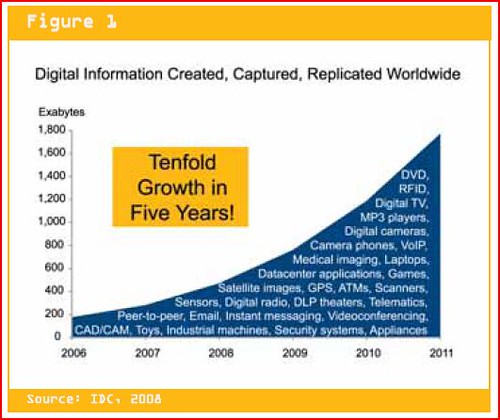
There are some wonderful stats in this new IDC white paper “The Diverse & Exploding Digital Universe: An Updated Forecast of Worldwide Information Growth Through 2011.” For example:
The IDC research shows that the digital universe—information that is either created, captured, or replicated in digital form — was 281 exabytes in 2007. In 2011, the amount of digital information produced in the year should equal nearly 1,800 exabytes, or 10 times that produced in 2006. The compound annual growth rate between now and 2011 is expected to be almost 60%. The size of the digital universe in 2007 (and 2006) is bigger by 10% than we calculated last year, and the growth is slightly higher. This is a factor of faster-than-expected growth in higher resolution digital cameras, surveillance cameras — especially in places like China and major urban centers — and digital TVs and of improved methodology for estimating replication.
Continue reading →

 The Technology Liberation Front is the tech policy blog dedicated to keeping politicians' hands off the 'net and everything else related to technology.