Ben Worthen explains why. (I am much better about guarding my privacy. I usually only give out my password if the chick is topless and offering ice cream!)
Ben Worthen explains why. (I am much better about guarding my privacy. I usually only give out my password if the chick is topless and offering ice cream!)
There are a lot of disturbing things out there on the Internet. I don’t think I need to provide an inventory. Occasionally, some of the more despicable sites (think pro-suicide sites or bomb-making sites) capture the attention of public policymakers and bans are proposed. It was only a matter of time, therefore, before “pro-ana” sites made the regulatory radar screen as they did this week when lawmakers in France proposed a measure, “aimed at fighting incitement to extreme thinness or anorexia.”
The pro-ana movement, which refers to people and websites that justify or glorify anorexia or an excessively “thin look” or lifestyle, came to my attention last year when an academic was interviewing me for a new book he was writing about online responsibility. He was asking me what I thought about the idea of liability being imposed on website developers who glorify potentially harmful lifestyles or activities. In other words, an “aiding and abetting” standard for hateful or “harmful” online speech. I expected our discussion to focus on the truly sick or stupid stuff out there—like the bomb-recipe nutjobs or the suicide fans—but, instead, the academic mentioned pro-ana sites, like House of Thin (which no longer seems to be around) and others. The danger of these sites is that they offer young girls, which seems to be the primary audience, very unhealthy advice about how they can use various techniques (fasting, vomiting, laxatives, etc) to become super-thin. Needless to say, that can lead to extreme weight loss and serious health disorders for these girls.
Should sites be banned, or held liable in some fashion, for the harm they cause? We could nitpick about whether of not pro-ana sites cause serious harm to girls, but let’s assume that they do cause some harm. Does that mean the site administrators should be held responsible for the actions of others who read those sites? The French law says “yes.” It would, according to Reuters:
impose penalties of two years plus a fine of 30,000 euros ($47,450) for “incitement to excessive thinness by publicizing of any kind.” The penalties would rise to three years in jail plus 45,000 euros fine in cases where a death was caused by anorexia. The bill was adopted by the lower house of parliament on Tuesday and must go before the Senate before it becomes law.
Fantastic:

And while I’m on the subject, I can’t resist linking to my all-time favorite techno-bashing animation.
Chairman Martin and his FCC colleagues testified today before the House Energy and Commerce Telecommunications and the Internet Subcommittee on the just-completed 700 MHz spectrum auction. At the top of the agenda was the failed D Block auction. According to Martin, all options are on the table. According to the WSJ, however, some have definite ideas for the block:
Some Republican members on the committee said they believed the 10 megahertz of spectrum should be sold off to the commercial wireless industry, and part of the proceeds then given to public safety so they could solve their communications shortcomings on their own. Those who advocate this solution have argued that public safety entities already control more than enough spectrum allocated to them by Congress over the years, but that it is being used ineffectively.
Those “some republicans” seem to include ranking member Joe Barton.
This is a bad idea. While I’m sympathetic to the argument that “public safety entities already control more than enough spectrum allocated to them by Congress over the years, but that it is being used ineffectively,” throwing more money at the problem isn’t going to fix it, either. Bringing commercial providers into the public safety sphere can help begin to break down the collective action problem that is the cause of the ineffective use of spectrum. If a commercial solution is successful, maybe then Congress can take a second look at all the spectrum public safety now holds and do something akin to the DTV transition: auction the spectrum while moving public safety to better, more efficient technologies.
As Hance discussed last Thursday, the FCC will soon rule on AT&T’s petition for regulatory forbearance. Over at Openmarket.org I blog about why the FCC should grant phone companies relief from costly reporting requirements:
America’s two largest phone companies, AT&T and Verizon, recently filed forbearance petitions asking the FCC for relief from various regulations. Verizon is asking for the freedom to set prices on wholesale connections to competitive local carriers, and AT&T has requested exemption from certain FCC audit requirements and service quality reporting mandates.The real question is, why should Verizon have to ask permission from bureaucrats to decide how much to charge for its products? And why must AT&T spend millions of dollars to fill out intricate paperwork just to prove to the FCC its product is good enough for customers? Interventionists say this is because phone companies won’t ensure service quality unless they are subject to government oversight. But this claim ignores market conditions. With competition intensifying between phone providers and new wireless networks on the verge of completion, the market will discipline any communications company that skimps on service or price. Sprint and Comcast have learned this lesson the hard way.
IPI’s Third Annual World Intellectual Property Day Event will feature panels on the latest content-conduit problem-solving (Digital Technologies: Emerging Challenges, Evolving Strategies with Mitch Bainwol of the RIAA, Dan Glickman of the MPAA, and Steve Largent of the Wireless Association).
The next considers the benefits and costs of IP (Social and Economic Benefits of IP: Who Wins? Who Loses? with Lien Verbauwhede Koglin of WIPO, Michael A. Gollin of Venable LLP and Public Interest Intellectual Property Advocates (PIIPA) and Mohit Mehrotra of Excel Life Sciences).
We move on to cover the valuation and trade of intellectual capital (The Intellectual Property Marketplace: The Role of IP Valuation & Tech Transfer with Usha Balakrishnan of Collaborative Social Responsibility Solutions, Abha Divine of Techquity, and Robert Cresanti of Ocean Tomo).
The last panel before lunch covers counterfeiting and enforcement (Combating (Dangerous) Counterfeits: How Countries are Policing their Borders) with Michael M. DuBose of the U.S. Department of Justice, Nicholas J. Smith of U.S. Immigration and Customs Enforcement and Charles Williams of Cisco).
Then, lunch!
EVENT DETAILS: Thursday, April 24, 2008, 9:00 AM to 2:00 PM Reserve Officers Association (ROA) Headquarters Minuteman Memorial Building Minuteman Ballroom, 5th Floor One Constitution Ave NE, Washington DC 20002
To register, kindly contact Erin Humiston at erin@ipi.org
Update: Note the change in venue below.

Over the last two years, our Alcohol Liberation Front happy hours have become a venerable DC institution. (See here, here, and here for reports from previous ALF events.) We’re going to have our fifth semi-annual ALF on Monday, and it promises to be our best ever, because we’ll be joined by libertarian hero Brooke Oberwetter. Most of us talk a good talk about defying the state, but on Saturday, Brooke walked the walk, getting arrested by humorless park police for silently (and soberly) dancing in honor of Thomas Jefferson’s birthday.
 In addition to Brooke, we’ll be joined by the usual TLF gang, James Gattuso’s groupies, and a few interns we’ll bring along to make our turnout look more impressive. Unfortunately, Cord Blomquist has to stay home for a hot date with “Call of Duty 4.” But for the rest of us, it’ll be from 5:30-7:30 at
 the 18th St. Lounge Science Club on Monday, April 21. Please leave a comment if you’re planning to join us so we know to keep an eye out for you.
Julian has a good write-up of this weekend’s dust-up between the DC libertarian crowd and the DC Park Police. My friend Brooke got arrested because she had the nerve to ask a police officer to explain himself, which makes her guilty of “interfering with an agency function.”
The park police have yet to drop the charges, and seem undeterred by the impending PR fiasco. We’ll all be doing our best to make them look at stupid as possible in the meantime.
Local news. Technology. Dancing. What happens when libertarian bloggers are arrested. http://www.theagitator.com/2008/04/13/so-about-that-tree-of-liberty/
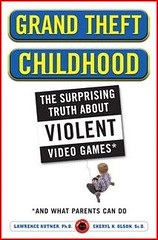 Don’t judge a book by its cover (or its title, for that matter). I’m usually faithful to that maxim, but I must admit that when I first saw the title and cover of “<a href="http://www.amazon.com/Grand-Theft-Childhood-Surprising-Violent/dp/0743299515/ref=pd_bbs_sr_1?ie=UTF8&s=books&qid=1208179493&sr=8-1″>Grand Theft Childhood: The Surprising Truth About Violent Video Games and What Parents Can Do,” I rolled my eyes and thought to myself, “here we go again.” I figured that I was in for another tedious anti-gaming screed full of myths and hysteria about games and gamers. Boy, was I wrong. Massively wrong.
Lawrence Kutner, PhD, and Cheryl K. Olson, ScD, cofounders and directors of the Harvard Medical School Center for Mental Health and Media, have written the most thoroughly balanced and refreshingly open-minded book about video games ever penned. They cut through the stereotypes and fear-mongering that have thus far pervaded the debate over the impact of video games and offer parents and policymakers common-sense advice about how to approach these issues in a more level-headed fashion. They argue that:
Today, an amalgam of politicians, health professionals, religious leaders and children’s advocates are voicing concerns about video games that are identical to the concerns raised one, two and three generations ago with the introduction of other new media. Most of these people have the best of intentions. They really want to protect children from evil influences. As in the past, a few have different agendas and are using the issue manipulatively. Unfortunately, many of their claims are based on scanty evidence, inaccurate assumptions, and pseudoscience. Much of the current research on violent video games is both simplistic and agenda driven. (p. 55)
They note that these groups, “probably worry too much about the wrong things and too little about more subtle issues and complex effects that are much more likely to affect our children.” They continue:
 The Technology Liberation Front is the tech policy blog dedicated to keeping politicians' hands off the 'net and everything else related to technology.
