As I have pointed out here many times before, education is a vital part of online child protection efforts. In fact, if there is one point I try to get across in my report on “Parental Controls and Online Child Safety,” it is that, regardless of how robust they might be today, technical parental control tools are no substitute for education, media literacy and online safety awareness training. To the extent lawmakers feel the need to “do something” about online safety issues, education-based efforts will bear much more fruit than regulatory initiatives.
 Unfortunately, it is clear that not nearly enough media literacy or online safety instruction is being done within America’s educational process at any level. For the most part, media literacy is not routinely integrated into the curricula at elementary school, secondary school, high school, or college. This situation must be reversed. Luckily, my home state of Virginia is helping to pave the way. This weekend, the
Washington Post ran a front-page story entitled, “Virginia Tries to Ensure Students’ Safety in Cyberspace,” that discussed the state’s effort to “launch Internet safety lessons across all grade levels, responding to a state mandate that is the first of its kind in the nation.” The text of the enabling legislation can be found here and, in September 2006, Virginia produced an outstanding report entitled “Guidelines and Resources for Internet Safety in Schools” that can serve as model legislation for other states.
Unfortunately, it is clear that not nearly enough media literacy or online safety instruction is being done within America’s educational process at any level. For the most part, media literacy is not routinely integrated into the curricula at elementary school, secondary school, high school, or college. This situation must be reversed. Luckily, my home state of Virginia is helping to pave the way. This weekend, the
Washington Post ran a front-page story entitled, “Virginia Tries to Ensure Students’ Safety in Cyberspace,” that discussed the state’s effort to “launch Internet safety lessons across all grade levels, responding to a state mandate that is the first of its kind in the nation.” The text of the enabling legislation can be found here and, in September 2006, Virginia produced an outstanding report entitled “Guidelines and Resources for Internet Safety in Schools” that can serve as model legislation for other states.
The Post story summarizes the focus of the program: Continue reading →
GamePolitics.com noted that presidential candidate Sen. Barack Obama had some comments upon the release of Grand Theft Auto IV this week, and they weren’t actually half bad. Indeed, instead of engaging in the typical game-bashing hysteria we’ve gotten used to, Obama instead focused on the need to find the right balance in terms of getting kids as interested in education as they are in games and other forms of entertainment. (This is something I was just discussing in the comments to another post I made yesterday).
Obama wondered, “How are we giving our kids a thirst for knowledge? And turning off the TV set, and getting them to be engaged and interested, like their future really does matter on how well they do in school.” That’s a good question, and I’ve provided some of my own thoughts on that here.
Importantly, I just want to remind everyone of the very sensible things Obama said when asked at a debate earlier this year about the role of government when it comes to media content. “[T]he primary responsibility is for parents,” he said. “And I reject the notion of censorship as an approach to dealing with this problem.” Better yet, he went on to stress the importance of making sure that parents have the tools to make these determinations for their families:
“[I]t is important for us to make sure that we are giving parents the tools that they need in order to monitor what their children are watching. And, obviously, the problem we have now is not just what’s coming over the airwaves, but what’s coming over the Internet. And so for us to develop technologies and tools and invest in those technologies and tools, to make sure that we are, in fact, giving parents power — empowering parents I think is important.”
He’s got it exactly right. I just wish he’d stress personal responsibility and limited government solutions across the board!
http://www.youtube.com/v/fmYyvLTzPhQ&hl=en
What happens as gamers grow older and become a more dominant voice in society? UK game developer Richard Bartle has some thoughts on that issue in an acerbic, in-your-face editorial in the UK Guardian this week:
I’m talking to you, you self-righteous politicians and newspaper columnists, you relics who beat on computer games: you’ve already lost. Enjoy your carping while you can, because tomorrow you’re gone. According to the UK Statistics Authority, the median age of the UK population is 39. Half the people who live here were born in 1969 or later. The BBC microcomputer was released in 1981, when those 1969ers were 12. It was ubiquitous in schools; it introduced a generation to computers. It introduced a generation to computer games. Half the UK population has grown up playing computer games. They aren’t addicted, they aren’t psychopathic killers, and they resent those boneheads – that’s you – who imply that they are addicted and are psychopathic killers. Next year, that 1969 will be 1970; the year after, it’ll be 1971. Dwell on this, you smug, out-of-touch, proud-to-be-innumerate fossils: half the UK population thinks games are fun and cool, and you don’t. Those born in 1990 get the vote this year. Three years from now, that 1969 will be 1972, then 1973. Scared yet? You should be: we have the numbers on our side. Do your worst – you can’t touch us. We’ve already won. 15 years from now, the prime minister of the day will have grown up playing computer games, just as 15 years ago we had the first prime minister to have grown up watching television, and 30 years ago to have grown up listening to the radio. Times change: accept it; embrace it. Don’t make yourself look even more 20th Century, even more public school, than you do already. You’ve lost! Understand? Your time has passed.
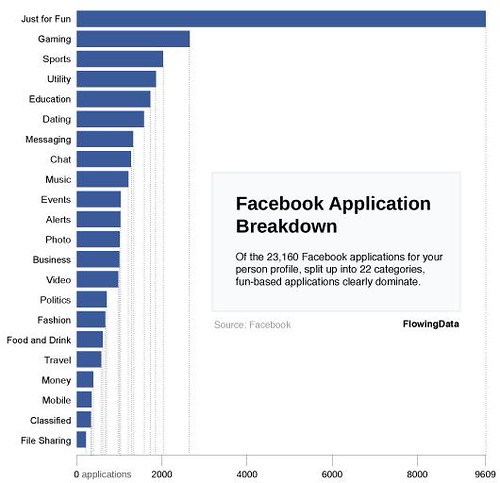
Over at “The Social,” a CNet blog about social networking and social life, Caroline McCarthy discusses a new study that she says “reveals [a] shocking truth: Most Facebook apps are silly, pointless.”
A new study from number-crunching firm Flowing Data did some eye-opening work recently, dividing 23,160 Facebook applications into 22 categories. A whopping 9,601 of them fall into Facebook’s “just for fun” category, followed by “gaming” and “sports” with over 2,000 each. In other words, the majority of Facebook applications are goofy time-wasters.
She calls this “an unsettling piece of news that I don’t think any of us saw coming” and says “The world of social networking may never be the same.”
 Continue reading →
True or false: “Openness” is the dominenant ideology of Silicon Valley. Discuss.
Update: I should clarify that I mean “openness” in the technical sense of open standards, open platforms, open networks, open source, etc.
D.C.-based TLFers, if you haven’t seen it yet, The Singing Revolution has been held over for another week at the E Street Cinema. Find showtimes here.
Non-D.C.-based TLFers, check out The Singing Revolution Web site for upcoming showings in your town.
Here’s my earlier post on the movie.
An incident at my son’s preschool yesterday serves as a good example of a problem I have sometimes pondered relating to IP–that is the extent to which substantive rules are adapted and sometimes distorted in response to difficulties or limitations on the enforcement end. An example, the tendency to boost the penalties for IP related offenses in an effort to compensate for low enforcement rates.
There is substantial room for disagreement on whether and when this kind of substantive adaptation is legitimate. One might think, at first, that one should never do that… consider the following example, though: Under the law of the Icelandic Commonwealth, the penalties for killing someone were much greater if one did not report the killing to one of the next three households one passed. A nice way to solve an evidentiary problem, and what is wrong with it, really, if otherwise disputes about killings would go on forever in the face of endless doubts about who was responsible?
Now, to preschool. The preschool classroom is well populated and while the little horrors are closely supervised they aren’t watched every minute. So any altercation that is not witnessed in full by a teacher can be resolved “correctly” only on the assumption that three and four-year-olds can be persuaded to talk about something other than princesses, guns, tadpoles, or dinosaurs. This is next to impossible. Yesterday the Grub was one of three small boys called to a conference at the “Peace Table” to settle down and talk over their differences. What happened? No one knows. The Grub told me gravely that he hit E, and when asked why, said it was because E. hit him. E. is a sensible chap a full year older and unlikely to hit absent provocation (unlike budding sociopath K.), provocation that The Grub is capable of supplying, but no testimony on this point was forthcoming. This morning The Grub told his father, in response to skilled cross-examination, that he had pushed E., still with the same grave honest face. What actually happened? How was the third little boy A. involved? A. is a scamp, so probably he was involved somehow, but this cannot be admissible. Pushing further only lead to bubbles being blown into milk. So the substantive rules we are left with as a result of such situations are mere pretty phrases, such as “play nicely with your friends.” This won’t do, and how The Grub is to learn that it is okay to defend himself but not attack in this context I do not know. So far, therefore, the main things he seems to have learned in preschool are 1) how to make a fist 2) how to use his sharp little elbows to keep his place in a crowd 3) what a transformer is. Luckily we have a few years left. If I were having another child, I would just let them scuffle away and trust that he would learn not to hit because it leads to being hit back, with some adaptations to avoid a doves/hawks problem. Just an experiment, to see how that one would turn out.
A link to “The poor stand to lose from Anti-Patent Crusades,” by Franklin Cudjoe, out April 30, 2008, with a free-market think tank in Ghana.
http://en.afrik.com/article13423.html
A selection: Patents are actually a critical part of the solution. They protect the financial incentives that drive pharmaceutical companies to create innovative medications in the first place. It takes an average of US$800 million and 10-15 years to bring a new drug to the market. Patents ensure that pharmaceutical companies can recoup that enormous investment. If countries start breaking patents, though, firms lose out on sales. And they’re less able to finance the development of new cures. That’s a blow to the public health efforts of all countries, rich and poor. Ghana’s health Minister told me that he fails to see how people could hold antagonistic positions against pharmaceutical companies, because in his own words “if drugs are being made, then people must be sick somewhere-it is not for charity”.
 The Technology Liberation Front is the tech policy blog dedicated to keeping politicians' hands off the 'net and everything else related to technology.