Several of us here have outlined our reservations about the proposal to allocate a block of the Advanced Wireless Services (AWS) spectrum for a free, nationwide wireless service. (Here’s a filing I signed on to that critiques the portion of the plan that requires censorship of the entire band once allocated).
But, strictly from an economic perspective, this is the best overview and critique of the plan I have seen so far: “The Static and Dynamic Inefficiency of Abandoning Unrestricted Auctions for Spectrum,” by Bob Hahn, Allan Ingraham, Greg Sidak, and Hal Singer. It’s a response to a paper favoring the M2Z plan that was penned by Simon Wilkie of USC, who also formerly served as the Chief Economist of the FCC. (Wilkie’s work on behalf of M2Z can be found on the M2Z site here). It’s a good debate and I encourage you to look at both papers if you are interested in this issue.
I’m thrilled that Julian Sanchez will be joining Ars full-time, where he’ll be their Washington editor. It’s a real coup for Ars and will beef up their already-superb tech policy coverage.
You can check out his freelance output over the last year here. And really, if you’re a TLF reader, there’s no excuse for you not to be subscribed to Ars already.
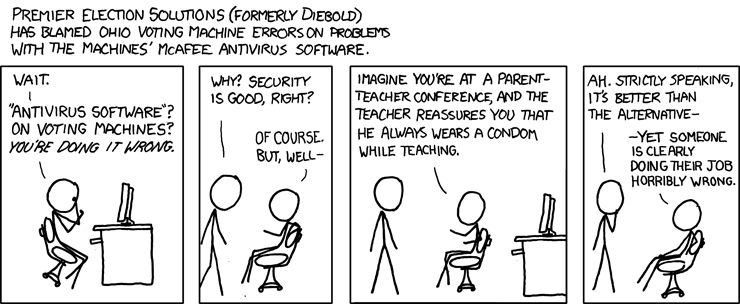
xkcd has outdone themselves once again:
Braden has noted the release of John McCain’s tech policy–rightly decrying McCain’s socialistic community broadband concept. But far more outrageous, in my view is this bit of doublethink. First, the good part we should all applaud:
John McCain Has Fought to Keep the Internet Free From Government Regulation
The role of government in the Innovation Age should be focused on creating opportunities for all Americans and maintaining the vibrancy of the Internet economy. Given the enormous benefits we have seen from a lightly regulated Internet and software market, our government should refrain from imposing burdensome regulation. John McCain understands that unnecessary government intrusion can harm the innovative genius of the Internet. Government should have to prove regulation is needed, rather than have entrepreneurs prove it is not.
Amen! Even a hardened Ron Paul/Bob Taft/Grover Cleveland/Jack Randolph-survivalist/libertarian-crank like me can rally behind that banner. But then this self-styled champion of deregulation pulls a really fast one:
John McCain Will Preserve Consumer Freedoms. John McCain will focus on policies that leave consumers free to access the content they choose; free to use the applications and services they choose; free to attach devices they choose, if they do not harm the network; and free to chose among broadband service providers.
That sure
sounds nice, but it’s all Wu-vian code for re-regulation, not de-regulation. You might recognize that McCain is talking obliquely here about the FCC’s 1968 Carterfone doctrine, which has consumed much attention on the TLF (see this piece in particular).
McCain then insists that he will be a bold leader for “good” regulations: Continue reading →
 As Berin noted in the last post, we have installed Disqus on the TLF as our new commenting system. There are a couple of things I’d like to highlight about the new system.
First, I want to underscore what Berin said: claim your comments! Why is this so important? First, this lets you and other users see a page with every other comment you’ve posted on the TLF. Second, people can choose to “follow” your comments and be notified when you post something. Finally, over at the TLF community page on Disqus there’s a “Top Commenters” leaderboard, and I know you want to be at the top. So don’t start from zero, claim all your existing comments.
Next I want to draw your attention to the two little arrows to the left of commenters’ avatars (photos). Most folks know what this means, but I’ll explain anyway for those who may not. This lets you vote on each comment to let the system know whether the comment is especially smart and interesting or boneheaded and unhelpful. Good comments (up arrow) move up to the top of the thread, and comments that receive negative votes (down arrow) move toward the bottom and eventually disappear if they get enough downgrades. If you’d like to sort comments by the order they were posted, and not by votes, you can click the “Options” button below and choose your sorting preference.
Last, I want to just mention a couple other cool features. If you post a comment and someone posts a reply to you, you’ll get an email notifying you of the fact. Pretty cool, but it gets better. To post a comment in reply to that reply you don’t have to visit the blog, you can just hit “reply” and write an email in response. Your email will get posted to the TLF blog as a reply comment. Also, Disqus makes a bunch of RSS feeds available. There’s a feed for all TLF comments, feeds for comments posted to a specific blog post, feeds for specific commenters, etc.
Anyhow, hope you folks like it. Now go claim your comments!
Ahoy, TLFers! You’ll notice that we’ve incorporated a new comment management system on the blog: Pronounced “discuss” (not “discus” as one might well assume–a potential branding problem indeed for an otherwise promising start-up), Disqus has exploded in the last few months (Google Trends) to over 30,000 blogs.
Disqus should help the TLF become even more of a true community–in which comments can be as valuable as blog pieces themselves and in which the line between “reader” and “author” is further blurred. Here‘s a list of cool things Disqus will let you, TLF’s valued readers to do:
- Track and manage comments and replies
- More control over your own comments on websites
- Never lose your comments, even if the website goes away
- Build a global profile, or comment blog, to collect and show off what you’re saying
- Easier to comment on websites using Disqus
- Reply to comments through email or mobile
- Edit and republish comments with one click
In particular, comments can now be directed as replies to other comments, creating clear discussion threads.
You might be wondering: “If Disqus is so darn awesome, why haven’t we incorporated it before?” The answer is that, until the new Disqus plug-in for WordPress came out a few days ago, comments were stored only on the Disqus site and merely replicated on partner blogs–making comments unsearchable, among other things. Now, we get the best of both worlds: Comments will beseemlessly duplicated and synchronized between our database and Disqus’s.
While it will still be possible to comment on the blog just as before (anonymously or merely without a Disqus account), we do encourage readers to take a minute (literally) to set up a free Disqus account. (For those of you who enjoy reading Terms of Use and Privacy policies or who just stay up late at night clutching their now-constitutionally-protected firearms and worrying about being tagged, tracked and someday unceremoniously culled from the herd, here are Disqus’s policies.) For the less privacy-obsessed, here‘s a general FAQ about Discus.
There are a number of bells and whistles you can enable–like tying your Disqus account to other social networking sites and adding a small image of yourself (or some other hopefully-family-friendly image). But
the one important thing everyone who has posted comments in the past should do is to “claim” your old comments by entering the email address associated with those comments on Disqus. Continue reading →
You can read McCain’s Technology plan here. Among other things he’s for “open and fair” trade and preserving the FCC’s 4 freedoms, but will not be in favor of a prescriptive, legislative approach to net neutrality. Overall it’s a mix of pretty good policies, albeit that one on muni broadband.
- Good: John McCain Opposes Higher Taxes On Wireless Services. John McCain has opposed new state and local discriminatory taxes and fees on wireless services, which are relied upon by over 250 million Americans. Taxes account for over 20 percent of many mobile phone users’ bills.
- Good: John McCain Has Been A Long And Ardent Supporter Of Fair And Open World Trade. Trade greatly benefits America and the American worker. The best protection for American workers is to ensure that they have access to the world’s customers, 95 percent of whom live outside the United States. This access is particularly important for workers in the information technology sector.
- Bad: John McCain believes that people acting through their local governments should be able to invest in their own future by building out infrastructure to provide high-speed Internet services. For this reason, Senator McCain introduced the “Community Broadband Bill,” which would allow local governments to offer such services, particularly when private industry fails to do so.
Tim has already analyzed the decision of the Federal Circuit in Jacobsen v. Katzer, but I’d go even further than he did and say that it could broadly impact the media and software industries. Because violating a condition to copyright can avail a plaintiff to seek greater damages than breach of contract, look for copyright owners to limit the scope of a license to use or redistribute a song or a software program by making them “conditions” of the copyright license and not contractual “covenants.”
The case is good for copyright owners that use open source licenses. But the rationale of the decision is not limited to only open source. And who relies on copyright the most? RIAA and MPAA. It’s only a decision of an interlocutory appeal, but copyright holders everywhere will be reviewing their licenses after this one. My fellow tech transactional attorney friends could be busy, as what’s good for the goose is good for the gander.
We’re installing a new commenting system on the blog, so you’ll find that all old comments will be gone for a little while. Don’t worry; they’ll be back shortly. We’ll have more info on the new system soon.

 The Technology Liberation Front is the tech policy blog dedicated to keeping politicians' hands off the 'net and everything else related to technology.
New TLF Comment Tool (Please Read!)
by Berin Szoka on August 14, 2008 · 21 comments
Ahoy, TLFers! You’ll notice that we’ve incorporated a new comment management system on the blog: Pronounced “discuss” (not “discus” as one might well assume–a potential branding problem indeed for an otherwise promising start-up), Disqus has exploded in the last few months (Google Trends) to over 30,000 blogs.
Disqus should help the TLF become even more of a true community–in which comments can be as valuable as blog pieces themselves and in which the line between “reader” and “author” is further blurred. Here‘s a list of cool things Disqus will let you, TLF’s valued readers to do:
In particular, comments can now be directed as replies to other comments, creating clear discussion threads.
You might be wondering: “If Disqus is so darn awesome, why haven’t we incorporated it before?” The answer is that, until the new Disqus plug-in for WordPress came out a few days ago, comments were stored only on the Disqus site and merely replicated on partner blogs–making comments unsearchable, among other things. Now, we get the best of both worlds: Comments will beseemlessly duplicated and synchronized between our database and Disqus’s.
While it will still be possible to comment on the blog just as before (anonymously or merely without a Disqus account), we do encourage readers to take a minute (literally) to set up a free Disqus account. (For those of you who enjoy reading Terms of Use and Privacy policies or who just stay up late at night clutching their now-constitutionally-protected firearms and worrying about being tagged, tracked and someday unceremoniously culled from the herd, here are Disqus’s policies.) For the less privacy-obsessed, here‘s a general FAQ about Discus.
There are a number of bells and whistles you can enable–like tying your Disqus account to other social networking sites and adding a small image of yourself (or some other hopefully-family-friendly image). But the one important thing everyone who has posted comments in the past should do is to “claim” your old comments by entering the email address associated with those comments on Disqus. Continue reading →