A new report from TeleGeography finds that bandwidth prices for backbone transit continue to decline rapidly across the globe. In San Francisco, for instance, the price per mbps of Gigabit Ethernet transit has dropped 38 % in the past 12 months. Developing countries are also enjoying substantial price cuts in 15 to 20% range.

But if the Internet’s core is controlled by an oligopolistic cartel—as Tim Wu argued in a recent New York Times essay—then why does bandwidth keep getting cheaper?

Perhaps it’s because the fourteen or so firms which offer backbone IP transit are competing fiercely to win over business from smaller carriers and enterprises. And as businesses of all sizes demand faster connectivity, more dark fiber is being lit, creating an expansion in network capacity. In DC, for instance, a price war has made high-speed commercial data services much more affordable, with one communications provider offering converged 10mbps full-duplex dedicated Ethernet over copper for less than the market price of four bonded T1 lines.

Why are some providers moving towards data transfer caps if bandwidth prices are dropping ? In part, it’s because backbone transit is not the only usage-variable expense that residential ISPs face. Last-mile bandwidth remains a highly contested resource in many neighborhoods, and the cost per megabit of bringing faster speeds to the doorstep far exceeds the cost of adding more wavelengths to a long-distance fiber optic line. As consumers demand greater speeds, providers are investing heavily in network upgrades—these costs are adding up, and there’s a strong case to be made that heavy users ought to shoulder a larger portion of the burden than light users.

I’ve been re-reading Nicholas Negroponte’s brilliant and extraordinarily prescient 1995 book Being Digital this week, and I just came to the famous section in Chapter 12 about “The Daily Me.”  It’s his visionary discussion of a future of personalized filters for all things digital to perfectly tune news and entertainment to your personal preferences. Here’s the key passage (again, remember that he wrote this in 1995, long before most of the digital things we take for granted today existed):

Imagine a future in which your interface agent can read every newswire and newspaper and catch every TV and radio broadcast on the planet, and then construct a personalized summary. This kind of newspaper is printed in an edition of one. […] Imagine a computer display of news stories with a knob that, like a volume control, allows you to crank personalization up or down. You could have many of these controls, including a slider that moves both literally and politically from left to right to modify stories about public affairs. These cotnrols change your window onto the news, both in terms of size and its editorial tone. In the distant future, interface agents will read, listen to, and look at each story in its entirety. In the near future, the filtering process will happen by using headers, those bits about bits.

Well, that future came about sooner than even Negroponte could have predicted.  We all have a “Daily Me” now; it’s called our RSS feed.  And there are other components to the “Daily Me,” such as iGoogle and Google Alerts, which provide automated search results served up instantaneously.  And there are many other digital tools and services out there today that help us personalize our media experience.

You really gotta hand it to Negroponte for being way ahead of the curve in foreseeing all of this at a time when most of us where still using Trumpet Winsock and 14.4 modems.  Hell, Al Gore hadn’t even built the Internet yet!

Peter Ferrara, offering us a taste of the dismal science for the American Spectator in reviewing a recent book’s economic predictions for an Obama Presidency (but what about civil liberties?). Hey, maybe they’ll send out more economic stimulus checks! We used ours this year to pay down a tax bill. It’s like the circle of life. (Other references to the Lion King will be swiftly and severely dealt with).

Space Politics

by on October 9, 2008 · 7 comments

I have a post on space politics at the WashingtonWatch.com blog. “If you think Washington politics is restricted to the debates among politicians, think again.”

I’m sure TLFer Berin Szoka knows this better than I do.

My colleague Barbara Esbin, a Senior Fellow and Director of the Center for Communications and Competition Policy at The Progress & Freedom Foundation, was asked to pen a short history of the net neutrality wars in the U.S. for a French publication, La Lettre de l’Autorité.  Her essay provides an excellent, concise overview of where we’ve come from and where we might be heading on this front.  I’ve pasted the entire essay down below, or you can download the PDF here.


Net Neutrality Regulation in the United States by Barbara Esbin

PFF Progress Snapshot Release 4.21 October 2008

The United States moved closer to “Net Neutrality” regulation this year when the Federal Communications Commission found that Comcast, a cable broadband Internet service provider, violated a set of Internet policy principles the FCC adopted in 2005 by limiting peer-to-peer (P2P) traffic. The ruling was the culmination of a ten-year effort that began as a call for wholesale “open access” to the cable platform for third-party Internet service providers. Requests for open access first emerged in 1998 when the FCC considered AT&T’s acquisition of cable operator TCI. The FCC rejected open access, but the issue quickly re-emerged in a subsequent proceeding to determine the appropriate regulatory classification of cable Internet service. Depending on how the FCC categorized cable Internet service, it would either be subject to telecommunications “common carrier” requirements, “cable service” requirements, or treated as a then-unregulated “information service.”

In 2002, the FCC classified cable Internet service as an “information service.” This meant that the telecommunications common carrier requirements — that service be provided upon request, without unreasonable discrimination as to rates, terms and conditions of service — would not apply to cable Internet services. The FCC’s decision was upheld by the U.S. Supreme Court in NCTA v. Brand X. Afterwards, advocates of open access re-directed their efforts away from advocating wholesale access for third-party ISPs, and towards rules aimed at consumer rights to a “neutral network” or “net neutrality.”

Continue reading →

Arnold Kling on the Sergey Brin effect and inequality:

Income inequality in the United States consists of two gaps. The first gap is an upper-lower gap, between those with a college education and those without. The second is an upper-upper gap, between those with high incomes and those with extraordinarily high incomes. The upper-lower gap reflects changes in the structure of the economy. New technologies place a premium on cognitive ability. Harvard University economists Claudia Goldin and Lawrence Katz have dubbed this “skill-biased technological change.” In today’s economy, more value added comes from knowledge work, and relatively less comes from unskilled labor.

It’s nearing Halloween, so it must mean the anniversary of the Digital Millennium Copyright Act is just around the corner. In fact, it was 10 years ago, on Sunday, that Congress passed the DMCA, on October 12, 1998. The law was signed by President Clinton on October 28, 1998.

The information and news service that I have launched, BroadbandCensus.com, is “celebrating” the passage of the law with the inaugural event of the Broadband Breakfast Club. The breakfast event will take place on Tuesday, October 14, from 8 a.m. to 10 a.m., at the Old Ebbitt Grill at 675 15th Street NW, Washington, DC.

This event will bring together several key stakeholders together to share perspectives on this topic:

  • Drew Clark, Executive Director, BroadbandCensus.com (Moderator)
  • Mitch Glazier, Senior Vice President, Government Relations, Recording Industry Association of America
  • Michael Petricone, Senior Vice President, Government Affairs, Consumer Electronics Association
  • Wendy Seltzer, Practitioner in Residence, Glushko-Samuelson Intellectual Property Law Clinic, American University Washington College of Law
  • Emery Simon, Counselor, Business Software Alliance

Breakfast for registrants will be available beginning at 8:00 a.m., and the forum itself will begin at around 8:30 a.m., and conclude promptly at 10 a.m. The event is open to the public. The charge for the breakfast is $45.00, plus an Eventbrite registration fee. Seated attendance is limited to the first 45 individuals to register for the event.

Future events in the Broadband Breakfast Club monthly series will feature other key topics involved in broadband technology and internet policy. In fact, you can mark your calendar for the next event on Tuesday, November 18, from 8 a.m. to 10 a.m., also at the Old Ebbitt Grill.

For more information about BroadbandCensus.com, or about the Broadband Breakfast Club at Old Ebbitt Grill – on the second Tuesday of each month – please visit http://broadbandcensus.com, or call me at 202-580-8196.

From ACU’s new issue of Battleline. ACU board member Joe Morris contributes an email from our new economic Czar:

My Dear American Friend Issue 117 – October 8, 2008 MY DEAR AMERICAN FRIEND: I AM NEEDING TO ASK YOU TO SUPPORT AN URGENT SECRET BUSINESS RELATIONSHIP WITH A TRANSFER OF FUNDS OF GREAT MAGNITUDE. I AM MINISTRY OF THE TREASURY OF THE REPUBLIC OF AMERICA. MY COUNTRY HAS HAD CRISIS THAT HAS CAUSED NEED FOR LARGE TRANSFER OF FUNDS OF 700 BILLION OF YOUR DOLLARS ( US). IF YOU WOULD ASSIST ME IN THIS TRANSFER IT WOULD BE MOST PROFITABLE TO YOU. I AM WORKING WITH HIGHLY REPUTABLE MR. PHIL GRAM, LOBBYIST FOR UBS, WHO WILL BE MY REPLACEMENT AS MINISTRY OF THE TREASURY IN JANUARY IF MY POLITICAL PARTY WINS UPCOMING ELECTION, WHICH WE CERTAINLY WILL BECAUSE WE ARE IN CONTROLING OF THE HIGHEST SUPREME COURT. YOU MAY REMEMBER HIM AS A SENATOR AS LEADER OF THE AMERICAN BANKING DEREGULATION MOVEMENT IN THE 1990S. I AM ALSO WORKING WITH HIGHLY REPUTABLE MR. BARNEY FRANK, MEMBER OF CONGRESS FROM PEOPLE’S REPUBLIC OF MASSACHUSETTS, WHO WILL BE MY REPLACEMENT AS MINISTRY OF THE TREASURY IN JANUARY IF OTHER POLITICAL PARTY, LED BY MR. BARACK OBAMA, WIN UPCOMING ELECTION, WHICH HE CERTAINLY WILL BECAUSE HE IS IN CONTROLLING OF VOTING IN ILLINOIS, OHIO, FLORIDA, AND MANY OTHER STATES. MR. BARNEY FRANK IS VERY KNOWLEDGEABLE ABOUT FINANCIAL TRANSACTIONS OF ALL KINDS, FROM WHOREHOUSE ADMINISTRATION TO HOME LOAN BUSINESS, AND FAITHFULLY TEACHES PRECEPTS OF MR. BARACK OBAMA (“FROM TINY A.C.O.R.N. GROWS GIANT FORECLOSURE OAK!”).
Continue reading →

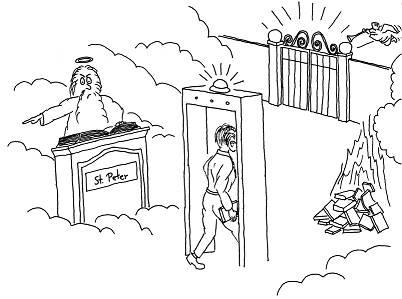
Arts+Labs, a new coalition “committed to a better, safer internet that works for both artists and consumers,” has written up Friday’s Cato Institute book forum on The Crime of Reason on their ArtLab blog. Author Robert B. Laughlin of Stanford University will present his book, then we’ll have comments from Tom Sydnor of the Progress and Freedom Foundation.

I’ve gotten a glimpse at the slides Dr. Laughlin will be using, and this Nobel laureate in physics also turns out to be something of an artist.

Join us Friday to learn what this drawing is all about.

Smart as Paint

by on October 6, 2008 · 19 comments

I remark briefly on the commentary “how smart is Palin,” noting her mispronunciation of “verbiage” and “pundit.” I’d suggest that observers be wary of assessing qualifications based on this kind of thing. Example: one very well-educated person I know, whose IQ is high enough to qualify enough for Mensa, mispronounces several words because he was socially isolated for his formative years and formed the habit of saying them before he had the chance to hear others pronounce them correctly. I don’t mean he was shut in a closet, which wouldn’t be relevant as Palin clearly hasn’t been, but just that he lived in a rural area where most of his peers were relatively uneducated.

In any case, it is curious that the anxious analysis of Palin, stemming from the fact that she is relatively unknown, seems to turn on characteristics of social class rather than on information about her decision-making as an executive. What significant choices about things like taxes, education policy, resources, and so on was she faced with as governor? What did she do in those situations? Why? What were the alternatives? Many voters probably do elect candidates based on how someone talks or looks, but mightn’t it be nice for a change for the talking classes to assess a candidate on policy? Would she make a better political candidate if some professor had had a couple months to drill her on vocabulary and delivery, like the hapless flower seller Eliza whats-her-name? Continue reading →