Sun Chairman Scott McNealy seemingly wants to shine some light on the benefits of software that is open sourced, but by advocating government mandates he’s calling for the specter of regulatory darkness. Here’s a quote from him in a BBC article:

“The government ought to mandate open source products based on open source reference implementations to improve security, get higher quality software, lower costs, higher reliability – all the benefits that come with open software.”

One could dispute the substance of his comment, but not his motive:

“Open source does not require you to pay a penny to Microsoft or IBM or Oracle or any proprietary vendor any money.”

Ah, so it’s all about some businesses getting a leg up over others, and using government to do so. Even Matt Asay writes that he’s not a supporter of mandates.

The scary thing is that, according to the BBC article, McNealy has been asked to prepare a paper on open source for the Obama administration! As the new administration is touting open government, let’s hope it remains open to the best products that are available, whatever license they may carry, without tech mandates.

judgeTech policy aficionados should by now be familiar with efforts to reform the patent system. Issues range from fixing the poor quality of granted patents to instituting post-grant review procedural reforms. What you don’t hear much about are efforts to educate judges on patents. Because no matter how much patent law is reformed to increase patent quality on the front-end, we’re still going to see patents being litigated in court.

That’s why I’m happy to see today’s reintroduction of Rep. Adam Schiff’s and Rep. Darrell Issa’s bill, HR 628. The bill creates a pilot program to educate participating judges on patent law and the technical matters underlying patent claims in Federal District Courts (HR 628 is the same as last session’s bill HR 5418). Here’s my  analysis of the bill from when it was introduced last session.

Judges have considerable power to affect a trial. They make procedural and evidentiary decisions, and often a judge’s decision at trial can only be overturned on appeal if there was an abuse of discretion (a high burden for an appellant to meet).

HR 5418 is a targeted pilot program and its effect could be substantial, if not immediate. Better informed judges can weed out frivolous claims more quickly while focusing on cases with legitimate claims. As a result, anticipated and actual costs of enforcing and defending lawsuits decrease, reducing the burden on all parties but particularly the budgets of small firms. Less money for lawyers means more money for innovating, so firms can increase their research budgets and returns on investment.

Caroline Kennedy has abruptly dropped her bid for Hillary Clinton’s Senate seat.  Her father, of course, probably ties with Andrew Mellon and Ronald Reagan as one of the greatest supply-side tax-cutters of all time.  The economic boom JFK unleashed probably makes up for whatever damage—personal or national—done by the Kennedy clan over the years.  

But whatever one thinks of Caroline in particular or the Kennedys in general, her departure from the “race” to succeed Clinton may go down in history as a catastrophe for Internet freedom, since it likely means that NY Attorney General Andrew Cuomo will take the seat.  

Cuomo has cast himself as a hero fighting to protect children by strong-arming ISPs into shutting down Usenets, as Ryan has explained.  Jim correctly points out the “shake down” nature of Cuomo’s operation.  And Adam has explained that this is all part of a broader assault on online free speech.  While few are willing to discuss this taboo subject, it’s fair to ask whether the “solutions” Cuomo are really the most effective way to deal with the scourge of child pornography. 

I’ll bet good money that if Cuomo makes it into the Senate, he’ll continue this fight on a broader scale—perhaps by pushing for legislation to mandate network-level filtering a la Cleanfeed.

Update: Gov. Paterson has decided to appoint Rep. Kirsten Gillibrand to this seat rather than Cuomo. That’s the good news.  The bad news is that this bully is still Attorney General of the Empire State.  I have no doubt he’ll continue his war on free speech in his current position.

My problem with what Nick Carr is saying about Wikipedia here — as well as in his book The Big Switch — is that he always seems to assume that Wikipedia constitutes the totality of most searches for information online. I suppose it does for some people, but I have a hard time accepting the argument that everyone’s search for enlightenment ends there, even if Wikipedia does rank high in many search results today.

For me, Wikipedia is just a launch pad; a great starting point in the search for truth. I take much of what I read on Wikipedia with a large grain of salt, however, because I know not every entry is as trustworthy as others, and entries could change at any moment. But that’s true of much of what one finds online!  If one adopts a sort of caveat emptor attitude toward Wikipedia, and then uses it to seek out truth from alternative sources found in each entry, or from other searches, then were is the harm?  Only if one could show that the search for truth ends with Wikipedia would I be as concerned as Carr and other Internet pessimists and Wikipedia critics (like Lee Siegel and Andrew Keen). But I just don’t believe that is the case.

Moreover, it is impossible for me to believe that we have fewer authoritative sources of information at our disposal today than we did in the past.   Continue reading →

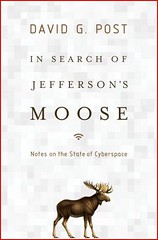
Post Jeffersons MooseI used to have a (semi-crazy) uncle who typically began conversations with lame jokes or bad riddles. This sounds like one he might have used had he lived long enough: What do Thomas Jefferson, a moose, and cyberspace have in common?

The answer to that question can be found in a new book, In Search of Jefferson’s Moose: Notes on the State of Cyberspace, by David G. Post, a Professor of Law at Temple University. Post, who teaches IP and cyberspace law at Temple, is widely regarded as one of the intellectual fathers of the “Internet exceptionalist” school of thinking about cyberlaw.  Basically, Post sees this place we call “cyberspace” as something truly new, unique, and potentially worthy of some special consideration, or even somewhat different ground rules than we apply in meatspace. More on that in a bit.

[ Full disclosure: Post’s work was quite influential on my own thinking during the late 1990s, so much so that when I joined the Cato Institute in 2000, one of the first things I did was invite David to become an adjunct scholar with Cato. He graciously accepted and remains a Cato adjunct scholar today. Incidentally, Cato is hosting a book forum for him on February 4th that I encourage you to attend or watch online. Anyway, it’s always difficult to be perfectly objective when you know and admire someone, but I will try to do so here.]

Post’s book is essentially an extended love letter — to both cyberspace and Jefferson. Problem is, as Post even admits at the end, it’s tough to know which subject this book is suppose to teach us more about. The book loses focus at times — especially in the first 100 pages — as Post meanders between historical tidbits of Jefferson’s life and thinking and what it all means for cyberspace. But the early focus is on TJ.  Thus, those who pick up the book expecting to be immediately immersed in cyber-policy discussions may be a bit disappointed at first.  As a fellow Jefferson fanatic, however, I found all this history terrifically entertaining, whether it was the story of Jefferson’s Plow and his other agricultural inventions and insights, TJ’s unique interest in science (including cryptography), or that big moose of his.

OK, so what’s the deal with the moose? When TJ was serving as a minister to France in in the late 1780s, at considerable expense to himself, he had the complete skeleton, skin and horns of a massive American moose shipped to the lobby of his Paris hotel. Basically, Jefferson wanted to make a bold statement to his French hosts about this New World he came from and wake them up to the fact that some very exciting things were happening over there that they should be paying attention to. That’s one hell of way to make a statement!

Continue reading →

You wouldn’t think that a book called In Search of Jefferson’s Moose could be about the Internet, but it is.

In his book, In Search of Jefferson’s Moose: Notes on the State of Cyberspace, Temple University Law Professor David Post draws remarkable and entertaining parallels between the Internet and the natural and intellectual landscape that Thomas Jefferson explored, documented, and shaped.

Post will be at the Cato Institute for a lunch-hour book forum on Wednesday, February 4th. Clive Crook and Jeffrey Rosen will comment.

Register here to see just how nicely Thomas Jefferson, cyberspace, and a rather large moose fit between the covers of Post’s new book.

Jason Kuznicki of the Cato Institute is asking some very sharp questions about Jonathan Zittrain’s book The Future of the Internet and How to Stop. He’s echoing a lot of the same concerns and criticisms I have raised here many times before about how overblown Zittrain’s fears are regarding the supposed death of digital generativity and online openness. Kuznicki argues:

First, the example he uses is far from perfect. The Internet abounds with descriptions of iPhone hacks, many of them well-documented and remarkably successful. The menacing control exists, but it’s often a paper tiger. And although Apple didn’t originally publish an iPhone software development kit, it does now. So which one is it? Is the iPhone still not hacky enough? Or should we find another, better example? But the hacking community delights in finding supposedly uncrackable devices, and in cracking them — often within days of release. Offhand, I can’t think of a single recently released Internet-enabled device that someone hasn’t hacked. (Another of Zittrain’s purported bad examples, the Xbox 360, supports an avid hacking community, albeit with far less support from Microsoft. It isn’t a community for everyone, but then, hacking isn’t for everyone. Neither is macrame.)

Continue reading →

First, let me just thank all the TLF readers who actively participate by commenting on the site.  We really value your participation in this community built on a shared interest in technology policy!

Readers who visit the site will notice two new badges at the top righthand corner of the site for the TLF’s Twitter and Facebook pages.  Please take a moment to follow us on Twitter and to become a fan of our Facebook page—and to “share” that page with your friends on Facebook.  Of course, we also have RSS feeds for the blog and the Tech Policy Weekly podcast (RSS or iTunes), which should again become more “weekly” this year.

I’d love to hear any ideas any TLF readers might have about how to increase the site’s readership or upgrade its functionality.  With the TLF’s five year anniversary coming up this August, we’re looking for ways to make the most of the blog as a tool for “keeping the politicans’ hands off the ‘net and everything else related to technology.”

Two quick tech tips for using the site.  First, regarding Disqus (“Discuss”), our Comment Management System:  If you haven’t already done so, don’t forget to “claim” comments made with your email address.  As Disqus explains, this will help ensure that no one else posts a comment under your name (something only someone as dastardly as, say, Jim Harper might do):

If you’ve made a comment on a blog using Disqus, you automatically have a profile. To claim the comments and profile, verify your identity by clicking “Claim” on the profile. Once the profile is claimed, no one else will be able to use that profile or email address to comment aside from you.

Second, Adam and I often post PDFs in our posts using the nifty iPaper viewer provided by Scribd (for example here).  Because it’s Flash, this tool allows you to see a PDF embedded on a page without having to download it or wait for the whole document to load.  A few of our crochetier TLF colleagues have complained that the Flash viewer is too small to read easily.  The simple solution is to click the rectangle-in rectangle button at the top right corner of the Scribd viewer, which will instantly expand the viewer to full-screen.  If clicked again, the viewer will revert to its original size.  This feature doesn’t seem to be as self-explanatory as the folks at Scribd assume.  

Again, thanks for reading and for your feedback!

My post yesterday wondering aloud whether the Obama administration was walking away from its transparency commitments was slightly premature. Memoranda were being issued/reported on as I wrote, and this morning’s Washington Post describes some of the technical glitches that befuddled White House staff on day one. The texts of the executive orders President Obama signed yesterday are now online, but his memoranda on transparency aren’t yet. Helpfully, they’ve been posted by the Sunlight Foundation.

But I think my post was sound in the main, because I was looking for actual pro-transparency deeds from the new administration, and they haven’t materialized. I appreciate the sentiments voiced in these documents, but don’t find myself wholly impressed with the actual transparency measures the White House has taken.

What I’m hearing is the transparency dog that didn’t bark: The Obama team set a great precedent in the transition with the Seat at the Table program, but there’s no sign that such a thing will be implemented in the White House. Why not?

We can expect an “Open Government Directive” within 120 days and new guidelines for the Freedom of Information Act, but I would have appreciated seeing President Obama’s commitment to openness illustrated the best way possible: through the direct and immediate commitment of his own White House operation.

The White House will not be run as openly as the transition was. The agencies, already predisposed against transparency, will see this as a sign of weak commitment and will whittle away even more fiercely at the good sentiments President Obama’s expressed in his transparency memoranda.

(“Thanks for inviting me!” said the skunk at the garden party.)

When the history books are finally written, I think it’s clear that outgoing FCC Chairman Kevin Martin will likely go down as one of — if not the — most aggressively pro-regulatory Republican chairman in the agency’s history.  Despite his occasional claims of believing in free markets and his support for a couple of legitimately deregulatory decisions, his tenure at the FCC has generally been characterized by a growth of government power, spending, and bureaucracy. But don’t take my word for it; read the report he issued last week called “Moving Forward,” which to some of us looks more like moving backwards (or at least stuck in the same ol’ mud).

Martin, however, touts his regulatory actions and expansion of FCC power as uniformly pro-consumer. Martin is just another in the long line of statists who claims that consumer welfare can only be enhanced by adding layers of government mandates and regulatory red tape.  History teaches us a different lesson: That regulation and bureaucracy typically stifle innovation and competition and hurt consumer welfare in the process. Moreover, there are some constitutional considerations and limitations that should trump — or at least limit — the powers of unelected bureaucrats to run roughshod over our rights. But hey, who cares about those meddlesome little things like the First, Fifth, Tenth, or Fourteenth Amendments?!  Certainly not Kevin Martin.

What’s equally troubling about Martin’s tenure at the agency is the track record of mismanagement and the bad blood that seemingly surrounds everything and everyone he comes in contact with. The picture painted in the House Energy & Commerce Committee’s 110-page report, “Deception and  Distrust: The FCC Under Chairman Kevin J.Martin,” is not a pretty one — although the report failed to mention that waste, mismanagement, and other regulatory shenanigans have been going on at this agency under the days of Democratic rule, too.

Martin’s response to the House report was all too predictable: The evil corporate interests are out to get me!  “[M]ost of the criticisms contained in the Majority Staff Report,” Martin says in a letter released a few days ago, “reflect the vehement opposition of the cable and wireless industries to my policies to serve and protect consumers.”

Whatever.

I’m just glad this nightmare is over. Hopefully Martin’s tenure will serve as a cautionary tale for a future Republican administration: If you actually believe in free minds and free markets, try vetting the guy you install at the FCC to make sure he’s a true believer as well.