Thanks to Mashable, we clearly see power laws at work on Twitter. While many protest this as evidence of “media inequality,” the “non-tweeting will always be with us” (to paraphrase Jesus’s comment about the persistence of “the poor”)—and this is nothing to get bent out of shape about, as Adam has explained.
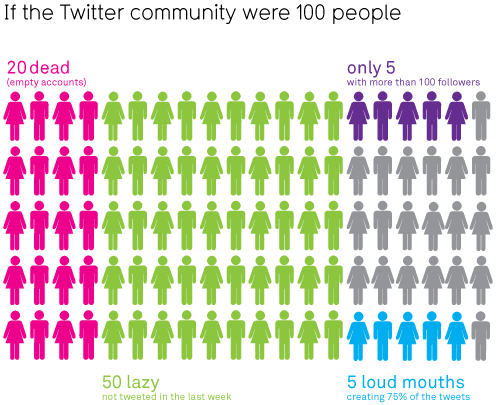
Courtesy of Mashable, David McCandless
“We’re at the beginning of an unmanned revolution.” That’s what Gary Kessler, who oversees unmanned aviation programs for the US Navy and Marines, told the AFP.
According to the article, “Robots or “unmanned systems” are now deployed by the thousands in Iraq and Afghanistan, spying from the sky for hours on end, searching for booby-traps and firing lethal missiles without putting US soldiers at risk.” This revolution is at hand because saving the lives of soldiers is very popular, which also happens to be part of a meme that is blocking President Obama’s health care plans.
That is, Americans expect technology to help save lives, even those that are in the most danger (hello robot drones). Any move to limit the use of technology to save lives (i.e., denying high tech care to those deemed “too sick or too old”) is guaranteed to hit resistance.
If you’re a lawyer, and you use the crazy-outmoded PACER system to access federal court documents, check out the new RECAP system launched today by Tim Lee, Harlan Yu, and Steve Schultze with the help of Princeton’s CITP. If you use PACER, you know it’s difficult to use. It also charges citizens to access what are nominally public documents, something that makes little sense online. This combination has resulted in a multi-million dollar surplus for the judiciary’s IT department, and lousy access to data that would be useful not just to lawyers and litigants, but to bloggers, librarians, reporters, and scholars.
Schultze, Lee, and Yu’s scheme to free the documents on PACER is an ingenious one. They have built a Firefox plugin called RECAP that attorneys and other regular users of PACER can install on their computers. When a user downloads a document from PACER, the plugin sends a copy to RECAP’s server, where it is made publicly available. If enough PACER users install RECAP, it will only be a matter of time before the entire database is liberated. Why would lawyers participate? When they search for a document, the plugin first checks the RECAP database to see if a copy has already been liberated. If it has, then the lawyer can retreive it without paying PACER. Like I said: ingenious.
I’m happy to see so many folks take up Carl Malamud’s mantle and not only liberate government data, but also provide competition to government. It’s the impetus behind my own OpenRegs.com. By demonstrating what’s possible, how the world won’t end when data is made freely available, we create demand for change in government. Three cheers for RECAP! Continue reading →
 Five years ago today the Technology Liberation Front (the “TLF”) got underway with this post. The idea for the TLF came about after I asked some tech policy wonks whether it was worth put together a blog dedicated to covering Internet-related issues from a cyber-libertarian perspective. The model I had in mind was a “Volokh Conspiracy
for Tech Issues,” if you will. I wanted to bring together a collection of sharp, liberty-loving wonks (most of whom worked in the think tank world) to talk about their research on this front and to give them a place to post their views on breaking tech policy developments. It was to be a sort of central clearinghouse for libertarian-oriented tech policy analysis and advocacy.
Five years ago today the Technology Liberation Front (the “TLF”) got underway with this post. The idea for the TLF came about after I asked some tech policy wonks whether it was worth put together a blog dedicated to covering Internet-related issues from a cyber-libertarian perspective. The model I had in mind was a “Volokh Conspiracy
for Tech Issues,” if you will. I wanted to bring together a collection of sharp, liberty-loving wonks (most of whom worked in the think tank world) to talk about their research on this front and to give them a place to post their views on breaking tech policy developments. It was to be a sort of central clearinghouse for libertarian-oriented tech policy analysis and advocacy.
At first, Tim Lee and I debated whether it even made sense to have that sort of narrow focus, but I think the passage of time and the rise of plenty of competition on this front shows that it was worthwhile. And I’ve been very pleased with the tag-team effort of all our TLF contributors and the way—without anyone planning it, in true libertarian fashion—we’ve sort of developed a nice division of labor on various tech policy issues.
Perhaps a few stats are in order on this occasion to mark our progress 5 years in. The best indication of our success is the fact that our Pagerank (Google’s logarithmic scale of website importance based on links to that site) has reached 7/10—the same score shared by the Volokh Conspiracy (our model), as well as Techmeme (the leading tech news aggregator), the Cato Institute, CDT, etc. (For comparison: ArsTechnica and EFF are 8s.) Unfortunately, we’ve only been using Google Analytics for three of the past five years, so it’s impossible to get a authoritative accounting of traffic growth since Day 1. But here are few markers:
- 4,450+ posts
- 29,000+ comments
- 2,698 RSS subscribers
- 15,763 unique visitors per month
- 1,000,000 pageviews since Nov. 2006 when we started using Google Analytics
- Besides organic search and direct links, we get the bulk of our traffic from other tech-oriented sites (in order of hits) TechDirt, Freedom to Tinker, Ars Technica, GamePolitics.com, TechMeme, Slate, etc., and aggregators such as reddit, Fark, and StumbleUpon
So, what’s our #1 post of all-time? Continue reading →
Please join us tonight for a very special Alcohol Liberation Front happy hour at Rocket Bar, 714 7th ST (7th & G) right across from the Chinatown/Verizon Center metro (Red/Green/Yellow) in D.C., 6:30-8:30ish.
Please join us as we celebrate, commiserate and plan for the next five years of fighting the good cyber-libertarian fight. We’ll even through in a free TLF laptop sticker! Just RSVP on Facebook!
 In a couple of blog posts on Cato@Liberty recently, I’ve used graphics to illustrate my very good points.
To sass the PR-ey use of Whitehouse.gov to advocate for health care regulation, and make a point or two about transparency, I modified the “Reality Check” image the White House created for their campaign. That was a good time.
But the
tour de force is the link that I embedded with a TSA graphic meant to illustrate what they’re doing with Secure Flight. For that one, you have to go look at the post. Read the graphic, enjoy its meaning, then do what it tells you to do.
An Illinois bill to ban convicted sex predators from social networking sites (HB 1314) is now law. Gov. Pat Quinn signed the bill yesterday. Even if predation on social networking sites is very rare, we certainly prefer to see efforts that target bad actors instead of tech mandates or age verification requirements. Given the broad definition of “social networking website” in the law, the ban might apply to many types of Internet sites.
Definition:
“Social networking website” means an Internet website containing profile web pages of the members of the website that include the names or nicknames of such members, photographs placed on the profile web pages by such members, or any other personal or personally identifying information about such members and links to other profile web pages on social networking websites of friends or associates of such members that can be accessed by other members or visitors to the website. A social networking website provides members of or visitors to such website the ability to leave messages or comments on the profile web page that are visible to all or some visitors to the profile web page and may also include a form of electronic mail for members of the social networking website.
In my last post, I touted an often-ignored benefit of targeted ads: that they directly enhance the browsing experience, compared to seeing dumb ads. This post argues that no one has a “right to her data” that ad-targeting takes away.
“Privacy” is a word of many meanings. The best explanation of the myriad ways the word has been used I’ve seen came from TLF’s own Jim Harper five years ago. People have a right to privacy in some senses, but not in others. They have a justice-based right (a political moral right) to freedom from government intrusion – the broad sense of privacy espoused in cases like Lawrence v. Texas. And they have a justice-based right to not have to give up information about themselves to the government, the sort of right violated by NSA wiretapping and that should be protected by the Fourth Amendment – the kind of right espoused in cases like Katz v. United States.
We do not have any justice-based right, however, to control what is done with those things we voluntarily give away to private individuals. If I sell you or give you my laptop, without any restrictions on your use, I have no rights-based complaint if you use it to do something I find objectionable, such as reading Perez Hilton. Nor do I have a rights-based complaint if you take the information I left on it and use it for your purposes. Even if that information is about me. Continue reading →
We here at TLF have long been pointing out the benefits of targeted ads. But recently, we have focused on what I call the “supply-side” benefits – that targeted ads make free content possible by increasing the price advertisers are willing to pay for each pageview and therefore the amount of revenue content providers collect. That is a crucial point, and one that has yet to be absorbed by Congress, the FTC, and even other experts in Internet policy.
But we haven’t talked a lot about what I call the “demand-side” benefits – that targeted advertising is better for the viewer,
directly, than non-targeted advertising. We have been too quick, I think, to legitimize the other side’s concerns, which they label under the heading “privacy,” by discussing the situation as one of trade-offs and TINSTAFL.
Our arguments have sounded like those supporting free trade agreements because of the trade barriers the
other countries are lifting, implying that we should not remove our own trade barriers unless other countries agree to remove theirs. This is the wrong argument to make, for the simple reason that trade barriers don’t just hurt the economies of other countries; they damage our own. As my economics professor, Jeff Miron, put it, when everyone is shooting themselves in the foot, you don’t wait until you can get everyone else to agree to stop with you; you just let go of the gun. Continue reading →

 The Technology Liberation Front is the tech policy blog dedicated to keeping politicians' hands off the 'net and everything else related to technology.