Hanno F. Kaiser, a U.S. and EU antitrust lawyer and partner with Latham & Watkins LLP, has just released an important essay on a topic I have devoted much time to here over the years: the debate over the relative advantages of “open” vs. “closed” technological systems and the Lessig-Zittrain-Wu school of thinking about these issues.
Kaiser’s essay is entitled, ” Are Closed Systems an Antitrust Problem?” and it appears in the latest edition of Competition Policy International.  This essay is not to be missed. Kaiser’s terrific paper helps us better understand and debunk many of the myths and misperceptions that continue to riddle this debate. Here’s Kaiser’s key insight:

At bottom, the bad reputation of closed systems or walled gardens in the “open versus closed” debate is quite undeserved. Walled gardens generally benefit their environments—both in the real world and the digital realm. The primary purpose of a garden wall, after all, is to shelter plants from wind and frost, not to keep intruders out. In the protected space of the garden, flowers can grow that would not otherwise survive in the wild. Walled gardens thus deliberately create a microcosm that is different from the surrounding ecosystem. Therefore, as long as the garden does not take over the entire ecosystem, walled gardens increase, not reduce, overall diversity. From a competition policy perspective, enjoying the fruits of a walled garden is generally not a guilty pleasure.

Therefore, “as a policy matter, ‘open’ is not necessarily better than ‘closed’,” Kaiser argues, and elaborates as follows: Continue reading →

TechFreedom, CEI and ATR’s DigitalLiberty.net just put out the following statement about ECPA reform, something Ryan and I have blogged about here and here. Also check out the larger coalition letter we released in April with seven other leading free market groups and digitalfourthamendment.org.

*  *  *

WASHINGTON D.C. – Sen. Patrick Leahy (D-Vt.) today introduced legislation (S. 1011) to reform the Electronic Communications Privacy Act (ECPA).  The law, enacted in 1986, was designed to protect individuals’ privacy by limiting governmental access to electronic data stored or sent using platforms or computers owned by third parties.

“Several lawmakers have proposed sweeping new regulation of how companies collect and use data to fund and improve the online content and services cherished by consumers,” said TechFreedom President Berin Szoka.  “The costs to consumers of such regulations could be enormous, yet the harms supposedly justifying new regulations remain largely amorphous.  Today, finally, we see a bill that focuses on the one clear harm that seems to underlie most online privacy concerns: law enforcement’s access to personal data without judicial scrutiny.  Addressing that very real problem should unite everyone who cares about privacy.”

Sen. Leahy’s proposed legislation would amend ECPA to protect Americans’ private information stored remotely or in the “cloud” from unwarranted search and seizure, and limit unwarranted governmental access to mobile location information.  The reforms would implement two of the four consensus principles advocated by the Digital Due Process coalition, a diverse coalition of public interest organizations, free market groups, high-tech companies, and scholars. Continue reading →

On the podcast this week, Joseph Menn, a Financial Times technology reporter and the author of Fatal System Error: The Hunt for the New Crime Lords Who Are Bringing Down The Internet, discusses cyber crime. Menn says that one of the main challenges of cybersecurity is that the internet was never intended for many of the things it’s used for today, like e-commerce or critical infrastructure management. He talks about the implications of the internet still being in beta form and comments on the recent Sony data breach and other similar cyber attacks. Menn also discusses his book, telling a few anecdotes about the people who go beyond computer screens in pursuit of internet crime lords.

Related Links

To keep the conversation around this episode in one place, we’d like to ask you to comment at the web page for this episode on Surprisingly Free. Also, why not subscribe to the podcast on iTunes?

Here’s a quick excerpt from an interesting press release sent out over PR Newswire last week—it sounds like someone is angling for a fat government contract:

EMC® announced the 2011 Data Hero Awards winners and finalists First annual Data Hero Visionary award goes to Vivek Kundra, the first Chief Information Officer (CIO) of the United States of America

EMC just happens to be huge provider of cloud storage solutions, which they’re actively trying to sell to the public sector, and apparently already have.

Kundra, of course, was honored:

I’m truly honored to be recognized for this 2011 Data Hero visionary award. The modern economy is powered by data and technology. That’s why we strive to find innovative paths to lower government cost, engage citizens and institute radical transparency to bring them closer to their government and to help move us all forward, together.

I really like the way he worked in the bit on “radical transparency.”  It’s not as though if you say something enough, it magically changes reality, but that doesn’t stop the flow of awards.

Be on the lookout for an EMC press release involving a massive federal government cloud computing project.

Just a final reminder that it isn’t too late to still register for this Wednesday’s Mercatus Center event on “The State of Wireless Competition” featuring Thomas W. Hazlett, Professor of Law & Economics, George Mason University School of Law; Joshua D. Wright, Assistant Professor of Law, George Mason University School of Law; Robert M. Frieden, Professor of Telecommunications & Law, Penn State University; and Harold Feld, Legal Director, Public Knowledge. These experts will discuss the FCC’s upcoming Wireless Competition Report and the debate:

  • What does a proper analysis of wireless competition look like?
  • What should we expect from the FCC’s report this year?
  • How should the FCC address competition in the future?

Again, the event will take place this  Wednesday (May 18) from 4:00 – 5:30 p.m at George Mason University’s Arlington Campus, just ten minutes from downtown Washington. (Founders Hall, Room 111, 3351 N. Fairfax Drive, Arlington, VA). A reception will follow.

To RSVP for yourself and your guests, please contact Megan Gandee at 703-993-4967 or mmahan@gmu.edu no later than May 16, 2011. Hope to see some regular TLF readers there!

I’ve written two articles on the Protect IP Act of 2011, introduced last week by Sen. Leahy (D-Vt.).

For CNET, I look at some of the key differences, better and worse, between Protect IP and its predecessor last year, known as COICA.

On Forbes this morning, I have a long meditation on what Protect IP says about the current state of the Internet content wars.  Copyright, patent, and trademark are under siege from digital technology, and for now at least are clearly losing the arms race.

The new bill isn’t exactly the nuclear option in the fight between the media industries and everyone else, but it does signal increased desperation. Continue reading →

As a rule of thumb, when I have to spend a given amount of time straightening out a company’s poor service or unscrupulous practices, I’ll spend an equivalent amount of time giving that company some payback. Today’s victim: T-Mobile. Fear the blog post.

A letter from Asurion Warranty Services arrived in my mail today thanking me for signing up for their “Premium Handset Protection Bundle” for T-Mobile phones.

Oh no I didn’t. It costs $5.99 a month for repair and replacement of my newly upgraded phone. That’s pretty much the price of a phone per year for such protections. Bad deal. I haven’t lost or damaged a phone in a decade, and I didn’t agree to get have this charge added to my phone bill.

I am on hold right now, trying to learn just how this got onto my bill. Friendly, helpful T-Mobile customer service people have told me that I should go down to the T-Mobile store where I upgraded in order to straighten this out. No I shouldn’t. T-Mobile should be straightening this out right now over the phone, with an apology and a thank you.

I am done with my 40-minute phone call, in which friendly customer service supervisor Kassidy K. (#1204178) tried to assign me the task Monday of calling the store where I upgraded my phone to get this straightened out. I explained to Kassidy K. that I’ve made the only call I need to—that’s the call we were on. Her next work-day is Wednesday, and I told her I expected to hear from her about this being cleared up.

If I have to make another call, it’s just as likely to be about returning my phone and canceling my service as getting this charge removed from my bill.

You people can argue all you want about top-down—whether the government should allow the AT&T-T-Mobile merger. I’ll do bottom-up—whether T-Mobile should get my business.

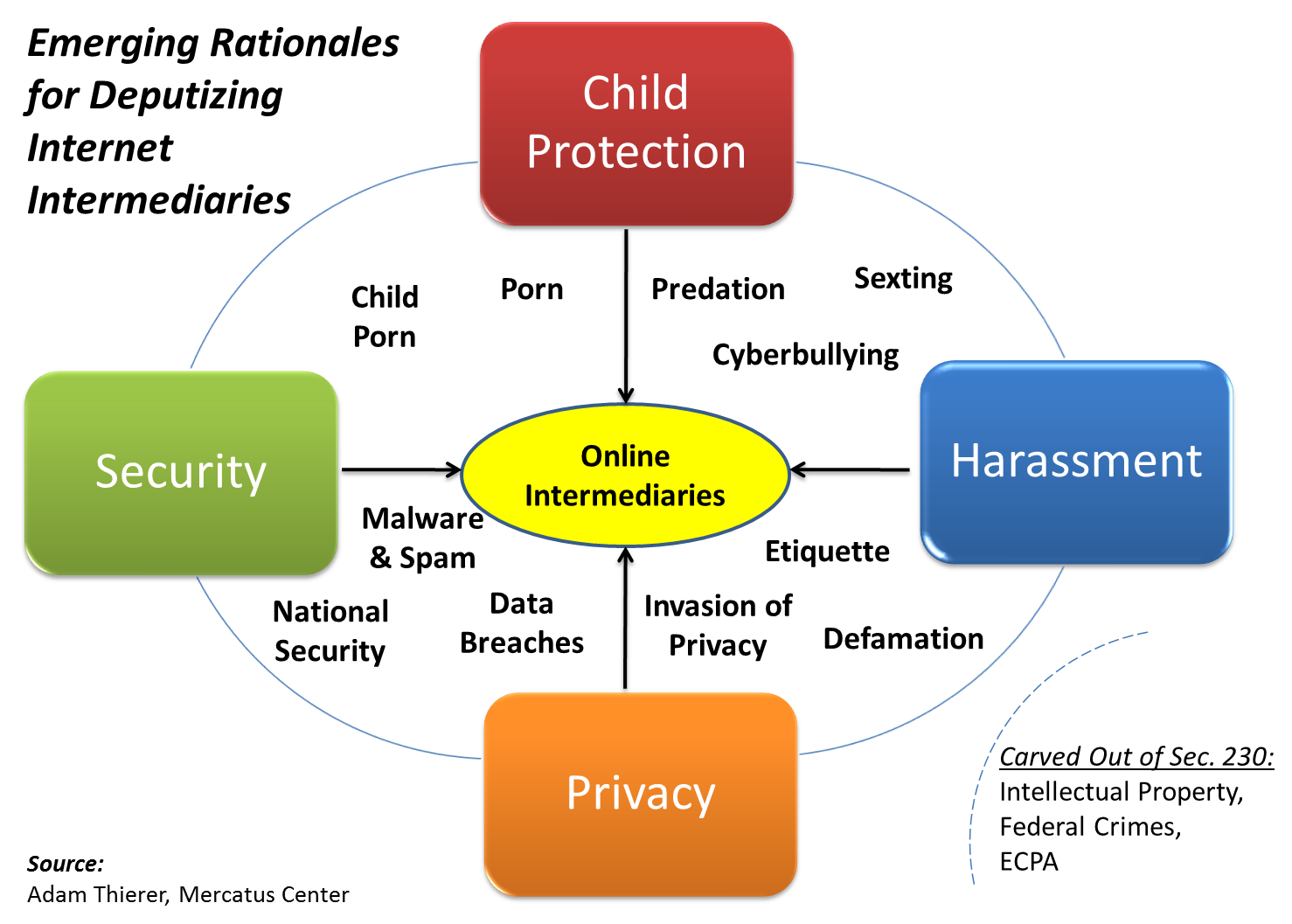
My latest Forbes column is a celebration of 47 U.S.C. §230, otherwise known as “Section 230.” Sec. 230 turns 15 years old this year and I argue that this important law has “helped foster the abundance of informational riches that lies at our fingertips today” and has served as “the foundation of our Internet freedoms.”  Sadly, however, few people have even heard of it. Worse yet, as I note in my essay, this important law is under attack from various academics and organizations who want it modified to address a variety of online problems. But, as I note:

If the threat of punishing liability is increased, the chilling effect on the free exchange of views and information would likely be quite profound. Many site administrators would immediately start removing massive amounts of content to avoid liability. More simply, they might just shut down any interactive features on their sites or limit service in other ways.

Head over to Forbes to read the rest. And here’s a graphic I put together illustrating all the new fault lines in the war against Sec. 230. It will be included in a new paper on the issue that I am wrapping up right now.

Last November, I penned an essay on these pages about the COICA legislation that had recently been approved unanimously by the U.S. Senate Judiciary Committee. While I praised Congress’s efforts to tackle the problem of “rogue websites” — sites dedicated to trafficking in counterfeit goods and/or distributing copyright infringing content — I warned that the bill lacked crucial safeguards to protect free speech and due process, as several dozen law professors had also cautioned. Thus, I suggested several changes to the legislation that would have limited its scope to truly bad actors while reducing the probability of burdening protected expression through “false positives.” Thanks in part to the efforts of Sen. Ron Wyden (D-Ore.), COICA never made it a floor vote last session.

Today, three U.S. Senators introduced a similar bill, entitled the PROTECT IP Act (bill text), which, like COICA, establishes new mechanisms for combating Internet sites that are “dedicated to infringing activities.” I’m glad to see that lawmakers adopted several of my suggestions, making the PROTECT IP Act a major improvement over its predecessor. While the new bill still contains some potentially serious problems, on net, it represents a more balanced approach to fighting online copyright and trademark infringement while recognizing fundamental civil liberties.

Continue reading →

Sometimes free-marketeers are branded “free market fundamentalists” or something similar by their ideological opponents. The implication is that our preference for a society in which free people interact voluntarily to organize society’s resources is an irrational desire or a religion. I’m sure there’s a similar epithet we give to nanny staters—oh, there’s one, “nanny staters”—who we believe to have excessive faith in government solutions.

Market processes have decent theoretical explanations, such as Friedrich Hayek’s essay, “The Use of Knowledge in Society.” It’s not the easiest read, but lovers of the Internet, who see the genius of its decentralization, should see similar genius in markets as a method for discovering society’s wants and uniting to achieve them—without coercion.

From time to time, we also point out examples of how market processes work to deliver even intangible goods like privacy. So, for example, I noted market pressure against Facebook’s privacy-invasive “beacon” advertising system in 2007. Berin pointed out in 2008 that market forces caused Google to remove an oppressive clause from the Chrome end user license agreement. Google competitor Cuil made a run at the search behemoth based on privacy that year, something I noted briefly then (and Ryan and I discussed in the comments). I’ve also noted the failure of many to find true market failures.

As Cuil illustrates, not every privacy play works, but companies routinely pitch the public on the privacy merits of their products and the demerits of others’. It’s not a highly visible process, but it sometimes gets a little more visible when it fails. So thank you, Facebook, for a big #FAIL in the privacy competition area this week. You provide us a nice lesson in one of the ways markets work to meet consumer privacy demands.

You see, Facebook hired PR firm Burson-Marsteller to do a whisper campaign on the privacy demerits of a Google product called Social Circle. By pushing the story of privacy problems with a Google effort in the social networking space, Facebook hoped to thwart a competitor that it fears. Success would also be a success for privacy protection. If Google were doing something wrong, and Facebook were to make the case to the public, Google would lose face and it would lose business. Most importantly, a privacy-invasive product—as determined by public consensus—would recede. Markets often work by silently shunning products that don’t cut it. (Again, hard to see if you’re not looking for it, or if you’re committed to disbelieving it.)

Facebook appears not to have succeeded. Prickly privacy advocate Chris Soghoian outed the Burson-Marsteller campaign. Dan Lyons of the Daily Beast cornered Facebook into confessing its role in the attack on Google. And privacy commentator Kashmir Hill gives the privacy issues with Social Circle a “meh.”

When it happens differently, you get a change in a service like Social Circle—the way Facebook changed “beacon” and Google changed the Chrome EULA. These are anecdotes, and they reflect but one element of the market processes that shape products and services. But it’s something that “market denialists” should consider as they dig deep to explain to themselves and others how various mechanisms in our society work.