Two data points in the news over the past 24 hours to consider:
- A new report on “Smartphone Adoption & Usage” by the Pew Internet Project finds that “one third of American adults – 35% – own smartphones” and that of that group “some 87% of smartphone owners access the Internet or email on their handheld” and “25% of smartphone owners say that they mostly go online using their phone, rather than with a computer.”
- According to the Wall Street Journal, the “Average iPhone Owner Will Download 83 Apps This Year.” That’s up from an average of 51 apps downloaded in 2010. (At first I was astonished when I read that, but then realized that I’ve probably downloaded an equal number of apps myself, albeit on an Android-based device.)
As I explain in my latest
Forbes column, facts like these help us understand “How iPhones And Androids Ushered In A Smartphone Pricing Revolution.” That is, major wireless carriers are in the process of migrating from flat-rate, “all-you-can-eat” wireless data plans to usage-based plans. The reason is simple economics: data demand is exploding faster than data supply can keep up.
“It’s been four years since the introduction of the iPhone and rival devices that run Google’s Android software,” notes Cecilia Kang of The Washington Post. “In that time, the devices have turned much of America into an always-on, Internet-on-the-go society.” Indeed, but it’s not just the iPhone and Android smartphones. It’s all those tablets that have just come online over the past year, too. We are witnessing a tectonic shift in how humans consume media and information, and we are witnessing this revolution unfold over a very short time frame. Continue reading →
Over
on his Google+ page, cyber-guru Andrew McLaughlin posted a bit of a rant about libertarians and Net neutrality arguing, among other things, that “the pro-freedom position is to enforce net neutrality.” Needless to say, I disagree and posted a long comment explaining why and trying to help him and others on the Left understand the way libertarians generally look at this issue. For what it’s worth, I thought I would just repost my response to him here:
________
Andrew… I’m happy, as always, to engage in friendly debate with you about this, although I suspect from the tone of some of the others here that nothing I will say will convince them that opposition to Net neutrality regulation can be based on anything other than pure corporate whoring!
I’m always mystified by the highly selective nature of this rhetorical device when employed by some on the Left against libertarians. After all, as Tim Lee already alluded to in his comments above, we never seem to hear our Lefty friends trot out those arguments when they agree with us. For example, Berin Szoka and I filed an amicus brief in the Supreme Court last year in the BROWN v. EMA video game case along with Lee Tien and Cindy Cohn of EFF. Why is it that I did not hear one peep from any Lefties about my obvious corporate whoring in that matter! I mean, clearly, there’s no possible way that a libertarian could support First Amendment rights. I must have just been in it for video game industry money, right?
OK, I’m being snarky here. And I know this is not your position because I’ve known you a long time and know that you do not adopt such tactics even when we do, on occasion, disagree heatedly over a major policy issue. But, even if I am wasting my breath, let me just say this to others: We libertarians in the academic and think tank world aren’t exactly living “Lifestyles of the Rich and Famous.” If we all just in it for the money than I can tell you that we are doing a tremendously shitty job at it! (In fact, most libertarian think tanks or organizations only have something like 5 to 10% corporate funding. The organization I work for has even less.) Seriously folks, we libertarians believe in our ideas and fight for them with the same passion that you fight for yours because of a heart-felt belief in the inherent rightness of our core principles. Continue reading →
In today’s Washington Post, Senators Lieberman, Collins and Carper had an op-ed calling for comprehensive cybersecurity legislation. If we don’t pass such legislation soon, they say, “The alternative could be a digital Pearl Harbor — and another day of infamy.”
Last time I checked, Pearl Harbor left over two thousand persons dead and pushed the United States into a world war. There is no evidence that a cyber-attack of comparable effect is possible. Yet as I write in TIME.com’s Techland, war rhetoric allows government to pursue avenues that might otherwise be closed:
The problem with the war metaphor is that treating a cyber attack as an act of war, rather than a crime, invites a different governmental response. In the offline world, vandalism, theft, and even international espionage are treated as crimes. When you detect them, you call law enforcement, who investigate and prosecute and, most importantly, do so while respecting your civil liberties. In war, these niceties can go out the window.
War changes the options available to government, says noted security expert Bruce Schneier. Things you would never agree to in peacetime you agree to in wartime. Referring to the warrantless wiretapping of Americans that AT&T allowed the NSA to conduct after 9/11, Schneier has said, “In peacetime if the government goes to AT&T and says, ‘Hey, we want to eavesdrop on everybody,’ AT&T says, ‘Stop, where’s your warrant?’ In wartime, AT&T says, ‘Use that closet over there, lock the door, and just put a do not disturb sign on it.’”
Check out the whole article for more outrage.
Of all the shockingly naive and shamelessly self-serving editorials I’ve read by businesspeople in recent years, today’s Wall Street Journal oped by Netflix general counsel David Hyman really takes the cake. It’s an implicit plea to policymakers for broadband price controls. Hyman doesn’t like the idea of broadband operators potentially pricing bandwidth according to usage /demand and he wants action taken to stop it. Of course, why wouldn’t he say that? It’s in Netflix’s best interest to ensure that somebody else besides them picks up the tab for increased broadband consumption!
But Hyman tries to pull a fast one on the reader and suggest that scarcity is an economic illusion and that any effort by broadband operators to migrate to usage-based pricing schemes is simply a nefarious, anti-consumer plot that must be foiled. “Consumers and regulators need to take heed of what is happening and avoid winding up like the proverbial frog in a pot of boiling water,” Hyman warns. “It’s time to jump before it’s too late.”
Rubbish! The only thing policymakers need to do is avoid myopic, misguided advice like Hyman’s, which isn’t based on one iota of economic theory or evidence.
Continue reading →
 Vivek Wadhwa, who is affiliated with Harvard Law School and is director of research at Duke University’s Center for Entrepreneurship, has a terrific column in today’s Washington Post warning of the dangers of government trying to micromanage high-tech innovation and the Digital Economy from above.
For reasons I have never been able to understand, the
Washington Post uses different headlines for its online opeds versus its print edition. That’s a shame, because while I like the online title of Wadhwa’s essay, “Uncle Sam’s Choke-Hold on Innovation,” the title in the print edition is better: “Google, Twitter and the Best Regulator.” By “best regulator” Wadhwa means the marketplace, and this is a point we have hammered on here at the TLF relentlessly: Contrary to what some critics suggest, the best regulator of “market power” is the market itself because of the way it punishes firms that get lethargic, anti-innovative, or just plain cocky. Wadhwa notes:
The technology sector moves so quickly that when a company becomes obsessed with defending and abusing its dominant market position, countervailing forces cause it to get left behind. Consider: The FTC spent years investigating IBM and Microsoft’s anti-competitive practices, yet it wasn’t government that saved the day; their monopolies became irrelevant because both companies could not keep pace with rapid changes in technology — changes the rest of the industry embraced. The personal-computer revolution did IBM in; Microsoft’s Waterloo was the Internet. This — not punishment from Uncle Sam — is the real threat to Google and Twitter if they behave as IBM and Microsoft did in their heydays.
Continue reading →
NPR science correspondent Shankar Vedantam had a great spot on NPR’s Morning Edition today about the disputes among social scientists over the impact of violent video games on kids. [“It’s A Duel: How Do Violent Video Games Affect Kids?”] You won’t be surprised to hear I wholeheartedly agree with Texas A&M psychologist Chris Ferguson, who noted in the spot:
Ferguson says it’s easy to think senseless video game violence can lead to senseless violence in the real world. But he says that’s mixing up two separate things. “Many of the games do have morally objectionable material and I think that is where a lot of the debate on this issue went off the rails,” he said. “We kind of mistook our moral concerns about some of these video games, which are very valid — I find many of the games to be morally objectionable — and then assumed that what is morally objectionable is harmful.”
I’ve written about Ferguson’s work and these issues more generally many times over through the years here at the TLF. Here are some of the most relevant essays:
In these essays, I’ve tried to make a couple of key points about the social science literature on “media effects” theory: Continue reading →
On the podcast this week, Daniel Solove, professor at the George Washington University Law School, discusses his new book Nothing to Hide: The False Tradeoff Between Privacy and Security. He suggests that developments in technology do not create a mutually exclusive relationship between privacy and national security. Solove acknowledges the interest government has in maintaining security within our technological world; however, Solove also emphasizes the value of personal privacy rights and suggests that certain procedures, such as judicial oversight on governmental actions, can be implemented to preserve privacy. This oversight may make national security enforcement slightly less effective, but according to Solove, this is a worthwhile tradeoff to ensure privacy protections.
Related Links
Nothing to Hide: The False Tradeoff Between Privacy and Security
I‘ve Got Nothing to Hide’ and Other Misunderstandings of Privacy, by Solove
“No rights left to lose: Destroying privacy in name of security in the age of terror”, The Daily
To keep the conversation around this episode in one place, we’d like to ask you to comment at the web page for this episode on Surprisingly Free. Also, why not subscribe to the podcast on iTunes?
Today is the 33rd anniversary of the Supreme Court’s landmark First Amendment decision, FCC v. Pacifica Foundation. By a narrow 5-4 vote in this 1978 decision, the Court held that the FCC could impose fines on radio and TV broadcasters who aired indecent content during daytime and early evening hours. The Court used some rather tortured reasoning to defend the proposition that broadcast platforms deserved lesser First Amendment treatment than all other media platforms. The lynchpin of the decision was the so-called “pervasiveness theory,” which held that broadcast speech was “uniquely pervasive” and an “intruder” in the home, and therefore demanded special, artificial content restrictions.
Back in 2008, when
Pacifica turned 30, I penned a 6-part series critiquing the decision and discussing its impact on First Amendment jurisprudence:
In addition to those essays, I brought all my thinking together on this issue in a 2007 law review article, “Why Regulate Broadcasting: Toward a Consistent First Amendment Standard for the Information Age.” Importantly, this could be the last year we “celebrate” a Pacifica anniversary. Earlier this week, on the same day it handed down a historical video game free speech win, the Supreme Court announced that next term it will examine the constitutionality of FCC efforts to regulate “indecent” speech on broadcast TV and radio. Here’s hoping the Supreme Court takes the sensible step of undoing the unjust regulatory mess they created with Pacifica 33 years ago. Speech is speech is speech. Lawmakers should not be regulating it differently just because it’s on TV or radio instead of cable TV, satellite radio or TV, physical media, or the Internet. Continue reading →
It remains unclear how interested the Federal Trade Commission (FTC) is in bringing a formal antitrust action against Google, but we at least know that inquiries have been made. I suspect these inquires are far more serious than whatever the agency is fishing for with its new Twitter inquires. After all, as I note in my latest Forbes column, “Google isn’t even a teenager yet (having only been founded in September 1998), but the firm’s rise has been meteoric and it has made a long list of enemies in the process. Practically every major player in the Digital Economy… is gunning for Google these days, both in the commercial and political marketplace.” In this sense, it’s not surprising the FTC might take a keen interest in the company with so many competitors complaining.
Still, I just can’t find much merit in an antitrust case against Google since, as I noted in my column, “The firm’s success seems tied to high quality products that users prefer over rival services. Importantly, barriers to entry are low: there’s nothing stopping new entrants from innovating and offering competing online services to match Google.”
Regardless, instead of arguing about the merits of an antitrust action against Google, let’s consider the more interesting, and I think intractable, question of remedies. Here’s what I had to say about that in my Forbes essay: Continue reading →
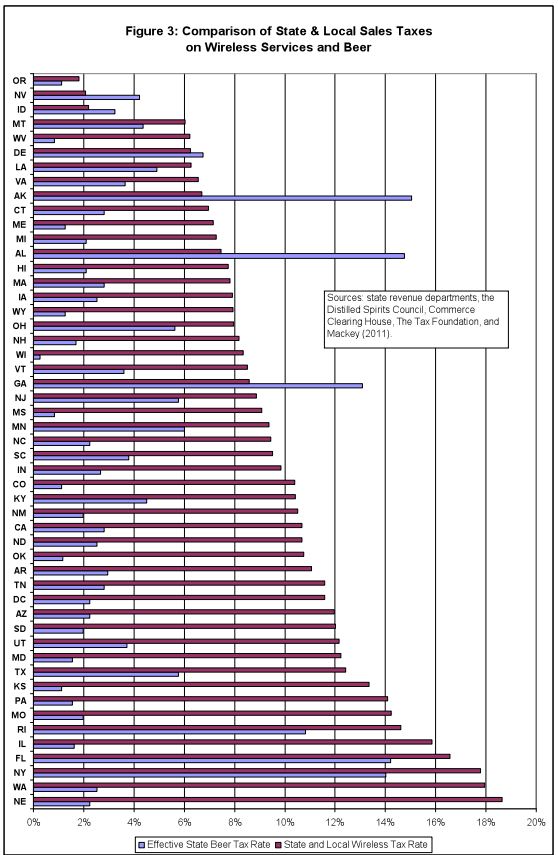 As we’ve noted here before, state and local politicians just love wireless taxes. They are going up, up, up. Dan Rothschild outlined this disturbing trend in his recent Mercatus Center paper making “The Case Against Taxing Cell Phone Subscribers,” and I discussed it in my recent Forbes essay lambasting the “Talking Tax.” Another new study by Glenn Woroch of the Georgetown University School of Business notes how “The ‘Wireless Tax Premium’ Harms American Consumers and Squanders the Potential of the Mobile Economy.” Woroch estimates that “the American consumer forgoes over $15 billion in surplus annually compared to when cell phones receive the
same tax treatment as other goods and service.” Read the entire study but I want to draw everyone’s attention to this chart that appears on page 7 of the report comparing state and local wireless taxes burdens to beer taxes. It really makes you realize just how drunk on wireless taxes are local lawmakers have become! [Click to enlarge. Red bar = wireless taxes.]
As we’ve noted here before, state and local politicians just love wireless taxes. They are going up, up, up. Dan Rothschild outlined this disturbing trend in his recent Mercatus Center paper making “The Case Against Taxing Cell Phone Subscribers,” and I discussed it in my recent Forbes essay lambasting the “Talking Tax.” Another new study by Glenn Woroch of the Georgetown University School of Business notes how “The ‘Wireless Tax Premium’ Harms American Consumers and Squanders the Potential of the Mobile Economy.” Woroch estimates that “the American consumer forgoes over $15 billion in surplus annually compared to when cell phones receive the
same tax treatment as other goods and service.” Read the entire study but I want to draw everyone’s attention to this chart that appears on page 7 of the report comparing state and local wireless taxes burdens to beer taxes. It really makes you realize just how drunk on wireless taxes are local lawmakers have become! [Click to enlarge. Red bar = wireless taxes.]

 The Technology Liberation Front is the tech policy blog dedicated to keeping politicians' hands off the 'net and everything else related to technology.