I spoke at the MSU/Quello Center’s “Governance of Social Media” workshop on November 11. My talk runs 21 minutes and starts at 1:16:54 in this video. The Q&A begins at 1:41:00.
My presentation follows below. Continue reading →
I spoke at the MSU/Quello Center’s “Governance of Social Media” workshop on November 11. My talk runs 21 minutes and starts at 1:16:54 in this video. The Q&A begins at 1:41:00.
My presentation follows below. Continue reading →
The Stop Online Piracy Act (SOPA), a controversial bill before the House of Representatives aimed at combating “rogue websites,” isn’t just about criminal, foreign-based sites that break U.S. intellectual property laws with impunity. Few dispute that these criminal websites that profit from large-scale counterfeiting and copyright infringement are a public policy problem. SOPA’s provisions, however, extend beyond these criminal sites, and would potentially subject otherwise law-abiding Internet intermediaries to serious legal risks.
Before moving forward with rogue websites legislation, it’s crucial that lawmakers take a deep breath and appreciate the challenges at stake in legislating online intermediary liability, lest we endanger the Nozickian “utopia of utopias” that is today’s Internet. The unintended consequences of overbroad, carelessly drafted legislation in this space could be severe, particularly given the Internet’s incredible importance to the global economy, as my colleagues have explained on these pages (1, 2, 3, 4, 5, 6)
To understand why SOPA could be a game-changer for online service providers, it’s important to understand the simmering disagreement surrounding the Digital Millennium Copyright Act (DMCA) of 1998, which grants certain online service providers a safe harbor from liability for their users’ copyright infringing actions. In exchange for these protections, service providers must comply with the DMCA’s notice-and-takedown system, adopt a policy to terminate users who repeatedly infringe, and meet several other conditions. Service providers are only eligible for this safe harbor if they act to expeditiously remove infringing materials upon learning of them. Also ineligible for the safe harbor are online service providers who turn a blind eye to “red flags” of obvious infringement.
The DMCA does not, however, require providers to monitor their platforms for infringing content or design their services to facilitate monitoring. Courts have held that a DMCA-compliant service provider does not lose its safe harbor protection if it fails to act upon generalized knowledge that its service is used for many infringing activities, in addition to lawful ones, so long as the service provider does not induce or encourage users’ infringing activities.
Defenders of the DMCA safe harbor argue that it’s helped enable America’s Internet-based economy to flourish, allowing an array of web businesses built around lawful user-generated content — including YouTube, Facebook, and Twitter — to thrive without fear of copyright liability or burdensome monitoring mandates.
Conversely, some commentators, including UCLA’s Doug Lichtman, argue that the DMCA inefficiently tips the scales in favor of service providers, to the detriment of content creators — and, ultimately, consumer welfare. Pointing to a series of court rulings interpreting the safe harbor’s provisions, critics argue that the DMCA gives online intermediaries little incentive to do anything beyond the bare minimum to stop copyright infringement. Critics further allege that the safe harbor has been construed so broadly that it shields service providers that are deliberately indifferent to their users’ infringing activities, however rampant they may be.
What does SOPA have to do with all of this? Buried in the bill’s 78 pages are several provisions that run a very real risk of effectively sidestepping many of the protections conferred on online service providers by the DMCA safe harbor.
Listening to this morning’s House Judiciary Committee hearing on H.R. 3261, the “Stop Online Piracy Act” (SOPA) was painful for many reasons, including the fact that the first hour of the Committee’s video stream was practically inaudible and unwatchable. That led to a barrage of snarky jokes on Twitter about whether we should trust these same folks to regulate the Internet in the way SOPA envisions if they can’t even get their own tech act together.
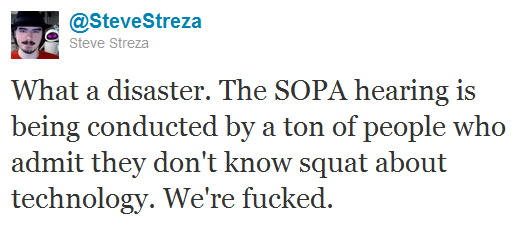
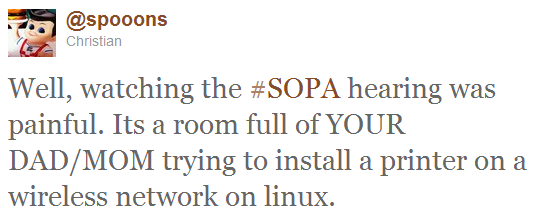
The snark-casm went into overdrive, however, once the lawmakers starting discussing DNS issues and the underlying architectural concerns raised by SOPA’s sweeping solution to the problem of online piracy. At that point, the techno-ignorance of Congress was on full display. Member after member admitted that they really didn’t have any idea what impact SOPA’s regulatory provisions would have on the DNS, online security, or much of anything else. This led to some terrifically entertaining commentary from the Twittersphere, including the two below.
Cross-posted at Reason.org
The big news in online gambling circles these past two weeks has been the busting of BLR Technologies, a software supplier for a number of online gambling sites, after a leading gaming mathematician determined the variance against winning at its craps game was statistically off the charts.
While most online gambling sites host honest games, there’s bound to be some bad apples. What’s often overlooked is that there is a market-enforced structure that militates against suspect play or outright cheating. That was clearly at work here.
The finding already has led at least one online casino, 5Dimes, to remove the BLR software from its site. That the news circulated the online gambling community as quickly as it did, and led to immediate action from a major online casino group, testifies to the knowledge and power of online gamblers. Of course, the image of informed players backed by mathematical and statistical experts contrasts with the views of government policymakers, who tend to treat online gamblers as gullible knuckleheads who need to be protected from unscrupulous gambling predators, predominantly through bans. This misconception is worth keeping in mind as a Congressional panel convenes this week to revisit federal laws against online gambling.
In the BLR case, Michael Shackleford, whose Wizard of Odds website takes an in-depth mathematical approach to all manner of gaming probabilities, strategies and odds, personally tested the software after a reader complained that he had won only 25 percent of 3,200 “pass” or “don’t pass” bets made.
On the podcast this week, Laura Heymann, Professor of Law at William & Mary Law School, discusses her recent article in the Boston College Law Review entitled, The Law of Reputation and the Interest of the Audience. Heymann proposes viewing the concept of reputation as something formed by a community rather than something owned by an individual. Reputation, according to Heymann, is valuable because of the way a community uses it. She then discusses how thinking of reputation differently leads to thinking about different remedies for reputation-based harms. Heymann thinks current remedies for damage to one’s reputation do not focus enough on the affect it has on the community and proposes remedies for emotional injuries be separate from remedies for damages to the reputation. She then discusses how the Internet affects reputation, including how it enlarges communities, and how it intersects with privacy.
To keep the conversation around this episode in one place, we’d like to ask you to comment at the webpage for this episode on Surprisingly Free. Also, why not subscribe to the podcast on iTunes?
Futurists have been predicting for years that there will be diminished privacy in the future, and we will just have to adapt. In 1999, for example, Sun Mcrosystems CEO Scott McNealy posited that we have “zero privacy.” Now, Wall Street Journal columnist Gordon Crovitz is suggesting that technology has the “power to rewrite constitutional protections.” He is referring to GPS tracking devices, of all things.
The Supreme Court is considering whether it was unreasonable for police to hide a GPS tracking device on a vehicle belonging to a suspected drug dealer. The Bill of Rights protects each of us against unreasonable searches and seizures. According to the Fourth Amendment,
The right of the people to be secure in their persons, houses, papers, and effects, against unreasonable searches and seizures, shall not be violated, and no Warrants shall issue, but upon probable cause, supported by Oath or affirmation, and particularly describing the place to be searched, and the persons or things to be seized.
In the case before the Supreme Court, U.S. v. Antoine Jones, the requirement to obtain a warrant was not problematic. In fact, the police established probable cause to suspect Jones of a crime and obtained a warrant. The problem is, the police violated the terms of the warrant, which had expired and which was never valid in the jurisdiction where the tracking occurred. Therefore, first and foremost, this is a case about police misconduct. Continue reading →
Over at TIME.com, I write about last week’s flap over Apple kicking out famed security researcher Charlie Miller out of its iOS developer program:
So let’s be clear: Apple did not ban Miller for exposing a security flaw, as many have suggested. He was kicked out for violating his agreement with Apple to respect the rules around the App Store walled garden. And that gets to the heart of what’s really at stake here–the fact that so many dislike the strict control Apple exercises over its platform. …
What we have to remember is that as strict as Apple may be, its approach is not just “not bad” for consumers, it’s creating more choice.
Read the whole thing here.
On Friday, both Josh Wright and I spoke on a panel at the Michigan State University’s conference on “Governance of Social Media.” Our particular panel focused on emerging competition policy issues affecting social media and social networking sites. Also joining us on the panel were Nicolas Economides of NYU and Michael Altschul of the CTIA. The video of the panel can be found here and I have also embedded it down below. [My remarks begin around the 23-min mark of the video.]
At the event, I presented my forthcoming paper on “The Perils of Classifying Social Media Platforms as Public Utilities,” which is currently out for peer review. I outlined the rising calls for treating social media or social networking sites as public utilities, essential facilities, or natural monopolies. Next, I briefly discussed some basic law and economics of public utility / essential facilities regulation. Third, I detailed six specific problems with efforts to classify these services as such. Finally, I briefly discussed regulatory proposals set forth by Professors Jonathan Zittrain and Tim Wu to apply traditional antitrust or public utility remedies to social media or information platforms. Specifically, I address Zittrain’s call for “API neutrality” (which would apply net neutrality-like principles at the applications and device layer) and Wu’s call for a “Separations Principle” (which would forcibly segregate information providers into three buckets: creators, distributors, and hardware makers). Watch the video for more details and see this for more critiques of the Zittrain and Wu proposals.
It was my pleasure this week to host a terrific panel discussion about the future of broadband policy and FCC reform featuring Raymond Gifford, a Partner at the law firm of Wilkinson Barker Knauer, LLP, Jeffrey Eisenach, a Managing Director and Principal at Navigant Economics and an Adjunct Professor at George Mason University Law School, and Howard Shelanski, Professor of Law at Georgetown Law School who previously served as Chief Economist for the Federal Communications Commission and as a Senior Economist for the President’s Council of Economic Advisers at the White House. We discussed two new papers by Gifford and Eisenach on these issues.
On the podcast this week, Johnny Ryan, Senior Researcher at the Institute of International and European Affairs, discusses his recent book, “A History of the Internet and the Digital Future.” The book is a comprehensive overview of the Internet and where it came from. Ryan discusses some of the core concepts, including what made the Internet revolutionary, and how many of these ideas came from RAND Corporation researcher Paul Baran. He explains that the initial concept for packet switching did come from the need to build a communications system to withstand nuclear attack. The discussion then turns to the advent of communication between computers, which sprang from a group of graduate students who used a collaborative process to create the network. Finally, Ryan discusses Web 2.0, and how technologies like cloud computing and 3-D printing will disrupt industries in the future.
To keep the conversation around this episode in one place, we’d like to ask you to comment at the webpage for this episode on Surprisingly Free. Also, why not subscribe to the podcast on iTunes?
 The Technology Liberation Front is the tech policy blog dedicated to keeping politicians' hands off the 'net and everything else related to technology.