Arnold Kling on the Sergey Brin effect and inequality:
Income inequality in the United States consists of two gaps. The first gap is an upper-lower gap, between those with a college education and those without. The second is an upper-upper gap, between those with high incomes and those with extraordinarily high incomes.
The upper-lower gap reflects changes in the structure of the economy. New technologies place a premium on cognitive ability. Harvard University economists Claudia Goldin and Lawrence Katz have dubbed this “skill-biased technological change.” In today’s economy, more value added comes from knowledge work, and relatively less comes from unskilled labor.
Arts+Labs, a new coalition “committed to a better, safer internet that works for both artists and consumers,” has written up Friday’s Cato Institute book forum on The Crime of Reason on their ArtLab blog. Author Robert B. Laughlin of Stanford University will present his book, then we’ll have comments from Tom Sydnor of the Progress and Freedom Foundation.
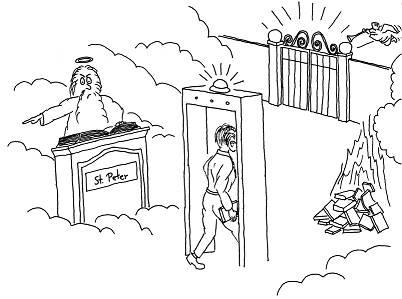
I’ve gotten a glimpse at the slides Dr. Laughlin will be using, and this Nobel laureate in physics also turns out to be something of an artist.
Join us Friday to learn what this drawing is all about.
I remark briefly on the commentary “how smart is Palin,” noting her mispronunciation of “verbiage” and “pundit.” I’d suggest that observers be wary of assessing qualifications based on this kind of thing. Example: one very well-educated person I know, whose IQ is high enough to qualify enough for Mensa, mispronounces several words because he was socially isolated for his formative years and formed the habit of saying them before he had the chance to hear others pronounce them correctly. I don’t mean he was shut in a closet, which wouldn’t be relevant as Palin clearly hasn’t been, but just that he lived in a rural area where most of his peers were relatively uneducated.
In any case, it is curious that the anxious analysis of Palin, stemming from the fact that she is relatively unknown, seems to turn on characteristics of social class rather than on information about her decision-making as an executive. What significant choices about things like taxes, education policy, resources, and so on was she faced with as governor? What did she do in those situations? Why? What were the alternatives? Many voters probably do elect candidates based on how someone talks or looks, but mightn’t it be nice for a change for the talking classes to assess a candidate on policy? Would she make a better political candidate if some professor had had a couple months to drill her on vocabulary and delivery, like the hapless flower seller Eliza whats-her-name? Continue reading →
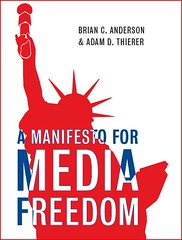 I’m pleased to announce the publication of A Manifesto for Media Freedom, which I co-authored with Brian C. Anderson of the Manhattan Institute. Brian serves as editor of Manhattan Institute’s excellent City Journal and he is the author of best-selling books like South Park Conservatives and Democratic Capitalism and Its Discontents.
In this little manifesto, we highlight one of the central ironies of the Information Age. Namely, that despite “the breathtaking abundance of new and old media outlets for obtaining news, information, and entertainment…”
many people hate this profusion, and never more than when it involves political speech. The current media market, they charge, doesn’t represent true diversity, or isn’t fair, or is subject to manipulation by a small and shrinking group of media barons. They want the government to regulate it into better shape, which just happens to be a shape that benefits them. Doing so… would be a disaster, a kind of soft or not-so-soft tyranny that would wipe out whole sectors of media, curtailing free speech and impoverishing our democracy.
In other words, instead of celebrating the unprecedented cornucopia of media choices at our collective disposal, many policymakers and media critics are calling for just as much media regulation as ever. We itemize these threats in our chapters and they include: efforts to revive the “Fairness Doctrine”, media ownership regulations, “localism” requirements, Net neutrality mandates, a la carte regulations, cable and satellite censorship, video game censorship, regulation of social networking sites, campaign finance-related speech restrictions, and so on.
In each case, we advance a pro-freedom paradigm to counter the advocates of media control. What do we mean by the “media freedom” that we advocate as the alternative to these new regulatory crusades? Here’s how we put it in the book:
Continue reading →
Apologies for the non-technology post, but since the only topics of conversation these days are Wall Street, credit default swaps, and Putin’s flights over Alaska, I thought I’d post my review of Dave Smick’s new book The World is Curved: Hidden Dangers to the Global Economy…the Mortgage Crisis Was Only the Beginning.
<div style="100%"><a href="http://www.scribd.com/doc/6320801/Not-So-Flat-After-All-Forbescom-092908-by-Bret-Swanson">"Not So Flat After All" - Forbes.com - 09.29.08 - by Bret Swanson</a> - <a href="http://www.scribd.com/upload">Upload a Document to Scribd</a></div>
If you find the title of this post provocative, you’ll be interested in a Cato Institute book forum on Friday, October 10th.
In
The Crime of Reason, Nobel laureate in physics Robert Laughlin argues that intellectual property laws and government security demands threaten the development of new knowledge. Without change, we risk bequeathing our heirs a world where knowledge is criminalized and our intellectual tradition of unfettered inquiry is lost.
The event should be a fascinating inquiry into the role of information and information rules in our society. Thomas Syndor of the Progress & Freedom Foundation will comment. I’ll be your humble moderator. It’s noon on Friday, October 10th, at the Cato Institute, 1000 Massachusetts Avenue, NW, Washington, D.C. Luncheon to follow.
You can register for the event here.
Walking around campus has given me plenty of time to listen to podcasts lately, and I wanted to recommend the best of what I’ve listened to over the last couple of weeks:
Russell Roberts and Chris Anderson: I just recently started listening to Russ Roberts’s excellent podcast, EconTalk, and so I’ve been catching up on old episodes. In this installment from May, Roberts talks to Anderson about the themes of his forthcoming book “free.” I found it particularly interesting to listen to a smart libertarian economist who doesn’t focus on the economics of information industries work through these issues.
“Hasn’t Steve Jobs learned anything in the last 30 years?” asks Farhad Manjoo of Slate in an interesting piece about “The Cell Phone Wars” currently raging between Apple’s iPhone and the Google’s new G1, Android-based phone. Manjoo wonders if whether Steve Jobs remembers what happen the last time he closed up a platform: “because Apple closed its platform, it was IBM, Dell, HP, and especially Microsoft that reaped the benefits of Apple’s innovations.” Thus, if Jobs didn’t learn his lesson, will he now with the iPhone? Manjoo continues:
Well, maybe he has—and maybe he’s betting that these days, “openness” is overrated. For one thing, an open platform is much more technically complex than a closed one. Your Windows computer crashes more often than your Mac computer because—among many other reasons—Windows has to accommodate a wider variety of hardware. Dell’s machines use different hard drives and graphics cards and memory chips than Gateway’s, and they’re both different from Lenovo’s. The Mac OS, meanwhile, has to work on just a small range of Apple’s rigorously tested internal components—which is part of the reason it can run so smoothly. And why is your PC glutted with viruses and spyware? The same openness that makes a platform attractive to legitimate developers makes it a target for illegitimate ones.
I discussed these issues in greater detail in my essay on”Apple, Openness, and the Zittrain Thesis” and in a follow-up essay about how the Apple iPhone 2.0 was cracked in mere hours. My point in these and other essays is that the whole “open vs. closed” dichotomy is greatly overplayed. Each has its benefits and drawbacks, but there is no reason we need to make a false choice between the two for the sake of “the future of the Net” or anything like that.
In fact, the hybrid world we live in — full of a wide variety of open and proprietary platforms, networks, and solutions — presents us with the best of all worlds. As I argued in my original review of Jonathan Zittrain’s book, “Hybrid solutions often make a great deal of sense. They offer creative opportunities within certain confines in an attempt to balance openness and stability.” It’s a sign of great progress that we now have different open vs. closed models that appeal to different types of users. It’s a false choice to imagine that we need to choose between these various models.
Continue reading →
 Sorry if it seems like I am beating a dead horse here, but the folks at the City Journal asked me a pen a review of Jonathan Zittrain’s new book, The Future of the Internet and How to Stop It. Faithful readers here will no doubt remember that I have already penned a review of the book and several follow-up essays. (Part 1, 2, 3, 4). I swear I am not picking on Jonathan, but his book is probably the most important technology policy book of the year–Nick Carr’s Big Switch would be a close second–and deserves attention. Specifically, I think it deserves attention because I believe that Jonathan’s provocative thesis is wildly out of touch with reality. As I state in the City Journal review of his book:
[C]ontrary to what Zittrain would have us believe, reports of the Internet’s death have been greatly exaggerated. […] Not only is the Net not dying, but there are signs that digital generativity and online openness are thriving as never before. […]
Essentially, Zittrain creates a false choice regarding the digital future we face. He doesn’t seem to believe that a hybrid future is possible or desirable. In reality, however, we can have a world full of some tethered appliances or even semi-closed networks that also includes generative gadgets and open networks. After all, millions of us love our iPhones and TiVos, but we also take full advantage of the countless other open networks and devices at our disposal. […]
Continue reading →


 The Technology Liberation Front is the tech policy blog dedicated to keeping politicians' hands off the 'net and everything else related to technology.