WASHINGTON, March 13, 2007 – The Electronic Frontier Foundation on Tuesday released a paper about the entertainment industry’s move to take copyright controls global.
The report is the result of EFF’s participation in a closed-door session of the Digital Video Broadcasting Project (DVB), the predominant global standard for digital television. (America uses a different digital standard that supports high-definition.)
EFF’s report documents the extent to which the DVB consortium has signaled its assent to copyright control technology. EFF called these a series of “unparalleled restrictions” on consumers’ rights to enjoy lawful digital content. These include “enforcing severe home recording and copying limitation,” “imposing controls on where you watch a program” and “dictating how you get to share shows with your own family,” according to EFF.
Continue reading →
WASHINGTON, March 7, 2007 – The country’s two satellite television companies have joined forces with four major technology companies and a wireless company to promote the auction of frequencies currently used by television broadcasters.
In a March 5 meeting at the Federal Communications Commission with FCC Commissioner Jonathan Adelstein, the tech companies – Google, Intel, Skype and Yahoo! – joined with Access Spectrum to promote their “Coalition for 4G in America.”
The engagement of Internet giants like Google and Yahoo!, which traditionally have not lobbied the FCC, suggests considerable interest by the technology industry in the upcoming auction, which is set to begin no later than January 28, 2008. In 2006, Congress fixed February 19, 2009, as the end-date for analog television, freeing a wide swath of radio-frequencies for use by new technologies.
Continue reading →
Arguing in favor of telecom regulation, some people say that telephone networks are owned by the public, which was forced to pay for them as captive ratepayers. The upshot is that telecom firms therefore shouldn’t be able to restrict competitors from using their wires.
As my colleague and co-blogger James Gattuso has explained in some detail, this historical analysis is deeply flawed. Today’s networks are “overwhelmingly the product of recent private investment,” concludes Gattuso.
But for those seeking more proof that private investment in building network capacity continues to be robust, today’s
Wall Street Journal covers Verizon’s hugely expensive effort to bring super-high-bandwidth fiber into the home.
Continue reading →
Nobody expected the net neutrality debate to die down with the installation of a Democratic majority in Congress, but even now, few realize that it will flare so powerfully as it is likely to do later this year.
A new IPTV service from the developers of Skype and the filesharing service Kazaa is set to force the issue. Joost is a peer-to-peer-based television-over-IP system that streams (relatively) high-quality video to users’ computers over their Internet connections. This eats up a lot of bandwidth: 320 MB in downloads and 105 MB in uploads per hour, according to the developers. They also note that “the application continues to run in the background after you close the main window,” presumably to help Joost’s developers save a bit on bandwidth costs by piggybacking on their users’ broadband connections. Running full-time, that amounts to about 225 GB downstream and 75 GB upstream per month, far more bandwidth than the average broadband user consumes today.
Continue reading →
Sunday’s Washington Post featured a story entitled, “Cable War Fails to Offer Rate Relief in Montgomery.” The gist of the story is that Comcast, the incumbent cable provider in Montgomery County, Maryland, is raising rates by 4 percent and residents are distraught that the much vaunted competition from Verizon has done nothing to curb prices.
So much for the idea that “competition will bring down rates,” said Montgomery County Council President Marilyn Praisner (D-Eastern County), who has long clashed with the industry over regulation. “That clearly hasn’t happened.”
David Isenberg links to the story under the headline “Benefits of Competition my Ass” and asks, “Are you listening Kevin Martin?”
You would think Verizon has been providing service in the country for years and has settled into a cozy duopoly with Comcast. So when did Verizon get permission from the county to start competing with Comcast? November 28, 2006. That’s right folks, less than three months ago.
As the
Post story notes, Comcast serves 200,000 households to Verizon’s 1,000. However, it will build out to most homes in four years. The story also notes–albeit in paragraph 14–competition on margins other than price: “Comcast, for instance, has improved its Internet speeds four times over the past three years without increasing its prices.”
Tim Wu will be presenting his paper “Wireless Net Neutrality” at an FTC workshop on network access tomorrow on Wednesday. (BTW: The workshop is free and open to the public.) Basically he’s arguing for Carterfone to be applied to the cell phone industry. The Washington Post has a write-up of the ideas behind the paper and reaction from both sides of the debate.
Until federal regulators issued a landmark ruling in 1968, Americans could not own the telephones in their homes, nor attach answering machines or other devices to them. Now, a growing number of academics and consumer activists say it’s time to deliver a similar groundbreaking jolt to the cellphone industry, possibly triggering a new round of customer options and technical innovations to rival the one that produced faxes, modems and the Internet.
Wireless carriers, which limit what customers may do with their phones, say the move is unnecessary and potentially harmful. But in articles, blogs and speeches, a number of researchers are asking why the companies are allowed to force consumers to buy new handsets when they change carriers, pay a specified carrier to transfer photos from a camera phone, or download ring tones or music from one provider only.
Carterfone was a great decision when it applied to Ma Bell, the quintessential monopoly, and wouldn’t compute for today’s wireless carriers. True, cell phones are locked (except when they’re not, as the article points out, because carriers will often unlock them for you when your contract expires). The one thing the article doesn’t mention is that cell phones are also subsidized. You can always buy an unlocked phone for a premium. I would love to see a greater market in unlocked phones, but if there’s no demand from consumers, I’ll just have to wait along with the proponents of regulation. Question: Unlocked phones are the norm in Asia and Europe. How are they priced there? How do service plan prices compare to U.S.?
Time for a quick reality check. The Federal Communications Commission regulates older media sectors and communications technologies: broadcast radio, broadcast TV, telephones, satellites, etc. These sectors and technologies are growing increasingly competitive and face myriad new, unregulated rivals. What, then, is wrong with this picture?
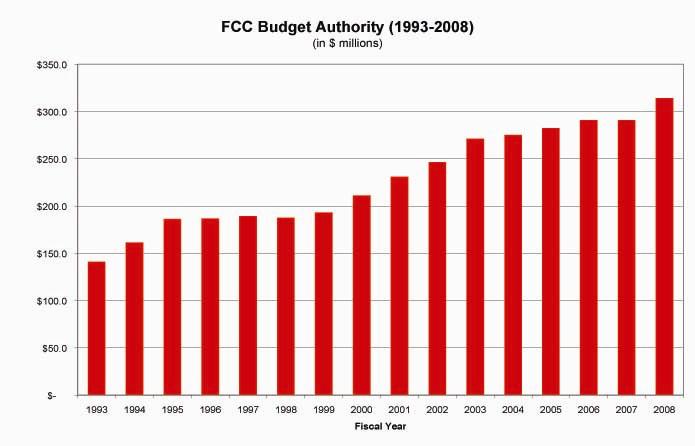
Seriously, I just don’t get it. Why does the FCC’s budget keep growing without constraint? Why does it need $313 million and nearly 2,000 bureaucrats to regulate industries and technologies that could do just fine, thank you very much, without endless meddling from DC. It seems to me like all those unregulated rivals are doing just fine without the FCC serving as market nanny, so why not cut the flow of funds to the FCC for awhile and see what happens?
This agency needs to be put on a serious diet. There’s just no excuse for this level of spending in an era when the market is growing more competitive. Check out the entire FCC 2008 budget here if you are interested in their profligate spending habits.
(And just imagine how much more the agency will be spending once Net neutrality regulations get on the books!)
WASHINGTON, January 23, 2007–Those who would “Save the Internet” came to Memphis last week and declared victory in their struggle. They also hosted a party to celebrate and launch the next phase of the battle: going on the offensive.
The SavetheInternet.com Coalition is, of course, David to the Bell companies’ Goliath. Over the last two years AT&T, Verizon Communications and their trade group the United States Telecom Association spent more than $50 million lobbying Congress to change the nation’s telecommunications laws, according to disclosure documents. But it was spent in vain. The Bell-favored bill, which had overwhelmingly passed the House, died last year in the Senate.
In contrast, SavetheInternet.com spent $250,000 on educating the public about its side of the story, said coalition spokesman Craig Aaron. “Save the Internet” opposed the Bell bill, and made “Net Neutrality” its rallying cry. The coalition gathered more than 1.5 million petition signatures supporting the notion that telecom companies must be stopped from controlling the content that flows over their broadband networks
Continue reading →
I found this post, from our friends over at Public Knowledge, rather puzzling. Art Brodsky thinks that the FCC’s decision to mandate that local franchise authorities approve franchise requests within 90 days “won’t help consumers.” But after reading his post twice, his argument strikes me as underwhelming. He acknowledges that…
There’s general agreement in principle that competition can benefit consumers. In the rare examples so far of competition in video, the over-priced cable services have had to lower their rates to compete with telephone company entrants. A cynic might say that over time, as telephone companies enter the market, that a nice, comfy duopoly will settle in and price decreases will moderate. For now, the idea of cable having some serious competition is good.
So what’s the problem? He notes that the FCC may have exceeded its authority, which is an important point but hardly evidence that the proposal is harmful to consumers. The real meat of his objection seems to be that…
Continue reading →


 The Technology Liberation Front is the tech policy blog dedicated to keeping politicians' hands off the 'net and everything else related to technology.