
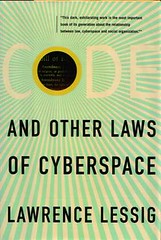
The Cato Unbound online debate about the 10th anniversary of Lawrence Lessig’s Code and Other Laws of Cyberspace continues today with my response to Declan McCullagh’s opening essay, “What Larry Didn’t Get,” as well as Jonathan Zittrain’s follow-up.
In my response, “Code, Pessimism, and the Illusion of ‘Perfect Control,'” I begin by arguing that:
The problem with peddling tales of a pending techno-apocalypse is that, at some point, you may have to account for your prophecies — or false prophecies as the case may be. Hence, the problem for Lawrence Lessig ten years after the publication of his seminal book, Code and Other Laws of Cyberspace.
I go on to argue that:
Lessig’s lugubrious predictions proved largely unwarranted. Code has not become the great regulator of markets or enslaver of man; it has been a liberator of both. Indeed, the story of the past digital decade has been the exact opposite of the one Lessig envisioned in Code.
After providing several examples of just how wrong Lessig’s predictions were, I then ask:
[W]hy have Lessig’s predictions proven so off the mark? Lessig failed to appreciate that markets are evolutionary and dynamic, and when those markets are built upon code, the pace and nature of change becomes unrelenting and utterly unpredictable. With the exception of some of the problems identified above, a largely unfettered cyberspace has left digital denizens better off in terms of the information they can access as well as the goods and services from which they can choose. Oh, and did I mention it’s all pretty much free-of-charge? Say what you want about our cyber-existence, but you can’t argue with the price!




 The Technology Liberation Front is the tech policy blog dedicated to keeping politicians' hands off the 'net and everything else related to technology.