Broadband & Neutrality Regulation

After gaining final approval to rollout FiOS in New York City a few weeks ago, Verizon has come to a preliminary agreement with the District of Columbia to deploy FiOS television service in the nation’s capital. This long-awaited announcement follows nearly a year of negotiation between Verizon and D.C. franchising authorities.

Thanks to its especially onerous franchising regime, the District of Columbia has lagged behind surrounding areas in fiber-optic connectivity. Neighboring communities such as Arlington, Fairfax, and Bethesda have had FiOS for years, and D.C.’s lack of fiber-optic service has long been a sore spot for the city.

D.C. residents can’t celebrate just yet, though. Verizon must overcome one more regulatory hurdle before starting to dig up the streets. The franchise agreement must receive a green-light from both the D.C. city council and the Attorney General. If the New York City episode is any indication, getting politicians to acquiesce will involve expensive demands and forced concessions, resulting in higher prices for everyone.

Continue reading →

Portland’s muni wi-fi experiment has failed. [Add it to the list of failures]. According to Broadband Reports, taxpayers are going to be on the line for $60K:

Portland had high hopes of being one of those cities where citywide wireless networks might actually work but those hopes did not pan out. Earlier this summer, Wi-Fi provider MetroFi announced that the company could not afford to continue operating the network there. Attempts to sell it off failed and the network was shut down. That’s not the end of the story, though. In order to launch the network, MetroFi had to set up 600 (arguably unsightly) antennas throughout the city. The company had claimed that these antennas would be removed by the end of July but they remain up; MetroFi says that they still plan to follow through on removing them but city staff members report fears that the company is too strapped for cash to keep their end of this bargain. Estimates for removal are around $90,000; subtracting out a $30,000 bond for removal that was part of the MetroFi contract would still mean that Portland’s taxpayers could pay up to $60,000 to get those antennas taken down.

There’s been a fair amount of chatter on this blog (here, here, and here) about how to properly view the FCC’s recent Comcast decision. My take is that while everyone is focused on questions of market failure, we are in the midst of a huge government failure. Read my full explanation here.

A recent post to Dave Farber’s [IP] list:

WASHINGTON, August 8 – I’d like to take a moment to respond to some of the issues raised by the recent e-mail of Brett Glass.

With respect to the issue data confidentiality, it’s important to separate out several issues here:

(1) The names of carriers and the locations in which they offer services, by ZIP code.

(2) The number of subscribers that carriers have in a particular ZIP code.

The Form 477 of the Federal Communications Commission requires carriers to submit both types of information to the FCC.

I agree that category (2) may well be confidential information. I do not think that category (1) can be considered confidential.

The web site that I run, http://BroadbandCensus.com, is an attempt to combine information about broadband from various sources. In addition to “crowdsourcing” data from internet users, we are combining public information from the FCC’s Form 477, publicly available information about carriers and where they offer services, as well as from states and localities. Since we launched BroadbandCensus.com in January 2008, We have had thousands of internet users tell us the names of their providers, where those providers are offering service, and they’ve taken our beta speed test.

It is important to note that Form 477 data released by the FCC does not include the names of the carriers. The FCC recently ordered carriers to begin to provide information on the census tract level (a unit slightly smaller than a ZIP code). However, unless the FCC changes its policy, consumers will still not be able to obtain carrier information from the agency.

Hence, the data we have from the FCC is extremely limited.

Continue reading →

On this week’s show, we discuss the implications of the FCC’s controversial recent ruling against Comcast in the BitTorrent controversy. This is a topic we have covered previously on our podcast in episodes 34 and 35, and have been writing extensively about on the Tech Liberation Front blog over the last few days. In its decision last Friday, the FCC held that Comcast had engaged in unreasonable network management practices when it delayed access to BitTorrent traffic. Even though BitTorrent Inc. and Comcast have already settled their dispute and indeed are now working collaboratively together on solutions to these issues, FCC Chairman Kevin Martin said that legal action was necessary because others had complained about the practice.

On today’s show we focus on the implications of the FCC’s decision and what it means for the future of net neutrality regulation and communications policy more generally. Joining us for this week’s show are TLF regular contributors Jerry Brito of the Mercatus Center at George Mason University, Hance Haney of the Discovery Institute, Tim Lee of the Cato Institute, Jim Harper of the Cato Institute, James Gattuso of the Heritage Foundation, and Adam Thierer of the Progress & Freedom Foundation who moderates the discussion.

We’re having a little problem with our podcasting plugin, so here’s a temporary way for you to listen. You can download the MP3 here, or use the online player below.

The FCC last Friday may have jumped with both feet into the business of regulating the Internet, but someone forgot to tell the folks that run the Commission’s website.   “The FCC Does Not Regulate the Internet or Internet Service Providers (ISP)” the “consumer publications” page of FCC.gov is still proudly telling visitors, referring them over to their state consumer protection office or to the Federal Trade Commission as the proper agencies for such things.

In the past, I’ve been critical of the shambolic way in which the FCC’s website is run.  But in this case, the problem isn’t with the web folks – they have the policy exactly right.  It’s the FCC, not FCC.gov, that’s bungled the job.

Someone at the Commission will eventually tell the website folks to fix the error.  But who will get the Commissioners to fix theirs?

An ex parte letter submitted to the FCC in the Comcast Kerfuffle – subject of strong criticism by TLF-friend and friendly sparring partner Harold Feld – got me thinking on another level about the FCC’s recent action against Comcast.

Among the accusations against Comcast is that it throttled a P2P conduit for movies because it’s also in the busines of delivering movies. The letter points out that colleges and universities, which have no similar interests, do the same things or take far blunter actions against P2P. It’s not a bad point, and it helps dispell the idea that Comcast was doing anything other than trying to provide good Internet service to the bulk of its customers.

Now, given that the letter summarizes the practices of many top universities, it throws in a provocative line: “If there is to be regulation, therefore, it must apply equally to all providers.” This suggests that the same regulation must apply to universities, which got Harold, Ars Technica, and a few others foaming.

The point of the letter was that network managers who don’t sell video services also degrade P2P. Point made. And from what I’ve seen of the reaction: point conceded. Comcast’s network management wasn’t motivated by an anti-competitive impulse.

But still, Feld seemed to argue, Comcast doesn’t get to do that because . . . it’s Comcast. Or something. It’s this blindness to a real legal justification or a real distinction between Comcast and other Internet service providers that I think has him walking hand-in-hand with the FCC into the NCTA’s trap.

The paragraph prior to the provocative line suggesting regulation of universities contains this sentence: “Allowing some Internet service providers to manage P2P traffic – much less to engage in complete blocking of P2P traffic – while prohibiting others from doing so would be arbitrary and capricious.” This is an administrative-law term of art – “arbitrary and capricious.” The use of it tells us that NCTA or Comcast will challenge the FCC’s decision to regulate only one provider of Internet access without regulating all similarly situated.

But Comcast is under a different regulatory regime!, says Harold and the others. Not in an enforcement of this “broad policy statement” thing-y. The FCC is claming free rein to regulate – not authority based firmly in statute – and if it can throw that rein over cable ISPs, it can throw that rein over universities, over Starbucks, and over the open wi-fi node in Harold’s house.

Now, given the free rein that the FCC is asserting, there is a darn good argument that it’s arbitrary (and “capricious”) to regulate only cable ISPs or commercial ISPs in this way. The FCC has to regulate the whole damn Internet this way if it’s going to regulate Comcast.

Is it the best argument ever? Nope. But it’s good enough for what FCC Chairman Kevin Martin wants to do.

Wait. What Kevin Martin wants to do? No, Jim, it’s the NCTA that’s setting the trap.

Au contraire, my inner voice. It’s Kevin Martin. He’s crafty.

By instituting this weird, weak, and barely legal regulation, Kevin Martin will get ‘net neutrality regulation bottled up in the courts for – what – the next five years? By that time, there’s a decent chance of there being more competition among ISPs. Projects like Broadband Census and NNSquad may have changed the product and market landscape. The political landscape will have shifted in exciting new ways. And when the FCC loses in the D.C. Circuit (yet again), the issue returns to a Congress where advocates of Internet regulation have moved to new issues and gotten rusty on net neutrality regulation. It’ll be another three or four years after the FCC loses before their net neutrality regulation efforts can get a head of steam.

So, has Kevin Martin deftly disposed of the ‘net neutrality issue for the next decade? My theory is plausible, though I know some would dispute it. Adam Thierer would undoubtedly call it “absurd” – but he puts that adjective on just about everything.

Net neutrality regulation wasn’t even close to getting through Congress, Adam argued to me recently, and Martin is motivated by his hatred of Comcast and the cable industry, along with his political aspirations. The former point is the strongest, but it’s a matter of perception. What I know of Chairman Martin is not a wild-eyed zealot or a hater, but a planner and careful thinker. Regulating Comcast doesn’t really redound to his political benefit in any meaningful way, and his political aspirations are doomed if he thinks it does.

So that’s my theory, and I’m stickin’ to it: Kevin Martin has set back net neutrality regulaton by a decade – by letting the camel’s nose under the tent.

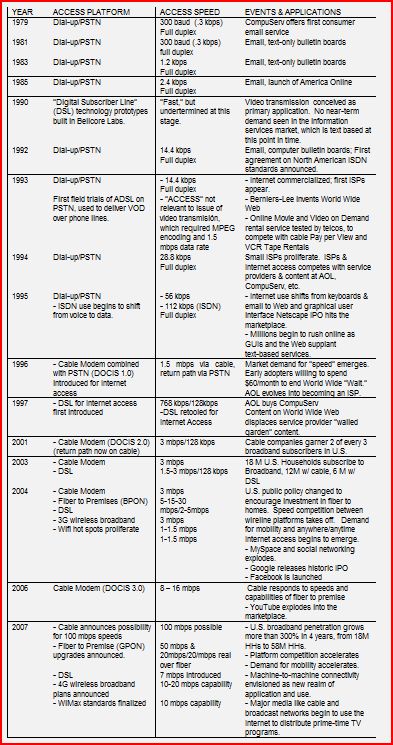
Very useful chart over on the Verizon policy blog put together by Link Hoewing and Larry Plumb. Link uses it illustrate the changes we have seen over the past three decades in terms of Internet access platforms and speeds. It’s too small to read here, so make sure to go there to see it more clearly and also see Link’s interesting discussion.

access platforms and speeds over 3 decades

Google’s Chief Internet Evangelist Vint Cerf, one of the fathers of the Net, has a very thoughtful post up on the Google Public Policy Blog today asking “What’s a Reasonable Approach for Managing Broadband Networks?” He runs through a variety of theoretical approaches to network load management. There’s much there to ponder, but I just wanted to comment briefly on the very last thing he says in the piece:

Over the past few months, I have been talking with engineers at Comcast about some of these network management issues. I’ve been pleased so far with the tone and substance of these conversations, which have helped me to better understand the underlying motivation and rationale for the network management decisions facing Comcast, and the unique characteristics of cable broadband architecture. And as we said a few weeks ago, their commitment to a protocol-agnostic approach to network management is a step in the right direction.

I found this of great interest because for the last few months I have been wondering: (a) why isn’t there more of that sort of inter- and intra-industry dialogue going on, and (b) what could be done to encourage more of it? With the exception of those folks at the extreme fringe of the Net neutrality movement, most rational people involved in this debate accept the fact that there will be legitimate network management issues that industry must deal with from time to time. So, how can we get people in industry — from all quarters of it — to sit down at a negotiating table and hammer things out voluntarily before calling in the regulators to impose ham-handed, inflexible solutions? What we are talking about here is the need for a technical dispute resolution process that doesn’t involve the FCC. Continue reading →

WASHINGTON, August 1 – The Federal Communication Commission’s enforcement action against Comcast can be seen either as a limited response to a company’s deceptive practices, or a sweeping new venture by the agency into regulating internet policy.

In ruling against Comcast on Friday, the agency ordered the company to “disclose the details of its discriminatory network management practices,” “submit a compliance plan” to end those practices by year-end, and “disclose to customers and the [FCC] the network management practices that will replace current practices.”

At issue in the decision was whether Comcast had engaged in “reasonable network management” practices when it delayed and effetively blocked access to users of BitTorrent, a peer-to-peer software program.

Although BitTorrent had already settled its complaints with Comcast, FCC Chairman Kevin Martin said that FCC action was necessary because the complaint had been brought by Free Press and Public Knowledge, two non-profit groups. The FCC did not impose a fine.

Martin said that he viewed the agency’s decision to punish the cable operator as a quasi-judicial matter: a “fact-intensive inquiry” against a specific company that it found to have “selectively block[ed]” peer-to-peer traffic.

[Continue reading “FCC Hammers Comcast For Deception and Unreasonable Internet Management“]