
Articles by Jerry Brito

Jerry is a senior research fellow at the Mercatus Center at George Mason University, and director of its Technology Policy Program. He also serves as adjunct professor of law at GMU. His web site is jerrybrito.com.


Yesterday the FBI effectively shut down three of the largest gambling sites online and indicted their executives. From a tech policy perspective, these events highlight how central intermediary control is to the regulation of the internet.

Department of Justice lawyers were able to take down the sites using the same tools we’ve seen DHS use against alleged pirate and child porn sites: they seize the domain names. Because the sites are hosted overseas (where online gambling is legal), the feds can’t physically shut down the servers, so they do the next best thing. They get a seizure warrant for the domain names that point to the servers and force the domain name registrars to point them instead to a government IP address, such as 50.17.223.71. The most popular TLDs, including .com, .net, .org, and .info, have registrars that are American companies within U.S. jurisdiction.

Another intermediary point of control for the federal government are payment processors. The indictments revealed yesterday relate to violations of the Unlawful Internet Gambling Enforcement Act, which makes it illegal for banks and processors like Visa, MasterCard and PayPal to let consenting adults use their money to gamble online. According to the DOJ, in order to let them bet, the poker sites “arranged for the money received from U.S. gamblers to be disguised as payments to hundreds of non-existent online merchants purporting to sell merchandise such as jewelry and golf balls.” (PDF)

Now, imagine if there were no intermediaries.

In my TIME.com Techland column today, I write about Bitcoin, a completely decentralized and anonymous virtual currency that I think will be revolutionary.

Because Bitcoin is an open-source project, and because the database exists only in the distributed peer-to-peer network created by its users, there is no Bitcoin company to raid, subpoena or shut down. Even if the Bitcoin.org site were taken offline and the Sourceforge project removed, the currency would be unaffected. Like BitTorrent, taking down any of the individual computers that make up the peer-to-peer system would have little effect on the rest of the network. And because the currency is truly anonymous, there are no identities to trace.

And if a P2P currency can make it so that there is no fiscal intermediary to regulate, how about a distributed DNS system so that there are no registrars to coerce? This is something Peter Sunde of Pirate Bay fame has been working on. These ideas may sound radical and far-fetched, but if we truly want to see an online regime of “denationalized liberalism,” as Milton Mueller puts it, then getting rid of the intermediaries in the net’s infrastructure might be the best path forward.

Again, check out my piece in TIME for a thorough explanation of Bitcoin and its implications. I plan to be writing about it a lot more and devote some of my research time to it.

On this week’s podcast, Rob Carlson, principal at Biodesic, an engineering, consulting, and design firm in Seattle, and author of the book, Biology is Technology: the promise, peril, and new business of engineering life, discusses his book. Carlson explains what he means by “biology is technology” and gives a few examples of how humans have been using biology as technology for thousands of years. He then discusses a few modern biotechnology applications, like antibiotics, biologics, genetically modified organisms, fuels, and plastics. Carlson also talks about why more biotech garage innovators are needed, what the industry might be able to learn from open source software and hardware, and how legal and regulatory barriers to innovation in biotechnology might be minimized.

Related Links

To keep the conversation around this episode in one place, we’d like to ask you to comment at the web page for this episode on Surprisingly Free. Also, why not subscribe to the podcast on iTunes?

On the podcast this week, Kevin Poulsen, a senior editor at Wired News, former hacker, and author of Kingpin: How One Hacker Took Over the Billion-Dollar Cybercrime Underground, discusses his new book. Poulsen first talks about how he became interested in hacking and why he was eventually sent to prison for it. He then discusses his book, a true crime account of Max Butler, a white hat hacker turned black hat who went from security innovator to for-profit cyber criminal to hacker of other hackers, eventually taking over the cyber crime underground. Poulsen finally comments on cyber security policy, noting that while many security vulnerabilities exist today, he suspects that legislation is not the answer.

Related Links

To keep the conversation around this episode in one place, we’d like to ask you to comment at the web page for this episode on Surprisingly Free. Also, why not subscribe to the podcast on iTunes?

On the podcast this week, Mark Stevenson, writer, comedian, and author of the new book An Optimist’s Tour of the Future: One Curious Man Sets Out to Answer “What’s Next?”, discusses his book. Stevenson calls An Optimist’s Tour of the Future a travelogue about science written for non-scientists, and he talks about why he traveled the world to try to draw conclusions about where human innovation is headed. He discusses his investigation of nanotechnology and the industrial revolution 2.0, transhumanism, information and communication technologies, and the ultimate frontier: space. Stevenson also discusses why he’s hopeful about the future and why he wants to encourage others to have optimism about the future.

Related Readings

To keep the conversation around this episode in one place, we’d like to ask you to comment at the web page for this episode on Surprisingly Free. Also, why not subscribe to the podcast on iTunes?

On this week’s podcast, Patri Friedman, executive director and chairman of the board of The Seasteading Institute, discusses seasteading. Friedman discusses how and why his organization works to enable floating ocean cities that will allow people to test new ideas for government. He talks about advantages of starting new systems of governments in lieu of trying to change existing ones, comparing seasteading to tech start-ups that are ideally positioned to challenge entrenched companies. Friedman also suggests when such experimental communities might become viable and talks about a few inspirations behind his “vision of multiple floating Hong Kongs”: intentional communities, Burning Man, and Ephemerisle.

Related Links

To keep the conversation around this episode in one place, we’d like to ask you to comment at the web page for this episode on Surprisingly Free. Also, why not subscribe to the podcast on iTunes?

Many folks will no doubt be writing a lot about the competitive issues surrounding the announced AT&T/T-Mobile merger, so instead I thought I’d weigh in on what I know best: spectrum.

To the extent you’re worried about the concentration of the wireless market, you should really be concerned about the government policies that make entry and expansion so difficult.

First, if a carrier wants to acquire more spectrum to meet consumer demand for new services, it can’t thanks to the artificial scarcity created by federal policies that dedicate vast swaths of the most valuable spectrum to broadcast television and likely inefficient government uses. It’s gratifying to see the FCC now confronting the “spectrum crunch,” but waiting for a deal to be brokered on incentive auctions is a luxury carriers don’t have. So, buying a competitor might be the only way left for them to acquire more spectrum.

Second, if a carrier wants to put up a new tower, or add antennas to existing towers, it has to get permission from the local zoning board. This can be an extremely onerous process as different localities will have different reasons to hold up the process. Buying a competitor is therefore also an obvious way to get access to more towers.

Again, I’m not sure this merger will have a negative effect on competition. Many high sunk costs industries are perfectly competitive with just two or three players. (I’m look forward to a good analysis on that question, perhaps from our own Geoff Manne of Josh Wright.) What I do know is that if you are worried about competition, antitrust policy is not going to solve the long-term issue of artificial scarcity, which is the real problem here.

Entry is possible. In fact, a new entrant in the wireless market is waiting in the wings in the form of the cable industry with the spectrum they acquired in the AWS auction. Before they can start offering services, however, they must move incumbent users of the bands they acquired. There is also Clearwire, part owned by Comcast, Time Warner, and Google–serious competitors to the Bells.

If we really got serious about reallocating broadcast and inefficiently used federal spectrum, we might not have to worry competition. We’d likely see new entry, and access to spectrum would be less of a reason to acquire a competitor.

One of the arguments I’ve been making about proposed cybersecurity regulation and legislation is that despite a lot of hype about a massive online threat, there is little evidence to corroborate the dire warnings. Almost every article I’ve read revealing a breach or cyberattack only quotes anonymous government sources, then defense contractors and politicians point to these articles and proclaim, “If you only knew what we know, you’d be taking action now!”

Fear, however, is poor driver of public policy. Before we start telling private companies how to run their security, we should analyze the threat and asses whether there is a legitimate concern and whether government could do a better job. That’s impossible as long as most evidence of a threat is classified.

So I’m glad to see former NSA and CIA chief Gen. Michael Hayden call for less secrecy in order to get better analysis. In the new issue of Startegic Studies Quartley, he writes [PDF]:

Let me be clear: This stuff is overprotected. It is far easier to learn about physical threats from US government agencies than to learn about cyber threats. In the popular culture, the availability of 10,000 applications for my smart phone is viewed as an unalloyed good. It is not—since each represents a potential vulnerability. But if we want to shift the popular culture, we need a broader flow of information to corporations and individuals to educate them on the threat. To do that we need to recalibrate what is truly secret. Our most pressing need is clear policy, formed by shared consensus, shaped by informed discussion, and created by a common body of knowledge. With no common knowledge, no meaningful discussion, and no consensus . . . the policy vacuum continues. This will not be easy, and in the wake of WikiLeaks it will require courage; but, it is essential and should itself be the subject of intense discussion. Who will step up to lead?

Who indeed. Congress may be getting secret briefings that outline a potential cyberthreat. If they are, they should recognize that they may be only getting one view of the issue. Also, the people on whose behalf they are legislating also deserve to have a clear understanding of the risks against which Congress might legislate. “Trust us,” is not good enough. By reducing the over-classification Hayden writes about, Congress could allow economists, computer scientists, and other academics delve into the weeds of determine what is the true nature of the threat and whether a market failure exists that calls for government intervention.

Over at Neighborhood Effects, the Mercatus Center’s state and local policy blog, my colleague Dan Rothschild compares wireless taxes to sin taxes. His analysis is too good not to reprint here in large part:

The purpose of taxes is to raise money for necessary governmental functions. To that end, economists frequently prescribe that rates be low and broad in order to minimize the impact on consumers’ behavior — so-called tax neutrality. This is because taxation should be about raising revenue, not changing behavior. Some economists tweak this prescription through the Ramsey Rule, which holds (in a nutshell) that the more influenced by tax rates consumers are (demand elasticity) the less something should be taxed (and vice versa). Sin taxes are the opposite; they’re about reducing a behavior that policy makers judge to be morally offensive (like many people view smoking). Relatedly, Pigouvian taxes seek to bring the costs to society (the social cost) in line with the costs born by a buyer. (For instance, some people advocate higher alcohol taxes on the theory that drinkers impose costs on others, though this argument is fraught with difficulties.) Cell phone taxes above regular sales taxes levied by states and localities do not fit any of the four rationales provided here. On the one hand, taxing them at over twenty percent of a user’s bill is hardly neutral. Nor does it likely fit the Ramsey Rule prescription; consumers respond to cell phone taxes by buying less of it or by avoiding taxes by pretending to move. (Just look around you at how consumer takeup and use of cell phones has changed as prices have fallen over the last decade.) Cell phones are not sinful or offensive. And there’s no serious case to be made that the social cost of cell phones exceeds the cost born by users. In short, by any principle of public finance, high cell phone taxes are a bad bad bad idea.

Now here’s hoping he takes this awesome analysis and turns it into a paper!

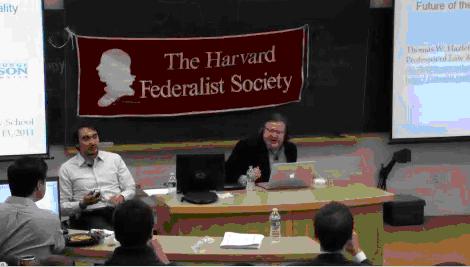
With all the attention on net neutrality this week, I thought I’d bring your attention to a debate on the-issue-that-won’t-go-away between Tom Hazlett and Tim Wu, which took place earlier this year at Harvard Univerisity. Below is the MP3 audio of the event, but if you want to check it out in living color, check out the video at the Information Economy Project wabsite.

Hazlett vs. Wu Net Neutrality Debate – Jan. 2011

On the podcast this week, Siva Vaidhyanathan, professor of media studies at the University of Virginia, discusses his new book, The Googlization of Everything: (And Why We Should Worry). Vaidhyanathan talks about why he thinks many people have “blind faith” in Google, why we should worry about it, and why he doesn’t think it’s likely that a genuine Google competitor will emerge. He also discusses potential roles of government, calling search neutrality a “nonstarter,” but proposing the idea of a commission to monitor online search. He also talks about a “Human Knowledge Project,” an idea for a global digital library, and why a potential monopoly on information by such a project doesn’t worry him the way that Google does.

Related Links

To keep the conversation around this episode in one place, we’d like to ask you to comment at the web page for this episode on Surprisingly Free. Also, why not subscribe to the podcast on iTunes?