Articles by Adam Thierer 
 Senior Fellow in Technology & Innovation at the R Street Institute in Washington, DC. Formerly a senior research fellow at the Mercatus Center at George Mason University, President of the Progress & Freedom Foundation, Director of Telecommunications Studies at the Cato Institute, and a Fellow in Economic Policy at the Heritage Foundation.
 My latest weekly Forbes column (“The Twilight of Copyright?”) considers the future of copyright law and the controversy generated by “Stop Online Piracy Act” (SOPA). [See Ryan Radia’s mega-post for all the details on the SOPA fight.] After co-editing a big book on copyright law with Wayne Crews nine years ago (Copy Fights: The Future of Intellectural Property in the Information Age, Cato Institute, 2002), I decided to stop covering copyright policy altogether. Any attempt to try to find balance in this debate is pretty much futile, and I also got tired of losing friends over the issue. (Nothing starts a good catfight among libertarians like copyright policy.)
I don’t plan to jump back in the fight in a big way, but I felt compelled to say something about SOPA since it represents one of the most sweeping attempts at Internet regulation ever conceived. As much as I detest the culture of free-riding that exists online today, I think extreme solutions like SOPA are never justified. And I’m not even sure it would work in practice. In my
Forbes essay, I wonder aloud about what’s left to try. I lay out three options: (1) Do nothing: Leave the shell of copyright law in place and hope for best; (2) Massive vertical integration: Let conduit guys buy out content owners and let them figure out how to pay content creators; (3) Blanket online compulsory license: Force everyone to pay an embedded fee on broadband or devices to cross-subsidize content.
In the end, I argue that all three solutions have serious drawbacks but, sadly, I don’t really have any fresh ideas to offer. Anyway, read the whole thing if you’re interested in the topic. I think I’m done with it for another decade.
Listening to this morning’s House Judiciary Committee hearing on H.R. 3261, the “Stop Online Piracy Act” (SOPA) was painful for many reasons, including the fact that the first hour of the Committee’s video stream was practically inaudible and unwatchable. That led to a barrage of snarky jokes on Twitter about whether we should trust these same folks to regulate the Internet in the way SOPA envisions if they can’t even get their own tech act together.
The snark-casm went into overdrive, however, once the lawmakers starting discussing DNS issues and the underlying architectural concerns raised by SOPA’s sweeping solution to the problem of online piracy. At that point, the techno-ignorance of Congress was on full display. Member after member admitted that they really didn’t have any idea what impact SOPA’s regulatory provisions would have on the DNS, online security, or much of anything else. This led to some terrifically entertaining commentary from the Twittersphere, including the two below.
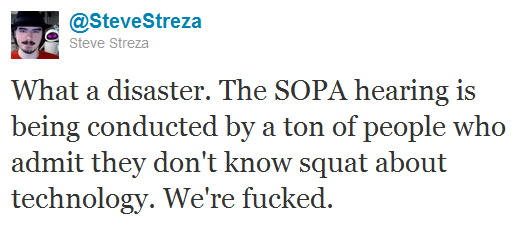
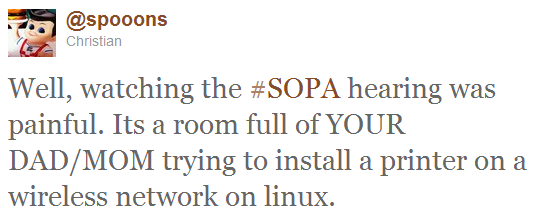 Continue reading →
On Friday, both Josh Wright and I spoke on a panel at the Michigan State University’s conference on “Governance of Social Media.” Our particular panel focused on emerging competition policy issues affecting social media and social networking sites. Also joining us on the panel were Nicolas Economides of NYU and Michael Altschul of the CTIA. The video of the panel can be found here and I have also embedded it down below. [My remarks begin around the 23-min mark of the video.]
At the event, I presented my forthcoming paper on “The Perils of Classifying Social Media Platforms as Public Utilities,” which is currently out for peer review. I outlined the rising calls for treating social media or social networking sites as public utilities, essential facilities, or natural monopolies. Next, I briefly discussed some basic law and economics of public utility / essential facilities regulation. Third, I detailed six specific problems with efforts to classify these services as such. Finally, I briefly discussed regulatory proposals set forth by Professors Jonathan Zittrain and Tim Wu to apply traditional antitrust or public utility remedies to social media or information platforms. Specifically, I address Zittrain’s call for “API neutrality” (which would apply net neutrality-like principles at the applications and device layer) and Wu’s call for a “Separations Principle” (which would forcibly segregate information providers into three buckets: creators, distributors, and hardware makers). Watch the video for more details and see this for more critiques of the Zittrain and Wu proposals.
It was my pleasure this week to host a terrific panel discussion about the future of broadband policy and FCC reform featuring Raymond Gifford, a Partner at the law firm of Wilkinson Barker Knauer, LLP, Jeffrey Eisenach, a Managing Director and Principal at Navigant Economics and an Adjunct Professor at George Mason University Law School, and Howard Shelanski, Professor of Law at Georgetown Law School who previously served as Chief Economist for the Federal Communications Commission and as a Senior Economist for the President’s Council of Economic Advisers at the White House. We discussed two new papers by Gifford and Eisenach on these issues.
Continue reading →
This week I will again be attending the Family Online Safety Institute’s excellent annual summit. The 2-day affair brings together some of the world’s leading experts on online safety and privacy issues. It’s a great chance to learn about major developments in the field. As I was preparing for the session I am moderating on Thursday, I thought back to the first FOSI annual conference, which took place back in 2007. What is remarkable about that period compared to now is that there was a flurry of legislative and regulatory activity related to online child safety then that we simply do not see today.
In fact, just 3 1/2 years ago, John Morris of the Center for Democracy and Technology and I compile a legislative index [summary here] that cataloged the more than 30 legislative proposals that had been introduced in the the 110th session of Congress. There was also a great deal of interest in these issues within the regulatory community. Finally, countless state and local measures related to online safety and speech issues had been floated. Today, by contrast, it is hard for me to find any legislative measures focused on online safety regulation at the federal level, and I don’t see much activity at the agency level either. I haven’t surveyed state and local activity, but it seems like it has also died down.
Generally speaking, I think this is a good development since I am opposed to most proposals to regulate online speech, expression, or conduct. But let’s ignore the particular wisdom of such measures and ask a simple question:
What explains the decline in Internet safety legislation and online content regulation? I believe there are three possible explanations: Continue reading →
On Wednesday, November 9th, the Mercatus Center will be hosting an event on “A New Framework for Broadband and the FCC.” It will take place at the Reserve Officers Association from 10:00am – 11:30am. At the event, telecom experts Raymond Gifford, Jeffrey Eisenach, and Howard Shelanski that will examine if a new framework might be needed for broadband policy and the possibility of reforming the Federal Communications Commission. Both Eisenach and Gifford will be presenting new papers at the event and Shelanski will be offering commentary. RSVP here to hold a seat. Complete event summary follows. Continue reading →
I highly recommend this important new study on “Why Parents Help Their Children Lie to Facebook about Age: Unintended Consequences of the Children’s Online Privacy Protection Act” by danah boyd of New York University, Eszter Hargittai from Northwestern University, Jason Schultz from University of California, Berkeley, and John Palfrey from Harvard University. COPPA is a complicated and somewhat open-ended law and regulatory regime. COPPA requires that commercial operators of websites and services obtain “verifiable parental consent” before collecting, disclosing, or using “personal information” (name, contact information) of children under the age of 13 if either their website or service (or “portion thereof”) is “directed at children” or they have actual knowledge that they are collecting personal information from a child.
The new study, which surveyed over 1,000 parents of children between the ages of 10 and 14, reveals that, despite the best of intentions, COPPA is having many unintended costs and consequences:
Although many sites restrict access to children, our data show that many parents knowingly allow their children to lie about their age — in fact, often help them to do so — in order to gain access to age–restricted sites in violation of those sites’ ToS. This is especially true for general–audience social media sites and communication services such as Facebook, Gmail, and Skype, which allow children to connect with peers, classmates, and family members for educational, social, or familial reasons.
The authors conclude that “COPPA inadvertently undermines parents’ ability to make choices and protect their children’s data” and that their results “have significant implications for policy–makers, particularly in light of ongoing discussions surrounding COPPA and other age–based privacy laws.” Indeed, this paper could really shake up the debate over online kids’ privacy regulation. I will have more analysis of the paper in my weekly
Forbes column this weekend.
Additional reading for COPPA background and current controversies: Berin Szoka & Adam Thierer, “COPPA 2.0: The New Battle over Privacy, Age Verification, Online Safety & Free Speech,” (May 21, 2009); and Adam Thierer, “Kids, Privacy, Free Speech & the Internet: Finding the Right Balance,” (August 12, 2011).
Web Pro News invited me on the show this week to chat about the ongoing Internet sales tax debate. Video embedded below. Here’s the new Mercatus paper that Veronique de Rugy and I wrote on the issue, which is referenced during the discussion.
Ladies and gentlemen, it is time for decisive action. Cyberlaw scholars have been warning us for years that tech titans dominate the digital landscape. Our leaders must act immediately to ensure that these 4 Internet gatekeepers don’t lock us in their walled gardens and turn us into their cyber-slaves. The future of Internet freedom is at stake. It’s market failure! There is no possibility of escaping their evil clutches. And there’s certainly no possibility markets will evolve to give us better choices. Only decisive regulatory action can give us a more competitive, innovative future.
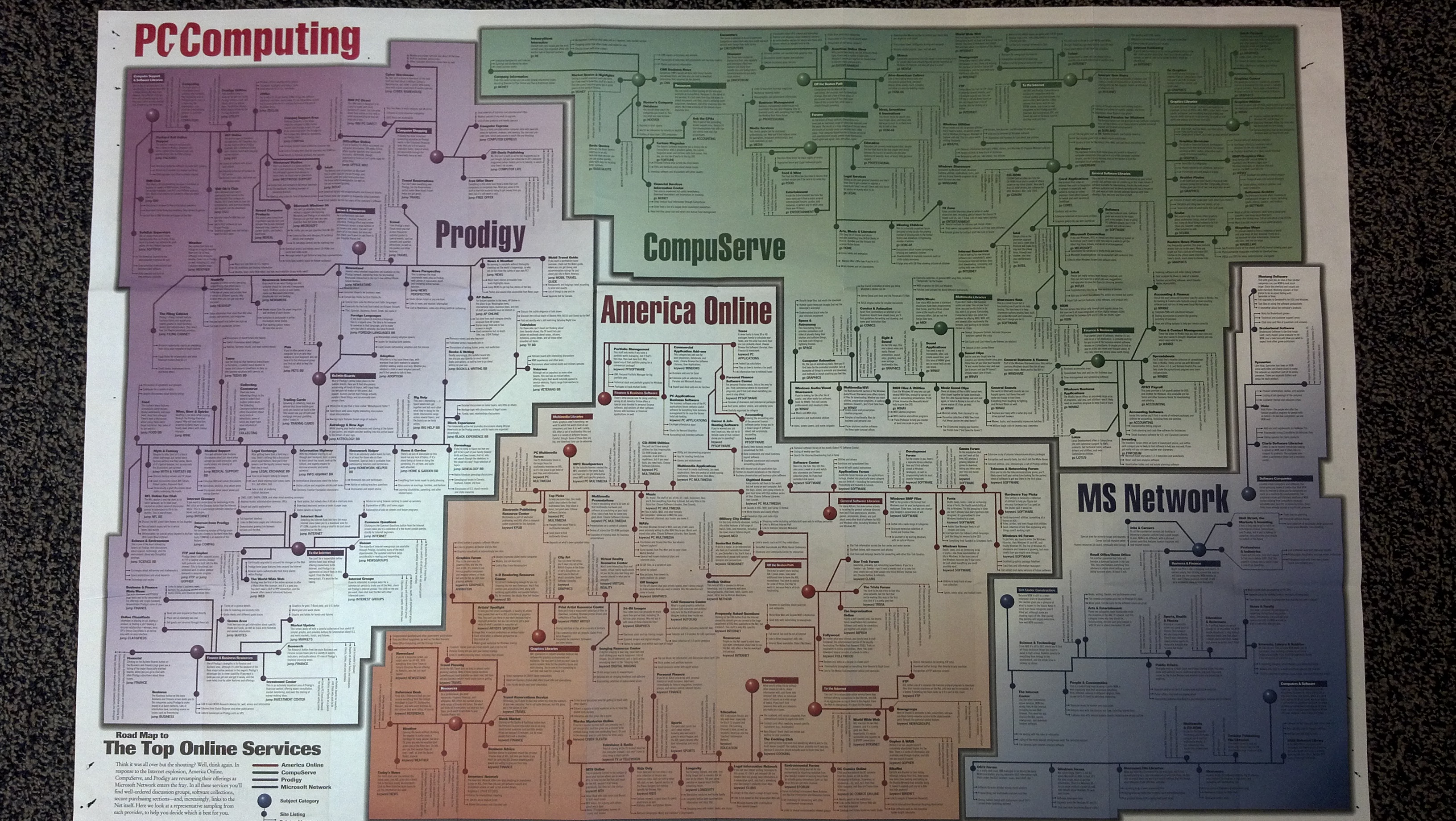
- [click for larger version]
Freelance journalist Laurence Cruz was kind enough to call me recently looking for comment on whether broadband should be considered a human right. Well, actually, he probably didn’t have many options. If you do a quick search on the topic, you’ll find an endless stream of essays in favor of the proposition. Then, somewhere in the mix, you’ll find a few dissenting rants I’ve penned here in the past. So I’m getting used to playing the baddie in this drama.
Cruz’s essay is now up over at “The Network,” which is Cisco’s technology news site. Here’s what I had to say in opposition to the proposition:
Continue reading →


 The Technology Liberation Front is the tech policy blog dedicated to keeping politicians' hands off the 'net and everything else related to technology.