Senior Fellow in Technology & Innovation at the R Street Institute in Washington, DC. Formerly a senior research fellow at the Mercatus Center at George Mason University, President of the Progress & Freedom Foundation, Director of Telecommunications Studies at the Cato Institute, and a Fellow in Economic Policy at the Heritage Foundation.
I was delivering a lecture to a group of academics and students out in San Jose recently [see the slideshow here] and someone in the crowd asked me to send them a list of some of the many books I had mentioned during my talk, which was about future policy clashes over various emerging technologies. I cut the list down to the five books that I believe best frame the nature of debates over innovation and technology policy. They are:
Virginia Postrel, The Future and Its Enemies (1998): Contrasts the conflicting worldviews of “dynamism” and “stasis” and shows how the tensions between these two visions influences debates over technological progress. No book has had a greater influence on my own thinking about debates over innovation and progress.
Joel Mokyr, Lever of Riches: Technological Creativity and Economic Progress (1990): One of the finest histories of technological innovation ever penned. It’s certainly my favorite. It explores how earlier technologies evolved and created social and economic tensions.
Matt Ridley, The Rational Optimist: How Prosperity Evolves (2010): Makes the case for “rational optimism” in debates about technology and innovation and takes on pessimistic critics of technological change.
Larry Downes, The Laws of Disruption: Harnessing the New Forces That Govern Life and Business in the Digital Age (2009): Explains how lawmaking in the information age is inexorably governed by the “law of disruption” or the fact that “technology changes exponentially, but social, economic, and legal systems change incrementally.” That fact, he explains, has profound ramifications for all technology policy debates going forward.
If you haven’t read these amazing books yet, add them to your collection
right now! They are worth reading again and again. They will forever change the way you think about debates over technology and innovation.
It was my pleasure this week to be invited to deliver some comments at an event hosted by the Information Technology and Innovation Foundation (ITIF) to coincide with the release of their latest study, “The Privacy Panic Cycle: A Guide to Public Fears About New Technologies.” The goal of the new ITIF report, which was co-authored by Daniel Castro and Alan McQuinn, is to highlight the dangers associated with “the cycle of panic that occurs when privacy advocates make outsized claims about the privacy risks associated with new technologies. Those claims then filter through the news media to policymakers and the public, causing frenzies of consternation before cooler heads prevail, people come to understand and appreciate innovative new products and services, and everyone moves on.” (p. 1)
As Castro and McQuinn describe it, the privacy panic cycle “charts how perceived privacy fears about a technology grow rapidly at the beginning, but eventually decline over time.” They divide this cycle into four phases: Trusting Beginnings, Rising Panic, Deflating Fears, and Moving On. Here’s how they depict it in an image:
I’ve been thinking about the “right to try” movement a lot lately. It refers to the growing movement (especially at the state level here in the U.S.) to allow individuals to experiment with alternative medical treatments, therapies, and devices that are restricted or prohibited in some fashion (typically by the Food and Drug Administration). I think there are compelling ethical reasons for allowing citizens to determine their own course of treatment in terms of what they ingest into their bodies or what medical devices they use, especially when they are facing the possibility of death and have exhausted all other options.
But I also favor a more general “right to try” that allows citizens to make their own health decisions in other circumstances. Such a general freedom entails some risks, of course, but the better way to deal with those potential downsides is to educate citizens about the trade-offs associated with various treatments and devices, not to forbid them from seeking them out at all.
The Costs of Control
But this debate isn’t just about ethics. There’s also the question of the costs associated with regulatory control. Practically speaking, with each passing day it becomes harder and harder for governments to control unapproved medical devices, drugs, therapies, etc. Correspondingly, that significantly raises the costs of enforcement and makes one wonder exactly how far the FDA or other regulators will go to stop or slow the advent of new technologies.
I have written about this “cost of control” problem in various law review articles as well as my little Permissionless Innovation book and pointed out that, when enforcement challenges and costs reach a certain threshold, the case for preemptive control grows far weaker simply because of (1) the massive resources that regulators would have to pour into the task on crafting a workable enforcement regime; and/or (2) the massive loss of liberty it would entail for society more generally to devise such solutions. With the rise of the Internet of Things, wearable devices, mobile medical apps, and other networked health and fitness technologies, these issues are going to become increasingly ripe for academic and policy consideration. Continue reading →
Yesterday, the White House Council of Economic Advisers released an important new report entitled, “Occupational Licensing: A Framework for Policymakers.” (PDF, 76 pgs.) The report highlighted the costs that outdated or unneeded licensing regulations can have on diverse portions of the citizenry. Specifically, the report concluded that:
the current licensing regime in the United States also creates substantial costs, and often the requirements for obtaining a license are not in sync with the skills needed for the job. There is evidence that licensing requirements raise the price of goods and services, restrict employment opportunities, and make it more difficult for workers to take their skills across State lines. Too often, policymakers do not carefully weigh these costs and benefits when making decisions about whether or how to regulate a profession through licensing.
The report supported these conclusions with a wealth of evidence. In that regard, I was pleased to see that research from Mercatus Center-affiliated scholars was cited in the White House report (specifically on pg. 34). Mercatus Center scholars have repeatedly documented the costs of occupational licensing and offered suggestions for how to reform or eliminate unnecessary licensing practices. Most recently, my colleagues and I have explored the costs of licensing restrictions for new sharing economy platforms and innovators. The White House report cited, for example, the recently-released Mercatus paper on “How the Internet, the Sharing Economy, and Reputational Feedback Mechanisms Solve the ‘Lemons Problem,’” which I co-authored with Christopher Koopman, Anne Hobson, and Chris Kuiper. And it also cited a new essay by Tyler Cowen and Alex Tabarrok on “The End of Asymmetric Information.” Continue reading →
“Why hasn’t Europe fostered the kind of innovation that has spawned hugely successful technology companies?” asks James B. Stewart in an important new column for the New York Times (“A Fearless Culture Fuels U.S. Tech Giants“).
That’s a great question, and one that I have tried to answer in a series of recent essays. (See, for example, “Europe’s Choice on Innovation” and “Embracing a Culture of Permissionless Innovation.”) What I have suggested in those essays is that the starkly different outcomes on either side of the Atlantic in terms of recent economic growth and innovation can primarily be explained by cultural attitudes toward risk-taking and failure. “For innovation and growth to blossom, entrepreneurs need a clear green light from policymakers that signals a general acceptance of risk-taking—especially risk-taking that challenges existing business models and traditional ways of doing things,” I have argued. And the most powerful proof of this is to examine the amazing natural experiment that has played out on either side of the Atlantic over the past two decades with the Internet and the digital economy.
For example, an annual Booz & Company report on the world’s most innovative companies revealed that 9 of the top 10 most innovative companies are based in the U.S. and that most of them are involved in computing and digital technology. None of them are based in Europe, however. Another recent survey revealed that the world’s 15 most valuable Internet companies (based on market capitalizations) have a combined market value of nearly $2.5 trillion, but none of them are European while 11 of them are U.S. firms. Again, it is America’s tech innovators that dominate that list.
Many European officials and business leaders are waking up to this grim reality and are wondering how to reverse this situation. In his
Times essay, Stewart quotes Danish economist Jacob Kirkegaard of the Peterson Institute for International Economics, who notes that Europeans “all want a Silicon Valley. . . . But none of them can match the scale and focus on the new and truly innovative technologies you have in the United States. Europe and the rest of the world are playing catch-up, to the great frustration of policy makers there.”
On Thursday, it was my great pleasure to participate in a Washington Legal Foundation (WLF) event on “Online Privacy Regulation: The Challenge of Defining Harm.” The entire event video can be found on YouTube here, but down below I pasted the clip of just my remarks. Other speakers at the event included: FTC Commissioner Maureen K. Ohlhausen, Commissioner; John B. Morris, Jr., the Associate Administrator and Director of Internet Policy athe U.S. Department of Commerce’s National Telecommunications and Information Administration; and Katherine Armstrong, Counsel at the law firm of Hogan Lovells. Glenn Lammi of the WLF moderated the session.
My remarks drew upon a few recent law review articles I have published relating digital privacy debates to previous debates over free speech and online child safety issues. (Here are those articles: 1, 2, 3).
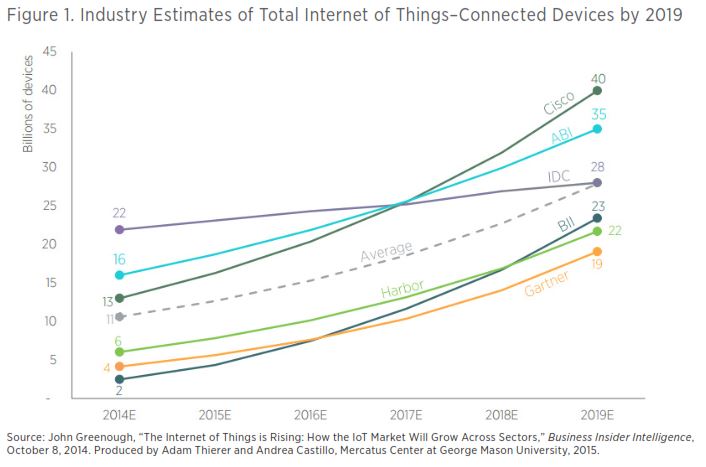
The “Internet of Things” (IoT) is already growing at a breakneck pace and is expected to continue to accelerate rapidly. In a short new paper (“Projecting the Growth and Economic Impact of the Internet of Things“) that I’ve just released with my Mercatus Center colleague Andrea Castillo, we provide a brief explanation of IoT technologies before describing the current projections of the economic and technological impacts that IoT could have on society. In addition to creating massive gains for consumers, IoT is projected to provide dramatic improvements in manufacturing, health care, energy, transportation, retail services, government, and general economic growth. Take a look at our paper if you’re interested, and you might also want to check out my 118-page law review article, “The Internet of Things and Wearable Technology: Addressing Privacy and Security Concerns without Derailing Innovation” as well as my recent congressional testimony on the policy issues surrounding the IoT.)
The FTC has now posted the videos from their workshop and down below I have embedded my particular panel. My remarks begin around the 5-minute mark of the video.
Along with colleagues at the Mercatus Center at George Mason University, I am releasing two major new reports today dealing with the regulation of the sharing economy. The first report is a 20-page filing to the Federal Trade Commissionthat we are submitting to the agency for its upcoming June 9th workshop on “The “Sharing” Economy: Issues Facing Platforms, Participants, and Regulators.” We have been invited to participate in that event and I will be speaking on the fourth panel of the workshop. The filing I am submitting today for that workshop was co-authored with my Mercatus colleagues Christopher Koopman and Matt Mitchell.
The Technology Liberation Front is the tech policy blog dedicated to keeping politicians' hands off the 'net and everything else related to technology. Learn more about TLF →





 The Technology Liberation Front is the tech policy blog dedicated to keeping politicians' hands off the 'net and everything else related to technology.