Articles by Adam Thierer 
 Senior Fellow in Technology & Innovation at the R Street Institute in Washington, DC. Formerly a senior research fellow at the Mercatus Center at George Mason University, President of the Progress & Freedom Foundation, Director of Telecommunications Studies at the Cato Institute, and a Fellow in Economic Policy at the Heritage Foundation.
Crosbie Fitch, Scott Carpenter & Enigma_Foundry.. I don’t know exactly what it is you have against open debate about IP issues, but as someone who both works at PFF and who gave birth to this blog many years ago while at the Cato Institute, let me at least try to briefly dissuade you (and others) of any nonsensical notion that there is some sort of grand conspiracy going on here by PFF / IP Central people to control the Tech Liberation Front.
First, if you’d bother reading the “About Us” note at the top of the TLF, you’d notice that this blog is not a one-man or one-issue show. It’s intended to be a clearinghouse of ideas to give the world a flavor for what various libertarians in a wide assortment of think tanks are thinking and saying about technology policy.
Second, libertarians have deep differences over copyright policy. Obviously, Tim Lee and Solveig Singleton stand on opposite ends of the spectrum. I’m somewhere in between. And everyone else who contributes to this blog has his or her own opinion. As I wrote in a 2002 Cato Institute book I edited on this subject (“CopyFights”), there is no clear “libertarian position” on copyright and IP matters. The movement is all over the board on the issue and this blog features contributions that reflect that intellectual schizophrenia.
Third, I would greatly appreciate it if you would refrain from engaging in vicious personal attacks against those who contribute their views on these matters. Despite the alleged, neo-conspiratorial “strange web” you guys speak of between the TLF and PFF, the reality is that PFF has no control over the TLF. Zero. Zip. Nothing. Nadda. Every scholar and commenter is free to post whatever they want here. Tim’s view’s on copyright, DRM, and DMCA certainly dominate here because he writes the most on the issue and he is the most aggressive of all our bloggers. Nothing that Tim says on the matter is ever edited or censored in any fashion. Nor are the comments you guys and many others make edited or excluded. Then again, neither are the opposing views of Solveig or anyone else. Do you think we’d be better off stifling all debate on this issue and telling Solveig or others with conflicting views to go buzz off? Why can’t we debate these things here on the TLF in a mature, adult fashion?
I hope you guys (and others) will take what I have said seriously because we certainly welcome your contributions to the TLF, but I would hope those contributions would not be done in such poor taste in the future.
Jennifer Medina of the New York Times penned an article yesterday on the debate over social networking fears leading to calls for age verification mandates. She noted that measures are moving in several states that would require social networking sites to age-verify users before they are allowed to visit the sites or create profiles there. But Medina also noted that there are many difficult questions about how age verification would work and how “social networking” would even be defined. (I summarize these questions in my recent PFF report, “Social Networking and Age Verification: Many Hard Questions; No Easy Solutions.”)
Ms. Medina was also kind enough to interview me for the story and she summarizes some of what I had to say in her piece. In a nutshell, I stressed that the most effective way to deal with this problem is to get serious about dealing with sex offenders instead of trying to regulate law-abiding citizens. We need to be locking up convicted sex offenders for a lot longer in this country to make sure they behind bars instead of behind keyboards seeking to prey on our children.
I also stressed the importance of online safety education as part of the strategy here. But my comments on that didn’t make the cut in the story. But you can read my big recent paper on this issue for additional details.
Some lawmakers at the federal, state and local level have advocated video game industry regulation in the name of protecting children from potentially objectionable content, usually of a violent nature. In my opinion, the better approach–and one that doesn’t involve government censorship or regulation of games–is to empower parents to better make these decisions for their own families. And the key to that effort is an effective rating / labeling system for game content that parents understand and use.
Luckily, there are good signs that the video game industry’s voluntary ratings system–the ESRB (the Entertainment Software Rating Board)–is doing exactly that. The game industry established the ESRB in 1994 and it has rated thousands of games since then. (The ESRB estimates it rates over 1,000 games per year). Virtually every title produced by major game developers for retail sale today carries an ESRB rating and content descriptors. Generally speaking, the only games that do not carry ESRB ratings today are those developed by web amateurs that are freely traded or downloaded via the Internet.
The ESRB applies seven different rating symbols and over 30 different content “descriptors” that it uses to give consumers highly detailed information about games. Thus, by simply glancing at the back of each game container, parents can quickly gauge the appropriateness of the title for their children.
So, how effective is this system, as measured by parental awareness and usage of the ESRB ratings and labels? Since 1999, the ESRB has asked Peter D. Hart Research Associates to study that question and conduct polls asking parents if they are aware of the ESRB ratings and if they use them. As this chart illustrates, the results are impressive with both awareness and use growing rapidly since 1999:
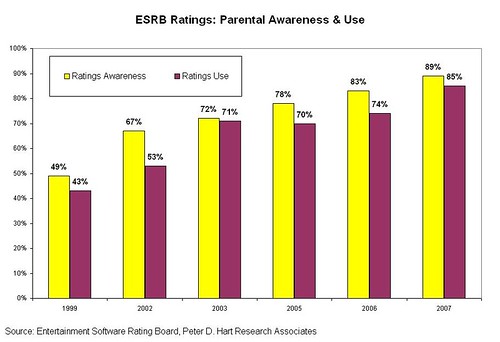
Better yet, all gaming platforms and most PCs can read these ratings and labels and allow parents to block games rated above a certain level they find unacceptable. But the real strength of the ESRB’s ratings system lies in the content descriptors, which give parents plenty of warning about what they will see or hear in each title. That way, parents can talk to their kids about those games or just not buy them for their kids until they think they are ready.
The game industry deserves credit not only for creating such an excellent content rating / labeling system, but also putting significant resources into public education / awareness efforts to ensure parents know how to take advantage of it. So then, why are lawmakers continuing to waste millions of taxpayer dollars litigating unneeded regulatory efforts?
Previous installments (1, 2, 3 & 4) in this series have documented how our government seems to have a difficult time keeping tabs on laptops and personal information. The latest on this front comes from the Transportation Security Administration (TSA). Last week, the TSA informed us that a computer hard drive containing the personal, payroll and bank information of 100,000 current and former TSA workers has apparently gone missing and is assumed stolen. The FBI and the Secret Service have apparently opened a criminal investigation into the matter.
I was about to launch into another rant on this front, but then I picked up this morning’s
Washington Post and their editorial on this issue really nails it:
Continue reading →
This is just a quick follow-up to an entry I posted late last year about Clear Channel’s possible divestiture of a significant number of its radio stations across America. Now we’re getting details and the sell-off is ready to begin. On Wednesday, Clear Channel said it would be selling 362 of its 1,150 radio stations as the company continues to shed assets and go private. Clear Channel hopes to fetch roughly $820 million from the sale of these radio stations. The company is also selling off TV assets. All total, the company expects to divest itself of almost $1.9 billion worth of properties.
As I’ve said many times before in this ongoing “media deconsolidation series,” this is just another sign of how dynamic the media marketplace is. Despite all the hand-wringing we’ve seen over media consolidation in recent years, critics fail to realize that this industry has continued to rapidly evolve, expand and innovate regardless of the ebbs and flows of media ownership patterns. A few years ago, mergers and acquisitions were all the rage. Today, however, a “back-to-basics” strategy is back in vogue that is seeing operators shed assets to figure out how to make customers happy while also weathering the storm of technological changes reshaping the media landscape. In other words, markets work!
But don’t expect the media Chicken Littles to say a peep about any of this. They’re always too busy concocting their next horror story about how the media sky is about to fall on our heads. This week, it’s the Rupert Murdoch offer for the Wall Street Journal. Who knows what it will be tomorrow, but there’s always something they want to complain about. Meanwhile, the rest of us are struggling to deal with the avalanche of media options that we’re showered with every second of our lives.
Continue reading →
Lots going on this week on the wireless Net neutrality front. You will recall that a couple of weeks ago several of us here
were blasting the new paper by Tim Wu and the petition by Skype asking the FCC to impose Carterfone-like regulatory mandates on the wireless industry. This new battle is now just known as “the wireless Net neutrality fight” here in Washington. And this week some important studies have been released opposing it by the CTIA, the wireless industry’s trade association, and economists from the American Enterprise Institute, Brookings Institution, and the Phoenix Center. I don’t have time to summarize them, but here are the links to each major report if you are interested:
(1) Filing of CTIA – The Wireless Association In the Matter of Skype Communications Petition to Confirm A Consumer’s Right to Use Internet Communications Software and Attach Devices to Wireless Networks (April 30, 2007).
(2) Robert W. Hahn, Robert E. Litan, and Hal J. Singer, “The Economics of ‘Wireless Net Neutrality,'” AEI-Brookings Joint Center for Regulatory Studies, AEI-Brookings Joint Center Working Paper No. RP07-10, (April 2007).
(3) George S. Ford, Thomas M. Koutsky and Lawrence J. Spiwak, “Wireless Net Neutrality: From Carterfone to Cable Boxes,” PHOENIX CENTER POLICY BULLETIN No. 17 (April 2007).
Over at National Review Online today, Peter Suderman has a good discussion of the current state of video game politics. As usual, a lot of politicians are playing games; political games, that is. Suderman notes that:
…attacking the video-game industry has long been a favored sport amongst politicians eager to shore up their credibility with the concerned parent crowd. At the state level, at least ten laws banning the sale of certain video games to minors have been brought to life. In California, Governor Arnold Schwarzenegger, a guy who made his name hacking and slashing his enemies to a bloody pulp on the big screen, apparently didn’t want high schoolers doing digital imitations: He tried to ban the sale of violent games to minors back in 2005. Oregon is currently considering a similar law, and New York Governor Eliot Spitzer recently stated that he intends to pursue one as well. But these laws go down like a final level boss once they hit the courts. To date, not one of the dubious proposals has stood up to a court challenge.
Some lawmakers can’t even be bothered to worry about anything so insignificant as considering whether a law is constitutional. Regarding one video-game ban, Minnesota state legislator Sandy Poppas shrugged off any such responsibility, saying, “Legislators don’t worry too much about what’s constitutional. We just try to do what’s right, and we let the courts figure that out.” The recurrent bashing of the game industry tends to resemble a major league team taking on a troop of t-ballers: Politicians get to knock a couple of balls out of the park in front of parents, but the whole thing is just a show.
Indeed it is. I made a similar argument in a piece for NRO last year as well as my big PFF study, “Fact and Fiction in the Debate over Video Game Regulation.”
This morning on Minnesota Public Radio, I debated two proponents of FCC efforts to regulate TV violence. I don’t know how long it will be up on their website, but you can currently listen to a stream of the entire show at this link on their website. I was up against Doug Gentile of the National Institute on Media and the Family and Melissa Caldwell of the Parents Television Council.
I’ve got a new editorial up over on the City Journal website today about the FCC’s new effort to regulate violence on television. I begin by noting that the FCC probably wouldn’t approve of my grandmother’s viewing choices for me back in the 1970s since I probably watched every episode of “The Three Stooges” with her as a kid. “Would The Three Stooges constitute ‘excessively violent’ programming unfit for a young child?” I ask. Who knows, and that’s just one of the many problems with the FCC’s new effort. See the rest of my editorial for details.
If you’re interested in this subject, I also want to draw your attention to this excellent editorial by First Amendment guru Robert Corn-Revere on the Freedom Forum website. Bob does an excellent job outlining the legal / constitutional issues that the FCC report ignored in its report. Bob’s essay is part of an excellent online symposium that the Freedom Forum has put together featuring many distinct viewpoints on this issue.
Finally, conservative columnist Cal Thomas had a column in The Washington Times a few days ago opposing the FCC’s regulatory effort. He argued that: “Anyone concerned about preserving the First Amendment and the rights it guarantees to free speech and free expression should worry about this latest assault on the Constitution. Conservatives who oppose regulation of talk radio, which most of them like, must be consistent and oppose overregulation of TV content they dislike.” Good for you, Cal !
George Will, conservative columnist for Newsweek and The Washington Post, is kind enough to cite my recent City Journal essay in his new article that takes liberals to task for trying to revive the so-called Fairness Doctrine. He argues that:
Some illiberal liberals are trying to restore the luridly misnamed Fairness Doctrine, which until 1987 required broadcasters to devote a reasonable amount of time to presenting fairly each side of a controversial issue. The government was empowered to decide how many sides there were, how much time was reasonable and what was fair.
By trying to again empower the government to regulate broadcasting, illiberals reveal their lack of confidence in their ability to compete in the marketplace of ideas, and their disdain for consumer sovereignty–and hence for the public.
Indeed. Will goes on to cite the multiplicity of media options we have at our disposal today relative to the past but he notes–in agreement with my recent City Journal essay–that that’s just not good enough for some liberals who want to guarantee that certain views get heard more than others that win out in the marketplace of ideas.

 The Technology Liberation Front is the tech policy blog dedicated to keeping politicians' hands off the 'net and everything else related to technology.