[UPDATE
4/30/13: This article was subsequently published in Volume 65, Issues 2 of the Federal Communications Law Journal in April 2013. The links below now point to the final FCLJ version.]
The Mercatus Center at George Mason University has just released a new paper by Brent Skorup and me entitled, “Uncreative Destruction: The War on Vertical Integration in the Information Economy.” Brent, who is the research director for the Information Economy Project at the George Mason University School of Law, and I have been working on this paper since the Spring and we are looking forward to getting it published in a law review shortly. The paper focuses on Tim Wu’s “separations principle” for the digital economy, something I’ve spent some time critiquing here in the past. Here’s the introduction from the 44-page paper that Brent and I just released:
Are information sectors sufficiently different from other sectors of the economy such that more stringent antitrust standards should be applied to them preemptively? Columbia Law School professor Tim Wu responds in the affirmative in his book The Master Switch: The Rise and Fall of Information Empires. Having successfully pushed net-neutrality regulation into the policy spotlight, Wu has turned his attention to what he regards as excessive market concentration and threats to free speech throughout the entire information economy.To support his call for increased antitrust intervention, Wu explains his view of competition in the information economy—a view that deviates substantially from current mainstream antitrust theory.
Continue reading →
It’s my great pleasure this week to be participating in a 2-day symposium on “Competition in Online Search” that is being hosted by the Antitrust & Competition Policy Blog. Daniel Sokol, Associate Professor of Law at the University of Florida Levin College of Law, was kind enough to invite me to join the fun. Professor Sokol is the editor of the Antitrust & Competition Policy Blog. Others participating in this symposium include: James Grimmelman (NY Law); Eugene Volokh (UCLA); Marvin Ammori (Stanford Law); Mark Jamison (Univ. of Florida); Eric Clemons (Wharton School); Dan Crane (Michigan Law); and both Marina Lao and Frank Pasquale (Seton Hall); and more.
My entry is now live. In it, I focus on how dynamically competitive and innovative the digital economy has been over the past 15 years and question to need for intervention at this time, especially of the “public utility” variety. I’ve re-posted my entry below, but make sure to head over to the Antitrust & Competition Policy Blog to read all the contributions to this excellent symposium. Continue reading →
On Wednesday afternoon, it was my great pleasure to make some introductory remarks at a Family Online Safety Institute (FOSI) event that was held at the Yahoo! campus in Sunnyvale, CA. FOSI CEO Stephen Balkam asked me to offer some thoughts on a topic I’ve spent a great deal of time thinking about in recent years: Who needs parental controls? More specifically, what role do parental control tools and methods play in the upbringing of our children? How should we define or classify parental control tools and methods? Which are most important / effective? Finally, what should the role of public policy be toward parental control technologies on both the online safety and privacy fronts?
In past years, I spent much time writing and updating a booklet on these issues called
Parental Controls & Online Child Protection: A Survey of Tools & Methods. It was an enormous undertaking, however, and I have abandoned updating it after I hit version 4.0. But that doesn’t mean I’m not still putting a lot of thought into these issues. My focus has shifted over the past year more toward the privacy-related concerns and away from the online safety issues. Of course, all these issues intersect and many people now (rightly) considered them to largely be the same debate.
Anyway, to kick off the FOSI event, I offered three provocations about parental control technologies and the state of the current debate over them. I buttressed some of my assertions with findings from a recent FOSI survey of parental attitudes about parental controls and online safety. Continue reading →
 Last night, Declan McCullagh of CNet posted two tweets related to the concerns already percolating in the privacy community about a new Apple and Android app called “Color,” which allows those who use it to take photos and videos and instantaneously share them with other people within a 150-ft radius to create group photo/video albums. In other words, this new app marries photography, social networking, and geo-location.
  And because the app’s default setting is to share every photo and video you snap openly with the world, Declan wonders “How long will it take for the #privacy fundamentalists to object to Color.com’s iOS/Android apps?” After all, he says facetiously, “Remember: market choices can’t be trusted!” He then reminds us that there’s really nothing new under the privacy policy sun and that we’ve seen this debate unfold before, such as when Google released its GMail service to the world back in 2004.
Indeed, for me, this debate has a “Groundhog Day” sort of feel to it. I feel like I’ve been fighting the same fight with many privacy fundamentalists for the past decade. The cycle goes something like this: Continue reading →
I’m in front of a non-TiVo-enabled television this evening, which has permitted me to see ads for a search site called YP.com. It’s a rebranded YellowPages.com, affiliated with AT&T, and it’s organized to be a search engine for the things in your life—dining, travel nightlife—distinguished from Google’s utilitarian-tech web search. Meanwhile Microsoft’s Bing has overtaken Yahoo! as the number two search engine. I was surprised to learn that “undisputed search king” Google has only 65 percent of the search market. Google is doing well, of course, but it can’t be comfortable with all these well-funded rivals circling it.
This is good news for consumers. These competitors are driving Google to improve, and they can pull consumers away from Google by serving search niches such as lifestyle search (as YP does), more privacy protective search, and so on. Competitors will threaten and cut into Google’s advertising profits, too.
Television ads also remind us that HughesNet is offering broadband Internet via satellite. It’s mostly aimed at moving rural Internet users off of dial-up, but it’s an outlet for consumers anywhere who are unsatisfied with cable or DSL service. Critics will point out that it’s not very fast, kind of expensive, and includes daily usage caps. But this doesn’t deny HughesNet’s role as competition for cable and DSL.
Internet service provided badly enough by the major ISPs would make satellite broadband a viable competitor. If HughesNet’s investors were confident that they could sign up enough customers, they would make the investments that bring satellite broadband to the economy of scale it needs to be price-, speed-, and usage-competitive.
The spur of competition does not have to pierce the horse’s belly to have its effect.
Companies often promote consistent and reliable customer experiences. KLM touts itself as “the reliable airline” while Michelin touts its dependability “because so much is riding on your tires.” And now we have Yahoo, who announced that it will be increasing the social networking functionality in Yahoo Mail. Yahoo has the ability to promote consistency in determining user defaults for sharing information.
But social networking is a product much different than most – it is participatory. Passengers can’t fly airplanes and drivers don’t design tire tread, but social networking users control what and with whom they share information.
So what happens when a social networking service changes functionality or adds new features? How does a company be consistent in carrying-over a user’s preference from the prior version to the new one? What assumptions should it make on user privacy preferences for new features?
These considerations matter whenever an online service tries to increase its social networking functionality. Last week, Facebook unveiled new privacy controls, and we blogged that it was a welcome response to clear-up confusion. In the coming weeks Yahoo will change how status updates work in Yahoo Mail. Michael Arrington’s TechCrunch article describes it well:
[C]urrently to see status updates for others in Yahoo Mail, you have to have a mutual follow, meaning both people have agreed to be “friends.” You can then see that user’s Yahoo status updates as well as updates on third party services that they have added to their Yahoo profile as well. In the new version there will no longer be a requirement for a mutual follow. So, like on Twitter, users can follow whomever they choose. This isn’t actually a dramatic change for Yahoo, since users can follow others in this way already on Yahoo Messenger.
Like Google and Facebook before it, Yahoo is adding features to make its service more “social.” And because of the scrutiny over the changes by Google and Facebook, Yahoo seems to be going out of its way to assure users that they can rely and depend on Yahoo. According to the Yahoo Corporate Blog: Continue reading →
Check out this amazing map of the “Dogs of War” of online competition created by Gizmodo’s Shane Snow (view full size here):
 For all the complaining about these three tech titans, they’re locked in fierce competition with each other. This chart doesn’t even mention other players in the vibrantly competitive online ecosystem, like Facebook, Yahoo!, Twitter, and countless others. Makes you want to go spend a weekend playing an endless game of Risk,
Axis & Allies or Supremacy with your best frenemies, doesn’t it? But of course, the board game analogy only goes so far, because today’s battlelines and players are only a snapshot of a long-term process of dynamic, highly rivalrous competition. But as Adam and I noted in our Forbes.com piece last fall calling for quick approval of Microsoft’s search partnership with Yahoo!:
For all the complaining about these three tech titans, they’re locked in fierce competition with each other. This chart doesn’t even mention other players in the vibrantly competitive online ecosystem, like Facebook, Yahoo!, Twitter, and countless others. Makes you want to go spend a weekend playing an endless game of Risk,
Axis & Allies or Supremacy with your best frenemies, doesn’t it? But of course, the board game analogy only goes so far, because today’s battlelines and players are only a snapshot of a long-term process of dynamic, highly rivalrous competition. But as Adam and I noted in our Forbes.com piece last fall calling for quick approval of Microsoft’s search partnership with Yahoo!:
Alas, regulators seem stuck in the past. European officials in particular seem hell-bent on continuing the antitrust crusade of the ’90s against Microsoft, myopically focused on fading paradigms (desktop operating systems and Web browsers). But instead of narrowly defining high-tech markets based on yesterday’s technologies or market structures, policymakers should embrace the one constant of the Internet economy: dynamic, disruptive and irrepressible change. Continue reading →
Last July, Adam Thierer and I argued in a Forbes.com piece that the Microsoft/Yahoo! search partnership should be cause for “celebration among as a good thing for consumers. By providing a strong competitor with a combined 28% market share, the deal should also be a source of relief at Google, which has come under increasing attack for its supposed market dominance.” Today, 205 days later, the companies have finally announced that EU and US antitrust regulators have approved their deal.
So… how does a delay of nearly seven months help consumers? Wouldn’t we be better off if the two companies had been able to start working together immediately to develop a stronger search engine competitor without this “Mother, May I?” routine?
Last year, I described how Microsoft’s delayed entry into search advertising put them at a serious disadvantage in competing with Google. (The company dithered over buying search ad startup Overture and ultimately decided to build its own system—which proved a serious miscalculation.) I’ll just reiterate what we said about the Yahoo!/Microsoft deal when it was first announced.
Yahoo!/Microsoft pact is just the latest pairing of Web 1.0 titans struggling to reinvent themselves and compete with Google, a titan that still thinks of itself as a start-up. All three companies will struggle to meet new challenges as search evolves toward the social(reflecting what your friends like), the semantic (reflecting the precise, rather than presumed, meanings of Web content), the personalized (reflecting your own preferences) and the interactive (including user-generated comments or reviews)…. Continue reading →
 I very much enjoyed Dennis Baron’s new book, A Better Pencil: Readers, Writers, and the Digital Revolution, and highly recommend you pick it up. Baron does a wonderful job exploring the history of techno-pessimism and the endless battles about the impact of new technologies on life and learning, something I have written about here before in my essays on “Internet optimists vs. pessimists” (See: 1, 2, 3).
I have a complete review of Baron’s
A Better Pencil now up on the City Journal‘s website here. I’ve also pasted it down below.
Plato Wrote it Down
by Adam Thierer
a review of A Better Pencil: Readers, Writers, and the Digital Revolution, by Dennis Baron (Oxford University Press, 280 pp., $24.95)
In the beginning, Dennis Baron reminds us in his new book,
A Better Pencil, there was the word—the spoken word, that is. Oral tradition, the passing of knowledge through stories and lectures, was the primary method of instruction and learning throughout early human civilization. But then a few innovative souls decided to start writing everything down on stones and clay. Almost as soon as they did, a great debate began on the impact of new communications technology on culture and education. And it rages on today, with a new generation of optimists and skeptics battling over the impact that computing, the Internet, and digital technologies have on our lives and on how we learn about the world.
Continue reading →
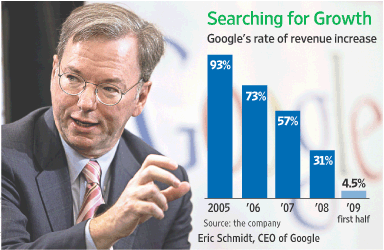 The Google juggernaut’s revenue growth has slowed steadily in the last five years, causing the Wall Street Journal to caution investors about buying Google stock. While much of the slow-down in Google’s revenue may be attributed to the recession, the WSJ cautions that:
- Microsoft is offering stiffer competition in search, which will only intensify once antitrust regulators approve its partnership with Yahoo! and the two companies actually implement their partnership (which could take another year);
- YouTube’s promise as an ad platform remains uncertain;
- Google lags behind Apple and Research in Motion in developing mobile phone operating systems, with Android still unproven;
- It remains unclear how successful the company will be in expanding beyond its existing lead in small text ads into the potentially lucrative realm of banner ads.
Somehow I doubt Google’s fall to Earth will do much to allay the concerns of those who see Google as the kind of evil monopolist Microsoft was made out to be in the 90s.
As the Journal concludes, “It would be foolish to predict that Google won’t have another business success, of course… Google may itself discover the next Google-like business.” As long as someone’s out there working to turn today’s idle fantasies into tomorrow’s multi-billion dollar businesses, consumers win—whoever that bold innovator might be.

 The Technology Liberation Front is the tech policy blog dedicated to keeping politicians' hands off the 'net and everything else related to technology.
