Here’s a video chat I did today with Americans for Prosperity – Virginia. My thanks to Benjamin Knotts for hosting the discussion. We talked about my recent book (Evasive Entrepreneurs) and my last one (Permissionless Innovation). We also discussed my new proposal with Matt Mitchell and Patrick McLaughlin to create “Fresh Start Initiatives” to address rules suspended during the COVID crisis. Watch the 30 min video here:

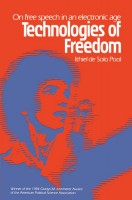 I was honored to be asked by the editors at Reason magazine to be a part of their “Revolutionary Reading” roundup of “The 9 Most Transformative Books of the Last 45 Years.” Reason is celebrating its 45th anniversary and running a wide variety of essays looking back at how liberty has fared over the past half-century. The magazine notes that “Statism has hardly gone away, but the movement to roll it back is stronger than ever.” For this particular feature, Reason’s editors “asked seven libertarians to recommend some of the books in different fields that made [the anti-statist] cultural and intellectual revolution possible.”
When Jesse Walker of
Reason first contacted me about contributing my thoughts about which technology policy books made the biggest difference, I told him I knew exactly what my choices would be: Ithiel de Sola Pool’s Technologies of Freedom (1983) and Virginia Postrel’s The Future and Its Enemies (1998). Faithful readers of this blog know all too well how much I love these two books and how I am constantly reminding people of their intellectual importance all these years later. (See, for example, this and this.) All my thinking and writing about tech policy over the past two decades has been shaped by the bold vision and recommendations set forth by Pool and Postrel in these beautiful books.
As I note in my
Reason write-up of the books: Continue reading →
Someone should consider making a movie about wasteful state-based film industy subsidies. It has become quite a cronyist fiasco in a very short period of time.
Some background: State and local tax incentives for movie production have expanded rapidly over the past decade. These inducements include tax credits, sales tax exemptions, cash rebates, direct grants, and tax or fee reductions for lodging or locational shooting. In 2002, only five states offered such inducements for movie production. By the end of 2009, forty-five states had some sort of incentives in place to lure film producers.
In 2010, the film industry received an estimated $1.5 billion in financial commitments from these programs. Unsurprisingly, these incentives have proven very popular with movie studios. Of the nine motion pictures that were nominated for Best Picture at the Academy Awards in 2012, five had received taxpayer-funded rebates, tax credits, and subsidies by state governments. “The Help” received a Mississippi spending rebate of $3,547,780 and “The Tree of Life” received $434,253 from Texas. In February 2012, Best Picture-nominee “Moneyball” received as much as $5.8 million from the state of California. It had grossed over $75 million at the box office. More recently, the biopic “Lincoln” received roughly $3.5 million in tax incentives from the Virginia Film Office.
Many state and local governments offer these inducements in the hope of attracting new jobs and investment; other simply seek to bill themselves as “the new Hollywood.” As William Luther of the Tax Foundation notes, “From politicians’ point of view, bringing Hollywood to town is the best of all possible photo opportunities—not just a ribbon-cutting to announce new job creation but a ribbon-cutting with a movie or TV star.” But it seems as if the glamor and prestige associated with films and celebrities have trumped sound economics since there is no evidence these tax incentives help state or local economies. Continue reading →
A recent article by Lisa Carley in the New York Wine Examiner reports that Amazon is suspending plans that would have allowed wine producers to sell direct to consumers. The culprit? State regulations:
One of the main reasons why this program has been put on hold is the complexity of wine-shipping laws within the United States, and that fact that the major wholesalers spend millions of dollars on the state level to keep it difficult for the consumer to have access to wine they want at good prices.
About 35 states permit some form of direct shipment to consumers, but laws vary greatly. In Virginia, consumers can order wine from any winery or retailer licensed in any state, as long as the seller registers with the state of Virginia and collects taxes. In Maryland, direct shipment of wine to consumers is still a felony. Montana limits the total amount of wine any consumer can order to 12 cases per year, which means most wineries won’t ship there because an individual winery has no way of knowing how much wine the consumer has ordered from other sellers. I’m not making this stuff up; check the Wine Institute’s compendium of state laws.
In several studies, Alan Wiseman and I found that consumers can enjoy significant savings on higher-priced wines if they order online. (The savings disappear for wines priced under $20 per bottle because of shipping costs.) The Internet also gives consumers access to wines that they might not find by simply walking into a store.
It would be a shame to see Amazon’s idea die. Currently, a winery or retailer that wants to ship directly to consumers has to figure out and comply with each state’s laws. It makes a lot of sense that a single retail sales portal could consolidate and continuously update this information, then set up a system that lets any seller market its wine direct to consumers in states where that’s legal, in compliance with all state laws.

When I open the
Washington Post in the morning and find a headline like, “Banned Books, Chapter 2,” I assume that I will be reading about yet another attempt by certain conservative or religious groups to ban books from local libraries that they find objectionable, unethical, or sacrilegious. How ironic then that the debate over banning books that is currently unfolding in my home county of Fairfax County, Virginia, is being led by liberals. My ongoing series about “Liberals Abandoning the First Amendment” has been focusing on Lefties getting weak-kneed about free speech principles that they have traditionally supported, but this one takes the cake.
Here’s what is going on here in Fairfax according to Michael Alison Chandler of the
Post:
During a week that librarians nationwide are highlighting banned books, conservative Christian students and parents showcased their own collection outside a Fairfax County high school yesterday — a collection they say was banned by the librarians themselves.
More than 40 students, many wearing black T-shirts stamped with the words “Closing Books Shuts Out Ideas,” said they tried to donate more than 100 books about homosexuality to more than a dozen high school libraries in the past year. The initiative, organized by Colorado Springs-based Focus on the Family, was intended to add a conservative Christian perspective to shelves that the students said are stocked with “pro-gay” books.
Most of the books were turned down after school librarians said they did not meet school system standards. Titles include “Marriage on Trial: The Case Against Same-Sex Marriage and Parenting” and “Someone I Love Is Gay,” which argues that homosexuality is not “a hopeless condition.” “We put ourselves out there . . . and got rejected,” said Elizabeth Bognanno, 17, a senior at West Springfield High School, standing before a semicircle of television cameras outside her school. “Censoring books is not a good thing. . . . We believe our personal rights have been violated.”
Continue reading →


 The Technology Liberation Front is the tech policy blog dedicated to keeping politicians' hands off the 'net and everything else related to technology.