Posts tagged as:

The US government has spent about $100 billion on rural telecommunications in the last 20 years. (That figure doesn’t include the billions of dollars in private investment and state subsidies.) It doesn’t feel like it in many rural areas.

The lion’s share of rural telecom subsidies come from the FCC’s “high-cost” fund, which is part of the Universal Service Fund. The high-cost fund currently disburses about $4.5 billion per year to rural carriers and large carriers serving rural areas. 

Excess in the high-cost program

Bill drafters in Congress and the CBO, after the passage of the 1996 Telecom Act creating the Fund, expected the USF program subsidies to decrease over time. That hasn’t happened. The high-cost fund has increased from $800 million in 1997 to $4.5 billion today.

The GAO and independent scholars find evidence of waste in the rural fund, which traditionally funded rural telephone (voice) service. For instance, former FCC chief economist Prof. Tom Hazlett and Scott Wallsten estimate that “each additional household is added to voice networks at an annual USF cost of about $25,000.” There are at least seven high-cost programs and each has its own complex nomenclature and disbursement mechanisms.

These programs violate many best practices for public finance. Shelanski and Hausman point out, for instance, that a huge distortion for decades has been US regulators’ choice to tax (demand-elastic) long-distance phone services to fund the (demand-inelastic) local phone services. The rural fund disbursement mechanisms also tempt providers to overinvest in goldplated services or, alternatively, inflate operational costs. Wallsten found that about 59 cent for every dollar of rural subsidy goes to carriers’ overhead.

To that end, the high-cost program appears to be supporting fewer households despite the program’s increasing costs. I found in Montana, for instance, that from 1999 to 2009 subsidies to carriers rose 40 percent even while the number of subsidized rural lines fell 30 percent.  The FCC’s administrative costs for the four USF programs also seem high. According to the FCC’s most recent report, administrative costs are about $172 million annually, which is more than what 45 states received in high-cost funds in 2016.

A proposal: give consumers tech vouchers

A much more transparent and, I suspect, more effective way of satisfying Congress’ requirement that rural customers have “reasonably comparable” rates to urban customers’s rates for telecom services is to give “tech vouchers.” Vouchers are used in housing, heating, and food purchases in the US, and the UK is using them for rural broadband.

My colleague Trace Mitchell and I are using Census and FCC data to calculate about how much rural households could receive if the program were voucher-ized. Assuming all high-cost funds disbursed to states in 2016 were converted into broadband vouchers, these are our estimates.

If vouchers were distributed equally among rural households today, every rural household in the US (about 20% of US households) would receive about $15 per month to spend on the broadband provider and service of their choice. Low-income rural households could tack on the $9.25 USF Lifeline subsidy and any state subsidies they’re eligible for.

Perfect equality probably isn’t the best way to subsidize rural broadband. The cost of rural service is driven primarily by the housing density, and providing telecom to a rural household in the American West and Great Plains is typically more expensive than providing telecom to a rural household in the denser Northeast, and this is borne out in the FCC’s current high-cost disbursements. For instance, Vermont and Idaho have about the same number of rural households but rural carriers in Idaho receive about 2x as much as rural carriers in Vermont.

However, some disparities are hard to explain. For example, despite South Carolina’s flatter geography than and similar rural population as North Carolina, North Carolina carriers receive, on a per-household basis, only about 40% what South Carolina carriers receive. Alabama and Mississippi have similar geographies and rural populations but Alabama carriers receive only about 20% of what Mississippi carriers receive.

A tiered system of telecom vouchers smooths the disparities, empowers consumers, and simplifies the program. We’ve sorted the states into six tiers based on how much the state received on a per-household basis in 2016. This ranking puts large, Western states in the top tier and denser, Northeastern states in the bottom tier.

In our plan, every rural household in five hardest-to-serve Tier 1 states (Alaska, Kansas, Montana, North Dakota, and South Dakota) would receive a $45 monthly discount on the Internet service of their choice, whether DSL, cable, fixed wireless, LTE, or satellite. As they do in the UK, eligible rural households would enter a coupon code when they receive their telecom services bill and the carrier would reduce the price of service accordingly.

Similarly, every rural household in:

Tier 2 states (ten states) would receive a $30 monthly discount.

Tier 3 states (ten states) would receive a $19 monthly discount.

Tier 4 states (ten states) would receive a $13 monthly discount.

Tier 5 states (ten states) would receive a $6 monthly discount.

Tier 6 states (five states) would receive a $3 monthly discount.

$3 per month per rural household doesn’t sound like much but, for each of these states (Connecticut, Delaware, Massachusetts, New Jersey, Rhode Island), this is more than the state currently receives in rural funds. In Connecticut, for instance, the current high-cost funding amounts to about 25 cents per rural household per month.

Under this (tentative) scheme, the US government would actually save $25 million per year from the current disbursements. And these are conservative numbers since they assume 100% participation from every rural household in the US. It’s hard to know what participation would look like but consider Lifeline, which is essentially a phone and broadband voucher program for low-income households. At $9.25 per month, 28% of those eligible for Lifeline participate.  This is just a starting point and needs more analysis (see link below for spreadsheet), but it seems conceivable that the FCC could increase the rural voucher amounts above, expect 50% participation, and still save the program money.

Conclusion

As Jerry Hausman and Howard Shelanski have said, “It is well established that targeted subsidies paid from general income tax revenues are often the most efficient way to fund specific activities.” Current law doesn’t allow allow for tech vouchers from general income taxes, but the FCC could allow states to convert their current high-cost funds into tech vouchers for rural households. Vouchers would be more tech-neutral, less costly to administer, and, I suspect, more effective and popular.


Excel spreadsheet of tech vouchers by state (Dropbox): link.

Expanding rural broadband has generated significant interest in recent years. However, the current subsidy programs are often mismanaged and impose little accountability. It’s not clear what effect rural broadband subsidies have had, despite the amount of money spent on it. As economist Scott Wallsten has pointed out, the US government has spent around $100 billion on rural telecommunications and broadband since 1995 “without evidence that it has improved adoption.”

So I was pleased to hear a few months ago that the Montana Public Service Commission was making an inquiry into how to improve rural broadband subsidy programs. Montana looms large in rural broadband discussions because Montana telecommunications providers face some of the most challenging terrain the US–mountainous, vast, and lightly-populated. (In fact, “no bars on your phone” in rural Montana is a major plot element in the popular videogame Far Cry 5. HT Rob Jackson.)

I submitted comments in the Montana PSC proceeding and received an invitation to testify at a hearing on the subject. So last week I flew to Helena to discuss rural broadband programs with the PSC and panelists.  I emphasized three points.

  • Federal broadband subsidy programs are facing higher costs and fewer beneficiaries.

Using FCC data, I calculated that since 1998, USF high-cost subsidies to Montana telecom companies have risen by about 40% while the number of rural customers served by those companies have decreased by over 50%. I suspect these trends are common nationally, and that USF subsidies are increasing while fewer people are benefiting.

  • Wireless broadband is the future, especially in rural areas.

“Fiber everywhere” is not a wise use of taxpayer funds and exurban and rural households are increasingly relying on wireless–from satellite, WISPs, and mobile. In 2016, the CDC reported that more households had wireless phone than landline phone service. You’re starting to see “cord cutting” pick up for broadband as well. Census surveys indicate that in 2013, 10% of Internet-using households were mobile Internet only (no landline Internet). By 2015, that percentage had doubled, and about 20% of households were mobile-only. The percentage is likely even higher today now that unlimited data plans are common. Someday soon the FCC will have to conclude that mobile broadband is a substitute for fixed broadband, and subsidy programs should reflect that.

  • Consumer-focused “tech vouchers” would be a huge improvement over current broadband programs.

Current programs subsidize the construction of networks even where there’s no demand. The main reason the vast majority of non-Internet users don’t subscribe to broadband is that they are uninterested in subscribing, according to surveys from the NTIA (55% are uninterested), Pew (70% are uninterested), and FCC and Connected Nation experts (63% are uninterested). With rising costs and diminishing returns to rural fiber construction, the FCC needs to reevaluate USF and make subsidies more consumer-focused. The UK for a couple years has pursued another model for rural broadband: consumer broadband vouchers. Since most people who don’t subscribe to broadband don’t want it, vouchers protect taxpayers from unnecessary expense and paying for gold-plated services.

For years, economists and the GAO have criticized the structure, complexity, and inefficiency of the USF programs, and particularly the rural program. The FCC is constantly changing the programs because of real and perceived deficiencies, but this has made the USF unwieldy. Montana providers participate in at least seven different rural USF programs alone (that doesn’t include the other USF programs and subprograms or other federal help, like RUS grants).

Unfortunately, most analysis and reporting on US broadband programs can be summed up as “don’t touch the existing programs–just send more money.” (There are some exceptions and scrutiny of the programs, like Tony Romm’s 2015 Politico investigation into the mismanagement of stimulus-funded Ag Department broadband projects.)

“Journalism as advocacy” is unfortunately the norm when it comes to broadband policy. Take, for instance, this article about the digital divide that omits mention of the $100 billion spent in rural areas alone, only to conclude that “small [broadband] companies and cooperatives are going it more or less alone, without much help yet from the federal government.”

(That story and another digital divide story had other problems, namely, a reliance on an academic study using faulty data purchased from a partisan campaign firm. FiveThirtyEight deserves credit for acknowledging the data’s flaws but that should have alerted the editors on the need for still more fact-checking.) 

States can’t rewrite federal statutes and regulations but it’s to the Montana PSC’s great credit that they sensed that all is not well. Current trends will only put more stress on the programs. Hopefully other state PUCs will see that the current programs do a disservice for universal service objectives and consumers.

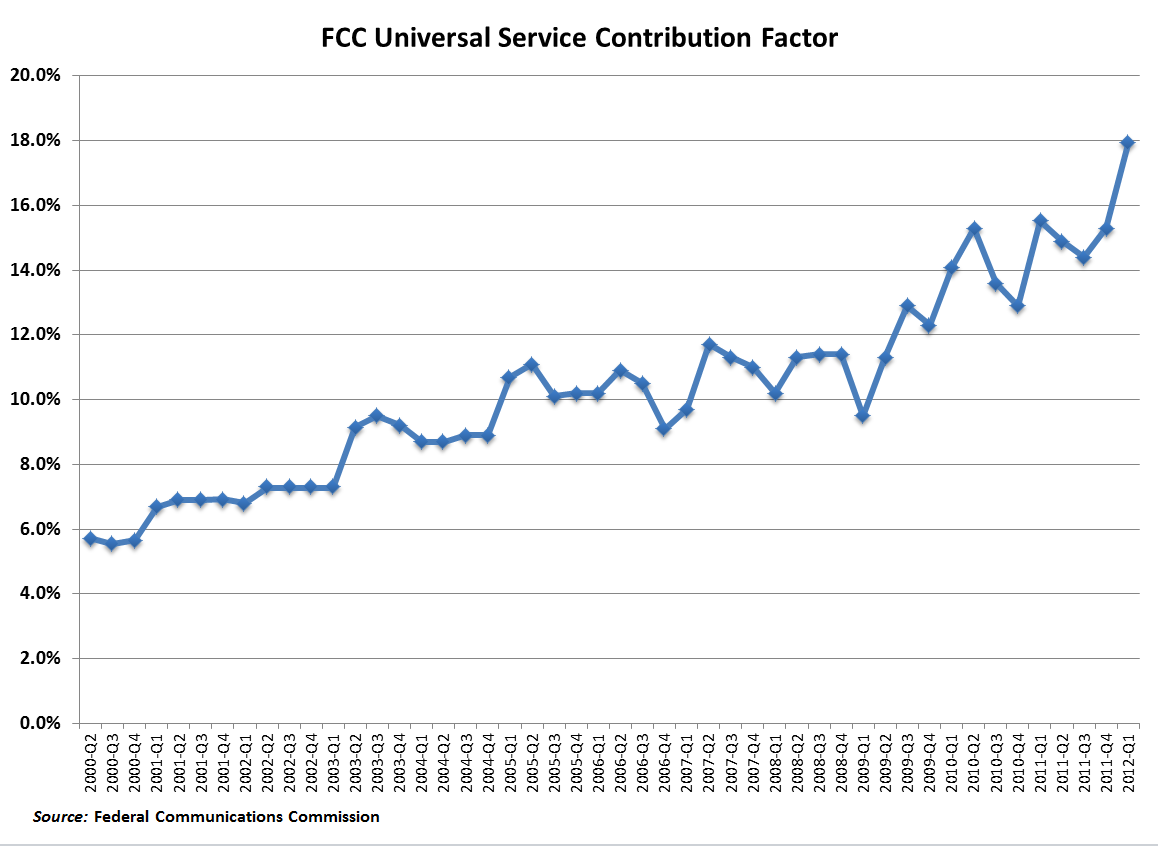
The FCC’s universal service tax is officially out of control. The agency announced yesterday that the “universal service contribution factor” for the 1st quarter of 2012 will go up to 17.9%.  This “contribution factor” is a tax imposed on telecom companies that is adjusted on a quarterly basis to accommodate universal service programs. The FCC doesn’t like people calling it a tax, but that’s exactly what it is. And it just keeps growing and growing. In fact, as the chart below reveals, it has been exploding in recent years. It was in single digits just a few years ago but is now heading toward 20%. And not only is this tax growing more burdensome, but it is completely unsustainable. As the taxable base (traditional interstate telephony) is eroded by new means of communicating, the tax rate will have to grow exponentially or the base will have to be broadened to cover new technologies and services. We should have junked the current carrier-delivered universal service subsidy system years ago and gone with a straight-forward voucher system. A means-tested voucher could have targeted assistance to those who needed it without creating an inefficient, unsustainable hidden tax like we have now. For all the ugly details, I recommend reading all of Jerry Ellig’s research on the issue.

Federal Communications Chairman Genachowski previewed the universal service reform plan the commissioners are discussing in a speech today.

The speech offers a masterful summary of the myriad inefficiencies created by the current universal service subsidies and intercarrier compensation payments. Most of the examples highlight plain old-fashioned waste. The universal service program collects billions of dollars from telephone subscribers, then simply wastes a goodly portion of it by subsidizing telephone competition in places where unsubsidized service from cable or satellite already exists, subsidizing multiple mobile wireless competitors, and subsidizing local phone companies that have little incentive for cost containment because they are still subject to rate-of-return regulation. The intercarrier compensation system uses per-minute charges to collect billions of dollars from telephone subscribers and hands it to phone companies that sometimes charge as little as $8 a month for phone service. There’s also a race to game this system as the companies that benefit seek new ways to inflate the regulated charges they collect, and the companies that pay seek clever ways to avoid paying.

It’s a powerful brief for reform. Never thought I’d live to see the day whan an FCC chairman would say so many things that are substantiated by economic research.

Nevertheless, a few parts of the speech give me cause for concern about the solutions the FCC commissioners may be discussing.

First, the chairman claims that 18 million Americans live in areas without access to broadband — up from the 14 million estimated in the National Broadband Plan.  The size of this figure suggests to me that the FCC is still over-estimating the number of people without access by defining “broadband” as a speed fast enough to exclude 3G wireless, many small rural Wireless Internet Service Providers, and satellite. Absent an adjustment in the definition of broadband, the subsidy program will be larger than it needs to be, and so telephone consumers will pay excessive universal service charges. Continue reading →

A couple days before Congress announced a debt deal, half a dozen telecommunications companies filed a plan on July 29 with the Federal Communications Commission that attempts to resolve a much longer-running set of negotiations over big bucks.  The “America’s Broadband Connectivity” Plan seeks to replace Universal Service Fund subsidies for telephone service in rural areas with subsidies for broadband in rural areas.

Like the federal budget negotiations, the never-ending negotiations over USF get bogged down in arguments over distribution: who gets what.  Indeed, it’s almost exclusively an argument over which companies get what. But federal telecommunications policy is supposed to advance the overall public interest, not just haggle over what corporate interest gets what piece of my pie. Here is a quick take on the biggest strengths and weaknesses of the plan in terms of advancing overall consumer welfare. By “consumer welfare,” I mean not just the welfare of the folks receiving subsidized services, but also the welfare of the majority who are paying a 15 percent charge on interstate phone services to fund the USF.

BIGGEST STRENGTHS

Fixed-term commitment: Rural phone subsidies have become a perpetual entitlement with no definition of when the subsidies can end because the problem is considered solved.  The ABC plan proposes a 10-year commitment to rural broadband subsidies.  By 2022 the FCC should assess whether any further high-cost universal service program is needed. This idea remedies a significant deficiency in the current high-cost subsidy program, which doesn’t even have outcome goals or measures. (That’s why I like to sing the final verse from “And the Money Kept Rolling In” from Evita when I talk about universal service.  Free State Foundation President Randy May asked me for an encore of this at the end of the foundation’s July 13 program on universal service, available here.)

Intercarrier compensation: “Intercarrier compensation” refers to the per-minute charges communications companies pay when they hand off phone traffic to each other. The plan proposes to ramp down all intercarrier charges to a uniform rate of $0.0007/minute.  Economists who study telecommunications have pointed out for decades that high per-minute charges reduce consumer welfare by discouraging consumers from communicating as much as they otherwise would.  MIT economist Jerry Hausman, in a paper prepared for the filing, estimates that low, uniform intercarrier charges would increase consumer welfare by about  $9 billion annually.

Legacy obligations: Public utility regulation traditionally forced regulated companies to offer certain services or serve certain markets at a loss, then charge profitable customers higher prices to cover the losses. Judge Richard Posner referred to this opaque practice as “Taxation by Regulation“: the customers paying inflated prices get “taxed” to accomplish a public purpose, but they don’t know it.  Some of these obligations continue today as federal requirements applied to “Eligible Telecommunications Carriers” or state “Carrier of Last Resort” obligations.  The plan would remove these obligations for companies that are not receiving USF subsidies.

BIGGEST WEAKNESSES

Definition of broadband: The plan would continue to inflate the cost of rural broadband subsidies by defining “broadband” as 4 megabytes per second download and 768 kilobytes per second upload.  This means 3G wireless, satellite, and some wireless Internet service providers do not count as “broadband.” This decision more than doubles the number of households considered “unserved” and rules out some lower-cost technologies.  Jerry Brito and I have written extensively about both the economics and the legality of this.  Interestingly, the ABC coalition’s legal white paper arguing that the commission has legal authority to adopt the plan makes no effort to show that the commission has authority to subsidize 4 mbps broadband; it only shows the commission has authority to subsidize some form of broadband.

Alternative cost technology threshold: The plan includes an “alternative cost technology” threshold that allows substitution of satellite broadband for customers who would cost more than $256/month to serve.  Inclusion of a threshold is actually a strength. But the $256/month figure is way too high.  Satellite broadband with speeds of 1-2 mbps is now available for $60 – $110 per month.  Consumers who pay a 15 percent surcharge on their local phone bills to fund USF should not be expected to provide a subsidy of more than $200 per month.

Mobility: The plan appears to advocate subsidies for mobile broadband service in places where it is not currently available.  So now the rural entitlement expands to include not just basic broadband service in the home to stay connected, but also a mobile service that a lot of Americans don’t even buy unless their employers pay for it! I question whether mobile broadband satisfies the 1996 Telecommunications Act’s criteria for universal service subsidies, such as “essential” (not just nice) for education or public safety, or subscribed to by a “substantial majority” of households. These questions should be thoroughly examined before anyone receives subsidies for mobile broadband. At a minimum, households should be eligible for only one broadband subsidy — wireline or mobile — but not both.


One of the reasons that so many of us here take issue with proposals to expand regulation of communications, broadband, and media markets is because we have studied the horrendous inefficiencies of economic regulation in practice. We oppose regulatory proposals not because of a “blind faith” in free markets, but because we understand that even when markets stumble they correct themselves quicker and more efficiently than regulatory systems do. One can profess the supposed theoretical benefits of enlightened “public interest” regulation all they want, but the facts are the facts. And the facts do not support the proposition that government regulation generally enhances consumer welfare.

In that regard, Tim Lee’s new Net neutrality report for Cato does a nice job of surveying some of the past unintended consequences of regulation. Also, even though it is now 10 years old, I highly recommend “Economic Deregulation and Customer Choice” by Jerry Ellig and Robert Crandall. It’s an outstanding overview of why economic regulation of various industries failed consumers so miserably in the past.

But if you want even more shocking proof of how horrendously inefficient communications regulation can be in practice, then you must read my PFF colleague Barbara Esbin’s two essays this week on the Universal Service Fund (USF): “The High Cost of USF Support,” and “More FCC Support Fund Follies.” In these two essays, Esbin walks the reader through various grim reports and statistics that have been released recently documenting the failures of the USF.

Continue reading →