Posts tagged as:

I’ve been floating around in conservative policy circles for 30 years and I have spent much of that time covering media policy and child safety issues. My time in conservative circles began in 1992 with a 9-year stint at the Heritage Foundation, where I launched the organization’s policy efforts on media regulation, the Internet, and digital technology. Meanwhile, my work on child safety has spanned 4 think tanks, multiple blue ribbon child safety commissions, countless essays, dozens of filings and testimonies, and even a multi-edition book.

During this three-decade run, I’ve tried my hardest to find balanced ways of addressing some of the legitimate concerns that many conservatives have about kids, media content, and online safety issues. Raising kids is the hardest job in the world. My daughter and son are now off at college, but the last twenty years of helping them figure out how to navigate the world and all the challenges it poses was filled with difficulties. This was especially true because my daughter and son faced completely different challenges when it came to media content and online interactions. Simply put, there is no one-size-fits-all playbook when it comes to raising kids or addressing concerns about healthy media interactions. Continue reading →

The Mercatus Center at George Mason University has just released a new paper on, “Artificial Intelligence and Public Policy,” which I co-authored with Andrea Castillo O’Sullivan and Raymond Russell. This 54-page paper can be downloaded via the Mercatus website, SSRN, or ResearchGate. Here is the abstract:

There is growing interest in the market potential of artificial intelligence (AI) technologies and applications as well as in the potential risks that these technologies might pose. As a result, questions are being raised about the legal and regulatory governance of AI, machine learning, “autonomous” systems, and related robotic and data technologies. Fearing concerns about labor market effects, social inequality, and even physical harm, some have called for precautionary regulations that could have the effect of limiting AI development and deployment. In this paper, we recommend a different policy framework for AI technologies. At this nascent stage of AI technology development, we think a better case can be made for prudence, patience, and a continuing embrace of “permissionless innovation” as it pertains to modern digital technologies. Unless a compelling case can be made that a new invention will bring serious harm to society, innovation should be allowed to continue unabated, and problems, if they develop at all, can be addressed later.

The future of emerging technology policy will be influenced increasingly by the interplay of three interrelated trends: “innovation arbitrage,” “technological civil disobedience,” and “spontaneous private deregulation.” Those terms can be briefly defined as follows:

  • Innovation arbitrage” refers to the idea that innovators can, and will with increasingly regularity, move to those jurisdictions that provide a legal and regulatory environment more hospitable to entrepreneurial activity. Just as capital now fluidly moves around the globe seeking out more friendly regulatory treatment, the same is increasingly true for innovations. And this will also play out domestically as innovators seek to play state and local governments off each other in search of some sort of competitive advantage.
  • Technological civil disobedience” represents the refusal of innovators (individuals, groups, or even corporations) or consumers to obey technology-specific laws or regulations because they find them offensive, confusing, time-consuming, expensive, or perhaps just annoying and irrelevant. New technological devices and platforms are making it easier than ever for the public to openly defy (or perhaps just ignore) rules that limit their freedom to create or use modern technologies.
  • Spontaneous private deregulation” can be thought of as de facto rather than the de jure elimination of traditional laws and regulations owing to a combination of rapid technological change as well the potential threat of innovation arbitrage and technological civil disobedience. In other words, many laws and regulations aren’t being formally removed from the books, but they are being made largely irrelevant by some combination of those factors. “Benign or otherwise, spontaneous deregulation is happening increasingly rapidly and in ever more industries,” noted Benjamin Edelman and Damien Geradin in a Harvard Business Review article on the phenomenon.[1]

I have previously documented examples of these trends in action for technology sectors as varied as drones, driverless cars, genetic testing, Bitcoin, and the sharing economy. (For example, on the theme of global innovation arbitrage, see all these various essays. And on the growth of technological civil disobedience, see, “DOT’s Driverless Cars Guidance: Will ‘Agency Threats’ Rule the Future?” and “Quick Thoughts on FAA’s Proposed Drone Registration System.” I also discuss some of these issues in the second edition of my Permissionless Innovation book.)

In this essay, I want to briefly highlight how, over the course of just the past month, a single company has offered us a powerful example of how both global innovation arbitrage and technological civil disobedience— or at least the threat thereof—might become a more prevalent feature of discussions about the governance of emerging technologies. And, in the process, that could lead to at least the partial spontaneous deregulation of certain sectors or technologies. Finally, I will discuss how this might affect technological governance more generally and accelerate the movement toward so-called “soft law” governance mechanisms as an alternative to traditional regulatory approaches. Continue reading →

book cover (small)I am pleased to announce the release of my latest book, “Permissionless Innovation: The Continuing Case for Comprehensive Technological Freedom.” It’s a short manifesto (just under 100 pages) that condenses — and attempts to make more accessible — arguments that I have developed in various law review articles, working papers, and blog posts over the past few years. I have two goals with this book.

First, I attempt to show how the central fault line in almost all modern technology policy debates revolves around “the permission question,” which asks: Must the creators of new technologies seek the blessing of public officials before they develop and deploy their innovations? How that question is answered depends on the disposition one adopts toward new inventions. Two conflicting attitudes are evident.

One disposition is known as the “precautionary principle.” Generally speaking, it refers to the belief that new innovations should be curtailed or disallowed until their developers can prove that they will not cause any harms to individuals, groups, specific entities, cultural norms, or various existing laws, norms, or traditions.

The other vision can be labeled “permissionless innovation.” It refers to the notion that experimentation with new technologies and business models should generally be permitted by default. Unless a compelling case can be made that a new invention will bring serious harm to society, innovation should be allowed to continue unabated and problems, if they develop at all, can be addressed later.

I argue that we are witnessing a grand clash of visions between these two mindsets today in almost all major technology policy discussions today. Continue reading →

GMLR coverI’m pleased to announce the release of my latest law review article, “A Framework for Benefit-Cost Analysis in Digital Privacy Debates.” It appears in the new edition of the George Mason University Law Review. (Vol. 20, No. 4, Summer 2013)

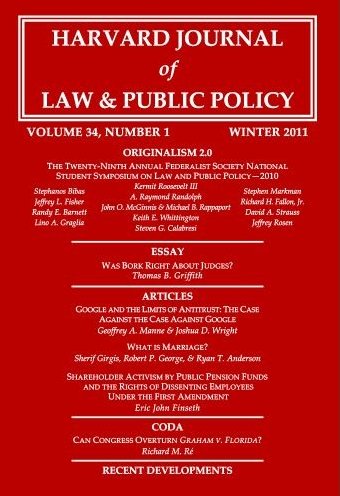
This is the second of two complimentary law review articles I am releasing this year dealing with privacy policy. The first, “The Pursuit of Privacy in a World Where Information Control is Failing,” was published in Vol. 36 of the Harvard Journal of Law & Public Policy this Spring. (FYI: Both articles focus on privacy claims made against private actors — namely, efforts to limit private data collection — and not on privacy rights against governments.)

My new article on benefit-cost analysis in privacy debates makes a seemingly contradictory argument: benefit-cost analysis (“BCA”) is extremely challenging in online child safety and digital privacy debates, yet it remains essential that analysts and policymakers attempt to conduct such reviews. While we will never be able to perfectly determine either the benefits or costs of online safety or privacy controls, the very act of conducting a regulatory impact analysis (“RIA”) will help us to better understand the trade-offs associated with various regulatory proposals. Continue reading →

***Cross-posted from Forbes.com***

It was, to paraphrase Yogi Berra, déjà vu all over again.  Fielding calls last week from journalists about reports the NSA had been engaged in massive and secret data mining of phone records and Internet traffic, I couldn’t help but wonder why anyone was surprised by the so-called revelations.

Not only had the surveillance been going on for years, the activity had been reported all along—at least outside the mainstream media.  The programs involved have been the subject of longstanding concern and vocal criticism by advocacy groups on both the right and the left.

For those of us who had been following the story for a decade, this was no “bombshell.”  No “leak” was required.  There was no need for an “expose” of what had long since been exposed.

As the Cato Institute’s Julian Sanchez and others reminded us, the NSA’s surveillance activities, and many of the details breathlessly reported last week, weren’t even secret.  They come up regularly in Congress, during hearings, for example, about renewal of the USA Patriot Act and the Foreign Intelligence Surveillance Act, the principal laws that govern the activity.

In those hearings, civil libertarians (Republicans and Democrats) show up to complain about the scope of the law and its secret enforcement, and are shot down as being soft on terrorism.  The laws are renewed and even extended, and the story goes back to sleep.

But for whatever reason, the mainstream media, like the corrupt Captain Renault in “Casablanca,” collectively found itself last week “shocked, shocked” to discover widespread, warrantless electronic surveillance by the U.S. government.  Surveillance they’ve known about for years.

Let me be clear.  As one of the long-standing critics of these programs, and especially their lack of oversight and transparency, I have no objection to renewed interest in the story, even if the drama with which it is being reported smells more than a little sensational with a healthy whiff of opportunism. Continue reading →

It’s not the culmination–that will come soon–but a major step in work I direct at the Cato Institute to improve government transparency has been achieved. I’ll be announcing and extolling it Wednesday at the House Administration Committee’s Legislative Data and Transparency conference. Here’s a quick survey of what we’ve been doing and the results we see on the near horizon.

After president Obama’s election in 2008, we recognized transparency as a bipartisan and pan-ideological goal at an event entitled: “Just Give Us the Data.” Widespread agreement and cooperation on transparency has held. But by the mid-point of the president’s first term, the deep-running change most people expected was not materializing, and it still has not. So I began working more assiduously on what transparency is and what delivers it.

In “Publication Practices for Transparent Government” (Sept. 2011), I articulated ways the government should deliver information so that it can be absorbed by the public through the intermediary of web sites, apps, information services, and so on. We graded the quality of government data publication in the aptly named November 2012 paper: “Grading the Government’s Data Publication Practices.”

But there’s no sense in sitting around waiting for things to improve. Given the incentives, transparency is something that we will have to force on government. We won’t receive it like a gift.

So with software we acquired and modified for the purpose, we’ve been adding data to the bills in Congress, making it possible to learn automatically more of what they do. The bills published by the Government Printing Office have data about who introduced them and the committees to which they were referred. We are adding data that reflects:

  • What agencies and bureaus the bills in Congress affect;

  • What laws the bills in Congress effect: by popular name, U.S. Code section, Statutes at Large citation, and more;

  • What budget authorities bills include, the amount of this proposed spending, its purpose, and the fiscal year(s).

We are capturing proposed new bureaus and programs, proposed new sections of existing law, and other subtleties in legislation. Our “Deepbills” project is documented at cato.org/resources/data.

This data can tell a more complete story of what is happening in Congress. Given the right Web site, app, or information service, you will be able to tell who proposed to spend your taxpayer dollars and in what amounts. You’ll be able to tell how your member of Congress and senators voted on each one. You might even find out about votes you care about before they happen!

Having introduced ourselves to the community in March, we’re beginning to help disseminate legislative information and data on Wikipedia.

The uses of the data are limited only by the imagination of the people building things with it. The data will make it easier to draw links between campaign contributions and legislative activity, for example. People will be able to automatically monitor ALL the bills that affect laws or agencies they are interested in. The behavior of legislators will be more clear to more people. Knowing what happens in Washington will be less the province of an exclusive club of lobbyists and congressional staff.

In no sense will this work make the government entirely transparent, but by adding data sets to what’s available about government deliberations, management and results, we’re multiplying the stories that the data can tell and beginning to lift the fog that allows Washington, D.C. to work the way it does–or, more accurately, to fail the way it does.

At this point, data curator Molly Bohmer and Cato interns Michelle Newby and Ryan Mosely have marked up 75% of the bills introduced in Congress so far. As we fine-tune our processes, we expect essentially to stay current with Congress, making timely public oversight of government easier.

This is not the culmination of the work. We now require people to build things with the data–the Web sites, apps, and information services that can deliver transparency to your door. I’ll be promoting our work at Wednesday’s conference and in various forums over the coming weeks and months. Watch for government transparency to improve when coders get a hold of the data and build the tools and toys that deliver this information to the public in accessible ways.

There’s a powerful irony lurking underneath the executive order and OMB memorandum on open data that the White House released in tandem today: We don’t have data that tells us what agencies will carry out these policies.

It’s nice that the federal government will work more assiduously to make available the data it collects and creates. And what President Obama’s executive order says is true: “making information resources easy to find, accessible, and usable can fuel entrepreneurship, innovation, and scientific discovery that improves Americans’ lives and contributes significantly to job creation.” GPS and weather data are the premier examples.

But government transparency was the crux of the president’s 2008 campaign promises, and it is still the rightful expectation of the public. Government transparency is not produced by making interesting data sets available. It’s produced by publishing data about the government’s deliberations, management, and results.

Today’s releases make few, if any, nods to that priority. They don’t go to the heart of transparency, but threaten to draw attention away from the fact that basic data about our government, including things as fundamental as the organization of the executive branch of government, are not available as open data.

Yes, there is still no machine-readable government organization chart. This was one of the glaring faults we found when we graded the publication practices of Congress and the executive branch last year, and this fault remains. The coders who may sift through data published by various agencies, bureaus, programs, and projects can’t sift through data reflecting what those organizational units of government are.

Compare today’s policy announcements to events coming up on Capitol Hill in the next two weeks.

On Thursday next week (May 16), the House Committee on Oversight and Government Reform will host a “DATA Demonstration Day” to illustrate to Congress and the media how technology may cut waste and improve oversight if federal spending data is structured and transparent. (That would include my hobby-horse, the machine-readable federal government organization chart.) We’ll be there demo-ing how we at Cato are adding data to the bills Congress publishes.

On May 22nd, the House Administration Committee is hosting its 2013 Legislative Data and Transparency Conference. This is an event at which various service providers to the House will announce not just policies, but recent, new, and upcoming improvements in publication of data about the House and its deliberations. (We’ll be there, too.)

The administration’s open data announcements are entirely welcome. Some good may come from these policies, and they certainly do no harm (barring procurement boondoggles–which, alas, is a major caveat). But I hope this won’t distract from the effort to produce government transparency, which I view as quite different from the subject of the new executive order and memorandum. The House of Representatives still seems to be moving forward on government transparency with more alacrity.

Susan W. Brenner, associate dean and professor of law at the University of Dayton School of Law,  discusses her new paper published in the Minnesota Journal of Law, Science & Technology entitled “Cyber-threats and the Limits of Bureaucratic Control.”

Brenner argues that the approach the United States, like other countries, uses to control threats in real-space is ill-suited for controlling cyberthreats. She explains that because this approach evolved to deal with threat activity in a physical environment, it is predicated on a bureaucratic organizations. This is not an effective way of approaching cyber-threat control, she argues. 

Brenner also explains why congressional efforts at cybersecurity legislation are flawed and why U.S. authorities persist in pursuing antiquated strategies that cannot provide an effective cyberthreats defense system. She outlines an alternative approach to the task of protecting the country from cyberthreats, and approach that is predicated on older, more fluid threat control strategies.

Download

Related Links

HJLPP coverI’m excited to announce the release of my latest law review article, “The Pursuit of Privacy in a World Where Information Control is Failing,” which appears in the next edition (vol. 36) of the Harvard Journal of Law & Public Policy. This is the first of two complimentary law review articles that I will be releasing this year dealing with privacy policy. The second, which will be published later this summer by the George Mason University Law Review, is entitled, “A Framework for Benefit-Cost Analysis in Digital Privacy Debates.” (FYI: Both articles focus on privacy claims made against private actors — namely, efforts to limit private data collection — and not on privacy rights against governments.)

The new Harvard Journal article is divided into three major sections. Part I focuses on some of normative challenges we face when discussing privacy and argues that there may never be a widely accepted, coherent legal standard for privacy rights or harms here in the United States. It also explores the tensions between expanded privacy regulation and online free speech. Part II turns to the many enforcement challenges that are often ignored when privacy policies are being proposed or formulated and argues that legislative and regulatory efforts aimed at protecting privacy must now be seen as an increasingly intractable information control problem. Most of the problems policymakers and average individuals face when it comes to controlling the flow of private information online are similar to the challenges they face when trying to control the free flow of digitalized bits in other information policy contexts, such as online safety, cybersecurity, and digital copyright.

If the effectiveness of law and regulation is limited by the normative considerations discussed in Part I and the practical enforcement complications discussed in Part II, what alternatives remain to assist privacy-sensitive individuals? I address that question in Part III of the paper and argue that the approach America has adopted to deal with concerns about objectionable online speech and child safety offers a path forward on the privacy front as well. Continue reading →