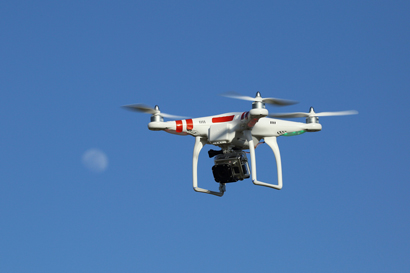
 The use of unmanned aircraft systems, or “drones,” for private and commercial uses remains the subject of much debate. The issue has been heating up lately after Congress ordered the Federal Aviation Administration (FAA) to integrate UASs into the nation’s airspace system by 2015 as part of the FAA Modernization and Reform Act of 2012.
The debate has thus far centered mostly around the safety and privacy-related concerns associated with private use of drones. The FAA continues to move slowly on this front based on a fear that private drones could jeopardize air safety or the safety of others on the ground. Meanwhile, some privacy advocates are worried that private drones might be used in ways that invade private spaces or even public areas where citizens have a reasonable expectation of privacy. For these and other reasons, the FAA’s current ban on private operation of drones in the nation’s airspace remains in place.
But what about the
speech-related implications of this debate? After all, private and commercial UASs can have many peaceful, speech-related uses. Indeed, to borrow Ithiel de Sola Pool’s term, private drones can be thought of as “technologies or freedom” that expand and enhance the ability of humans to gather and share information, thus in turn expanding the range of human knowledge and freedom.
A new Mercatus Center at George Mason University working paper, “News from Above: First Amendment Implications of the Federal Aviation Administration Ban on Commercial Drones,” deals with these questions. This 59-page working paper was authored by Cynthia Love, Sean T. Lawson, and Avery Holton. (Love is currently a Law Clerk for Judge Carolyn B. McHugh in 10th Circuit U.S. Court of Appeals. Lawson and Holton are affliated with the Department of Communication at the University of Utah.)
“To date, little attention has been paid to the First Amendment implications of the [FAA] ban,” note Love, Lawson, and Holton. Their article argues that “aerial photography with UASs, whether commercial or not, is protected First Amendment activity, particularly for news-gathering purposes. The FAA must take First Amendment-protected uses of this technology into account as it proceeds with meeting its congressional mandate to promulgate rules for domestic UASs.” They conclude by noting that “The dangers of [the FAA’s] regulatory approach are no mere matter of esoteric administrative law. Rather, as we have demonstrated, use of threats to enforce illegally promulgated rules, in particular a ban on journalistic use of UASs, infringes upon perhaps our most cherished constitutional right, that of free speech and a free press.” Continue reading →
You have to wade through a lot to reach the good news at the end of Time reporter Joel Stein’s article about “data mining”—or at least data collection and use—in the online world. There’s some fog right there: what he calls “data mining” is actually ordinary one-to-one correlation of bits of information, not mining historical data to generate patterns that are predictive of present-day behavior. (See my data mining paper with Jeff Jonas to learn more.) There is some data mining in and among the online advertising industry’s use of the data consumers emit online, of course.
Next, get over Stein’s introductory language about the “vast amount of data that’s being collected both online and off by companies in stealth.” That’s some kind of stealth if a reporter can write a thorough and informative article in
Time magazine about it. Does the moon rise “in stealth” if you haven’t gone outside at night and looked at the sky? Perhaps so.
Now take a hard swallow as you read about Senator John Kerry’s (D-Mass.) plans for government regulation of the information economy.
Kerry is about to introduce a bill that would require companies to make sure all the stuff they know about you is secured from hackers and to let you inspect everything they have on you, correct any mistakes and opt out of being tracked. He is doing this because, he argues, “There’s no code of conduct. There’s no standard. There’s nothing that safeguards privacy and establishes rules of the road.”
Securing data from hackers and letting people correct mistakes in data about them are kind of
equally opposite things. If you’re going to make data about people available to them, you’re going to create opportunities for other people—it won’t even take hacking skills, really—to impersonate them, gather private data, and scramble data sets. Continue reading →
What Unites Advocates of Speech Controls & Privacy Regulation? [pdf]
by Adam Thierer & Berin Szoka
The Progress & Freedom Foundation,
Progress on Point No. 16.19
Anyone who has spent time following debates about speech and privacy regulation comes to recognize the striking parallels between these two policy arenas. In this paper we will highlight the common rhetoric, proposals, and tactics that unite these regulatory movements. Moreover, we will argue that, at root, what often animates calls for regulation of both speech and privacy are two remarkably elitist beliefs:
- People are too ignorant (or simply too busy) to be trusted to make wise decisions for themselves (or their children); and/or,
- All or most people share essentially the same values or concerns and, therefore, “community standards” should trump household (or individual) standards.
While our use of the term “elitism” may unduly offend some understandably sensitive to populist demagoguery, our aim here is not to launch a broadside against elitism as
Time magazine culture critic William H. Henry once defined it: “The willingness to assert unyieldingly that one idea, contribution or attainment is better than another.”[1] Rather, our aim here is to critique that elitism which rises to the level of political condescension and legal sanction. We attack not so much the beliefs of some leaders, activists, or intellectuals that they have a better idea of what it in the public’s best interest than the public itself does, but rather the imposition of those beliefs through coercive, top-down mandates.
That sort of elitism—elitism enforced by law—is often the objective of speech and privacy regulatory advocates. Our goal is to identify the common themes that unite these regulatory movements, explain why such political elitism is unwarranted, and make it clear how it threatens individual liberty as well as the future of free and open Internet. As an alternative to this elitist vision, we advocate an empowerment agenda: fostering an environment in which users have the tools and information they need to make decisions for themselves and their families. Continue reading →

 The Technology Liberation Front is the tech policy blog dedicated to keeping politicians' hands off the 'net and everything else related to technology.