 The Internet’s greatest blessing — its general openness to all speech and speakers — is also sometimes its biggest curse. That is, you cannot expect to have the most widely accessible, unrestricted communications platform the world has ever known and not also have some imbeciles who use it to spew insulting, vile, and hateful comments.
It is important to put things in perspective, however. Hate speech is not the norm online. The louts who spew hatred represent a small minority of all online speakers. The vast majority of online speech is of a socially acceptable — even beneficial — nature.
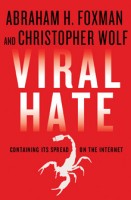
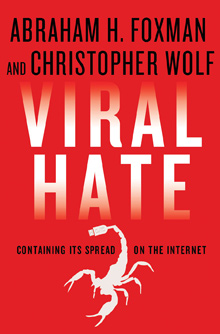
Still, the problem of hate speech remains very real and a diverse array of strategies are needed to deal with it. The sensible path forward in this regard is charted by Abraham H. Foxman and Christopher Wolf in their new book, Viral Hate: Containing Its Spread on the Internet. Their book explains why the best approach to online hate is a combination of education, digital literacy, user empowerment, industry best practices and self-regulation, increased watchdog / press oversight, social pressure and, most importantly, counter-speech. Foxman and Wolf also explain why — no matter how well-intentioned — legal solutions aimed at eradicating online hate will not work and would raise serious unintended consequences if imposed.
In striking this sensible balance, Foxman and Wolf have penned the definitive book on how to constructively combat viral hate in an age of ubiquitous information flows. Continue reading →
I posted a rant here over the weekend about those who were engaging in what I believed was excessive whining about Apple’s moves to restrict pornographic content in the Apple Apps Store. (see: “Apple’s App Store, Porn & ‘Censorship‘”) It received a surprising number of comments and featured a back and forth between me and our old TLF blogging colleague Tim Lee. Tim has continued the discussion over on his personal blog and argued that:
[T]he key thing to focus on isn’t the abstract question of whether porn on iPhones is good or bad. The key thing to recognize is how fundamentally broken the process itself is. “Overtly sexual content” is a concept that seems clear in the abstract but gets leaky once you have to actually classify tens of thousands of applications. Apple is going to make mistakes, and when they do hapless developers are going to find their apps blocked, often with little explanation or recourse. Also, Apple is going to change its mind periodically, and when they do the affected developers are going to find their hard-earned apps rendered worthless overnight. This is no way to run a technology platform. It’s unfair to developers and it doesn’t scale. And this is precisely why it would be better for everyone if Apple could come up with an application distribution scheme that didn’t require so much central planning.
I followed up with a comment over there, but just thought I would repost it here, in which I argue that Tim is underestimating how difficult this task of defining acceptable content is and that he is also downplaying Apple’s legitimate editorial discretion to establish standards for the community platform they provide. I’m also uncomfortable with Tim’s constant use of “central planning” rhetoric to describe almost any private, proprietary model of institutional governance or platform development he doesn’t seem to agree with, but I have not elaborated on that point here. Anyway, here’s how I responded over on his blog: Continue reading →
I really appreciate the venture capitalists (VCs) in Silicon Valley subsidizing my soapbox at Twitter. Seriously, it is an absolutely awesome platform for getting a message out to the masses. But at some point I worry that the gravy train will come to an end and that users will have to start picking up part of the tab. After all, will those VCs continue to subsidize Twitter if it never turns a profit? According to the Wikipedia entry about Twitter:
In total, Twitter has raised over US$57 million from venture capitalists. The exact amounts of funding have not been publicly released. Twitter’s first round of funding was for an undisclosed amount that is rumored to have been between $1 million and $5 million. Its B round of funding in 2008 was for $22 million and its C round of funding in 2009 was for $35 million from Institutional Venture Partners and Benchmark Capital along with an undisclosed amount from other investors including Union Square Ventures and Spark Capital. Twitter is backed by Union Square Ventures, Digital Garage, Spark Capital, and Bezos Expeditions.
Again, thank you VCs! But, like them, I do wonder when and how Twitter will bring in some cash. Is there a “freemium” model that could work? Perhaps. “Pro” or corporate accounts have been rumored to be in the works. Getting someone else to pick up the tab that way might bring in enough cash for Twitter to allow the free ride to continue for the rest of us. But what about advertising? It’s been the “mother’s milk” of most online media and platforms for some time now, and Twitter seems perfectly suited to insert a few banner ads or contextual ads here and there. It could be happening sooner than you think. Austin Modine of The Register notes in a new piece, “Twitter ‘Leaves Door Open’ for Targeted Ads,” that: Continue reading →
Well, here we go again. Harvard’s Jonathan Zittrain has penned another gloomy essay about how “freedom is at risk in the cloud” and the future of the Internet is in peril because nefarious digital schemers like Apple, Facebook, and Google are supposedly out to lock you into their services and take away your digital rights. And so, as I have done here many times before (see 1, 2, 3, 4, 5 + video!), I will offer a response arguing that Jonathan’s cyber-Chicken Little-ism is largely unwarranted.
Zittrain’s latest piece is entitled “Lost in the Cloud” and it appears in today’s New York Times. It closely tracks the arguments he has set forth in his book The Future of the Internet–And How to Stop It, which I named the most important technology policy book of 2008, but not because I agreed with its central thesis. Zittrain’s book and his new NYT essay are the ultimate exposition of Lessigite technological pessimism. I don’t know what they put in the water up at the Berkman Center to make these guys so remarkably cranky and despondent about the future of of the Internet, but starting with Lawrence Lessig’s Code in 1999 and running through to Zittrain’s Future of the Internet we have been forced to endure endless Tales of the Coming Techno-Apocalypse from these guys. Back in the late 90s, Prof. Lessig warned us that AOL and some other companies would soon take over the new digital frontier since “Left to itself, cyberspace will become a perfect tool of control.” Ah yes, how was it that we threw off the chains of our techno-oppressors and freed ourselves from that wicked walled garden hell? Oh yeah, we clicked our mouses and left! And that was pretty much the end of AOL’s “perfect control” fantasies. [See my recent debate with Prof. Lessig over at Cato Unbound for more about this “illusion of perfect control,” as I have labeled it.]
But Zittrain is the equivalent of the St. Peter upon which the Church of Lessigism has been built and, like any good disciple, he’s still vociferously preaching to the unconverted and using fire and brimstone sermons to warn of our impending digital damnation. In fact, he’s taken it to all new extremes. In
Future of the Internet, Jonathan argues that we run the risk of seeing the glorious days of the generative, open Net and digital devices give way to more “sterile, tethered devices” and closed networks. The future that he hopes to “stop” is one in which Apple, TiVo, Facebook, and Google — the central villains in his drama — are supposedly ceded too much authority over our daily lives because of a combination of (a) their wicked ways and (b) our ignorant ones.
Continue reading →
Facebook sparked a major user uprising when it amended its terms of service earlier this month to grant the social networking site greater licensing rights over user-submitted content. The implications of Facebook’s amended Terms of Use were originally uncovered by The Consumerist this past Sunday in a story entitled, “Facebook’s New Terms Of Service: ‘We Can Do Anything We Want With Your Content. Forever.'” The title pretty much sums up what the controversy was all about: under Facebook’s amended Terms of Use, even after a user deletes his Facebook account, Facebook would retain its license to distribute nearly all types of user-submitted content including photos and videos.
Predictably, news of Facebook’s expanded licensing rights made many users angry, with several Facebook groups against Terms of Use modifications popping up, attracting thousands of members overnight. As is often the case with juicy reports like this one, news of the Facebook fiasco spread throughout the blogosphere rapidly, eventually making its way to major tech sites and even the main page of CNN.com. By yesterday afternoon, a snapshot of Mark Zuckerberg‘s face was plastered on Fox News Channel, next to an excerpt of an entry he posted to Facebook’s blog in defense of the social networking site’s new terms.
Facebook’s explanation of its new terms seemed reasonable enough: even after a user quits Facebook, material that user has posted on friends’ walls and other messages the user has sent to others may remain available. Facebook also noted that its perpetual license only allowed the site to use material in accordance with departed users’ privacy settings (presumably at the time of their departure). Under the new terms, therefore, Facebook would still be required to respect albums marked as private–and ensure they stay that way.
But the seemingly stark contrast between Facebook’s attempts to justify the changes to its terms of use and, well, the
actual language of terms themselves left many observers dissatisfied. In theory, if a user who had a Facebook photo album open to her entire network were to delete her account, Facebook would retain license to make those photos available to members of her network in perpetuity. And depending on how you parse the amended terms, Facebook could even use your profile pic in ads for the social network long after you terminated your Facebook account.
Continue reading →
 The Internet’s greatest blessing — its general openness to all speech and speakers — is also sometimes its biggest curse. That is, you cannot expect to have the most widely accessible, unrestricted communications platform the world has ever known and not also have some imbeciles who use it to spew insulting, vile, and hateful comments.
 The Technology Liberation Front is the tech policy blog dedicated to keeping politicians' hands off the 'net and everything else related to technology.