It’s over. The FCC, which voted to approve the merger between satellite radio firms XM and Sirius two weeks ago, finally released its formal report on the case on Tuesday, ending the drama 505 days after the firms submitted their application to the Commission.
The episode was not the FCC’s finest hour. The agencies once-vaunted “shot clock” — by which the FCC pledged to decide on mergers within 180 was left in shreds, with the counter going around almost three times before the circus finally ended. Even at that, XM and Sirius managed to claw their way to approval only by making an (ever-longer) series of “voluntary” commitments: including offering “a la carte” programming, capping prices for 36 months, making 8% of its capacity available to others to non-commercial and other entities, and extending service to Puerto Rico. Even more was being considered when the music stopped, including a proposal to require all satellite radio receivers to have built-in HD broadcast tuners as well. (Apparently, there was concern that broadcasters would be frozen out of the audio market, in which they hold a market share of about 96 percent).
This regulatory free-for-all contrasts with the approach taken by the Department of Justice, which — after a fact-specific inquiry, approved the merger – without conditions – five months ago. Continue reading →
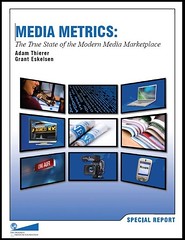 Faithful readers will recall that, several months ago, I penned a 7-part “Media Metrics” series that took a hard look at the health of the media marketplace. Today, the Progress & Freedom Foundation is releasing a greatly expanded version of these essays that I have put together with my PFF colleague Grant Eskelsen. In this 100-page special report, “Media Metrics: The True State of the Modern Media Marketplace,” we begin by noting that heated debates about the state of the media marketplace continue to rage in Washington, and opinions seem to range from grim to outright apocalyptic. As we note on pg. 1:
Many people—including a large number of legislators and regulators—argue that America’s media marketplace is in a miserable state. Some claim that citizens lack choice in media outlets and that options are just as scarce as ever. Others believe that media “localism” is dead or that many groups or niches go underserved because of a lack of true “diversity” in media. Others argue that the market is hopelessly over-concentrated in the hands of a few evil media barons who are hell-bent on force-feeding us corporate propaganda. And still others say that the quality of news and entertainment in our society has deteriorated because of a combination of all of the above. It all sounds quite troubling, but is any of it true?
After taking an objective look at the true state of America’s media marketplace, we conclude that such pessimism is unwarranted. Indeed, a careful review of the facts reveals that—contrary to what those media critics suggest—we have more media choice, more media competition, and more media diversity than ever before. Indeed, to the extent there was ever a “golden age” of media in America, we are living in it today. The media sky has never been brighter and it is getting brighter with each passing year.
Continue reading →

 The Technology Liberation Front is the tech policy blog dedicated to keeping politicians' hands off the 'net and everything else related to technology.