Everywhere you look in tech policy land these days, people decry China as a threat to America’s technological supremacy or our national security. Many of these claims are well-founded, while others are somewhat overblown. Regardless, as I argue in a new piece for National Review this week, “America Won’t Beat China by Becoming China.” Many pundits and policymakers seem to think that only a massive dose of central planning and Big Government technocratic bureaucracy can counter the Chinese threat. It’s a recipe for a great deal of policy mischief.
Some of these advocates for a ‘let’s-be-more-like-China’ approach to tech policy also engage in revisionist histories about America’s recent success stories in the personal computing revolution and internet revolution. As I note in my essay, “[t]he revisionists instead prefer to believe that someone high up in government was carefully guiding this decentralized innovation. In the new telling of this story, deregulation had almost nothing to do with it.” In fact, I was asked by
National Review to write this piece in response to a recent essay by Wells King of American Compass, who has penned some rather remarkable revisionist tales of government basically being responsible for all the innovation in digital tech sectors over the past quarter century. Markets and venture capital had nothing to do with it by his reasoning. It’s what Science writer Matt Ridley correctly labels “innovation creationism,” or the notion that it basically takes a village to raise an innovator. Continue reading →
Wishful thinking is a dangerous drug. Some pundits and policymakers believe that, if your intentions are pure and you have the “right” people in power, all government needs to do is sprinkle a little pixie dust (in the form of billions of taxpayer dollars) and magical things will happen.
Of course, reality has a funny way of throwing a wrench into the best-laid plans. Which brings me to the question I raise in a new 2-part series for
Discourse magazine: Can governments replicate Silicon Valley everywhere?
In the first installment, I explore the track record of federal and state attempts to build tech clusters, science parks & “regional innovation hubs” using state subsidies and industrial policy. This is highly relevant today because of the huge new industrial policy push at the federal level is building on top of growing state and local efforts to create tech hubs, science parks, or various other types of industrial “clusters.
At the federal level, this summer, the Senate passed a 2,300-page industrial policy bill, the “United States Innovation and Competition Act of 2021,” that included almost $10 billion over four years for a Department of Commerce-led effort to fund 20 new regional technology hubs, “in a manner that ensures geographic diversity and representation from communities of differing populations.” A similar proposal that is moving in the House, the “Regional Innovation Act of 2021,” proposes almost $7 billion over five years for 10 regional tech hubs. Meanwhile, the Biden administration also is pitching ideas for new high-tech hubs. In late July, the Commerce Department’s Economic Development Administration announced plans to allocate $1 billion in pandemic recovery funds to create or expand “regional industry clusters” as part of the administration’s new Build Back Better Regional Challenge. Among the possible ideas the agency said might win funding are an “artificial intelligence corridor,” an “agriculture-technology cluster” in rural coal counties, a “blue economy cluster” in coastal regions, and a “climate-friendly electric vehicle cluster.”
In my essay, I note that the economic literature on these efforts has been fairly negative, to put it mildly. Continue reading →
In recent essays and papers, I have discussed the growth of “innovation arbitrage,” which I defined as, “The movement of ideas, innovations, or operations to those jurisdictions that provide a legal and regulatory environment more hospitable to entrepreneurial activity.” A new Economist article about “Why startups are leaving Silicon Valley,” discusses innovation arbitrage without calling it such. The article notes that, for a variety of reasons, Valley innovators and investors are looking elsewhere to set up shop or put money into new ventures. The article continues:
Other cities are rising in relative importance as a result. The Kauffman Foundation, a non-profit group that tracks entrepreneurship, now ranks the Miami-Fort Lauderdale area first for startup activity in America, based on the density of startups and new entrepreneurs. Mr Thiel is moving to Los Angeles, which has a vibrant tech scene. Phoenix and Pittsburgh have become hubs for autonomous vehicles; New York for media startups; London for fintech; Shenzhen for hardware. None of these places can match the Valley on its own; between them, they point to a world in which innovation is more distributed.
If great ideas can bubble up in more places, that has to be welcome. There are some reasons to think the playing-field for innovation is indeed being levelled up. Capital is becoming more widely available to bright sparks everywhere: tech investors increasingly trawl the world, not just California, for hot ideas. There is less reason than ever for a single region to be the epicentre of technology. Thanks to the tools that the Valley’s own firms have produced, from smartphones to video calls to messaging apps, teams can work effectively from different offices and places.
That’s the power of innovation arbitrage at work. Continue reading →
Here are a few Internet policy essays I collected over the past year which I thought were particularly well done and worth highlighting once more. They are listed in chronological order:
- L. Gordon Crovitz – “Silicon Valley’s ‘Suicide Impulse,'” Wall Street Journal, January 28. (“It’s a measure of how far Silicon Valley has strayed from its entrepreneurial roots that a top regulator is calling on technology companies to do less lobbying and more competing,” Crovitz argued. “Rather than lobby government to go after one another, Silicon Valley lobbyists should unite to go after overreaching government. Instead of the “suicide impulse” of lobbying for more regulation, Silicon Valley should seek deregulation and a long-overdue freedom to return to its entrepreneurial roots.”)
- John Gruber – “Open and Shut,” Daring Fireball, March 1. (An absolutely brutal evisceration of Tim Wu’s recent work.)
- R. U. Sirius – “Cypherpunk Rising: WikiLeaks, Encryption, and the Coming Surveillance Dystopia,” The Verge, March 7.
- Julian Sanchez – “A Reply to Epstein & Pilon on NSA’s Metadata Program,” Cato at Liberty, June 16. (A meticulous point-by-point takedown of an essay by Roger Pilon & Richard Epstein defending NSA’s online surveillance tactics.)
- Ethan Zuckerman – “Is Cybertopianism Really Such a Bad Thing?” Slate, June 17 (A “defense of believing that technology can do good.”)
Continue reading →
I liked the title of this new Cecilia Kang article in the Washington Post: “In Silicon Valley, Fast Firms and Slow Regulators.” Kang notes:
As federal regulators launch fresh investigations into Silicon Valley, their history of drawn-out cases has companies on edge. In taking on an industry that moves at lightening speed, federal officials risk actions that could appear to be too heavy-handed or embarrassingly outdated, some analysts and antitrust experts say.
For example, she cites ongoing regulatory oversight of Microsoft and MySpace, even though both companies have fallen from the earlier King of the Hill status in their respective fields. Kang notes that some “want the government to aggressively pursue abusive practices but question whether antitrust laws are too dated to rein in firms that are continually redefining themselves and using their dominance in one arena to press into others.”
Simply put, antitrust can’t keep up with an economy built on Moore’s Law, which refers to the rule of thumb that the processing power of computers doubles roughly every 18 months while prices remain fairly constant. This issue has been the topic of several of my
Forbes columns over the past year, as well as several other essays I’ve written here and elsewhere. [See the list at bottom of this essay.] Moore’s Law has been a relentless regulator of markets and has helped keep the power of “tech titans” in check better than any Beltway regulator ever could. As I noted here before in my essay, “Antitrust & Innovation in the New Economy: The Problem with the Static Equilibrium Mindset“: Continue reading →
On Forbes this morning, I argue that the Department of Justice’s effort to block the AT&T/T-Mobile merger signals a dangerous turn in antitrust enforcement.
While President Obama promised during his campaign to “reinvigorate” antitrust, few expected the agency would turn its attention with such laser-like precision on the technology sector, one of the few bright spots in the economy. But as Comcast, Google, Intel, Oracle and now AT&T can testify, the agency seems determined to make its mark on the digital economy. If only it had the slightest idea how that economy actually worked, and why it works so well. Continue reading →
I’m always amused when I read stories quoting high-tech company leaders bemoaning the fact that they supposedly don’t get enough respect from Washington legislators or regulators. The latest example comes from a story in today’s Politico (“D.C. Crowd’s Path to Silicon Valley” by Tony Romm) which begins by noting that, “A trek to Silicon Valley has become a must-do for D.C. lawmakers seeking to stress their business and tech bona fides while developing relationships that could lead to big campaign donations down the road.” And yet it ends with this ironic bit:
Silicon Valley types typically don’t mind hosting lawmakers, as the trips give businesses out West the chance to put issues and needs on the minds of their regulators. But tech bellwethers sometimes don’t take kindly to lawmakers who treat the valley as an endless ATM. “All too often, people see Silicon Valley as the wallet and set aside the words or wisdom that [it] can provide,” said Carl Guardino, president and CEO of the Silicon Valley Leadership Group.
Well, boo-hoo. If Mr. Guardino and his fellow Silicon Valley travelers don’t like being treated like an ATM, then they should stop behaving like one! No one makes them give a dime to any politician. And once you start playing this game, you shouldn’t be surprised by how quickly you’ll become entrenched in the cesspool that is Beltway politics and become less and less focused on actually innovating and serving consumers.
I wish people like this would go back and read “
Why Silicon Valley Should Not Normalize Relations with Washington, D.C.” by Cypress Semiconductor President and CEO T.J. Rodgers. Everything he said 10 years ago has come true.
Continue reading →
by Berin Szoka & Adam Thierer, Progress Snapshot 5.11 (PDF)
Ten years ago, Nobel Prize-winning economist Milton Friedman lamented the “Business Community’s Suicidal Impulse:” the persistent propensity to persecute one’s competitors through regulation or the threat thereof. Friedman asked: “Is it really in the self-interest of Silicon Valley to set the government on Microsoft?” After yesterday’s FCC vote’s to open a formal “Net Neutrality” rule-making, we must ask whether the high-tech industry—or consumers—will benefit from inviting government regulation of the Internet under the mantra of “neutrality.”
The hatred directed at Microsoft in the 1990s has more recently been focused on the industry that has brought broadband to Americans’ homes (Internet Service Providers) and the company that has done more than any other to make the web useful (Google). Both have been attacked for exercising supposed “gatekeeper” control over the Internet in one fashion or another. They are now turning their guns on each other—the first strikes in what threatens to become an all-out, thermonuclear war in the tech industry over increasingly broad neutrality mandates. Unless we find a way to achieve “Digital Détente,” the consequences of this increasing regulatory brinkmanship will be “mutually assured destruction” (MAD) for industry and consumers.
New Fronts in the Neutrality Wars
The FCC’s proposed rules would apply to all broadband providers, including wireless, but not to Google or many other players operating in other layers of the Net who favor such broadband-specific rules. With this rulemaking looming, AT&T came after Google with letters to the FCC in late September and then another last week accusing the company of violating neutrality principles in their business practices and arguing that any neutrality rules that apply to ISPs should apply equally to Google’s panoply of popular services. In particular, AT&T accused Google of “search engine bias,” suggesting that only government-enforced neutrality mandates could protect consumers from Google’s supposed “monopolist” control.
The promise made yesterday by the FCC—to only apply neutrality principles to the infrastructure layer of the Net—is hollow and will ultimately prove unenforceable. Continue reading →
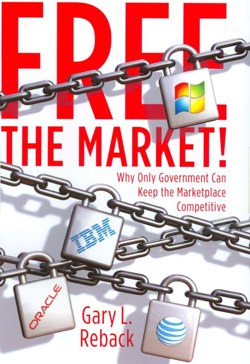 I recently finished reading Free the Market: Why Only Government Can Keep the Marketplace Competitive, a new book by noted antitrust agitator Gary L. Reback. Unsurprisingly, Reback, who led the antitrust jihad against Microsoft during the 1990s, has written a book that reads like an extended love letter to antitrust law. This man loves antitrust the way teenage girls love the Jonas Brothers — gushing, teary-eyed, ‘I-would-just-die-for-you’ sort of love. In Reback’s world, antitrust seemingly has no costs, no downsides, no trade-offs. It is our salvation and he serves as its high prophet. Everything good that happened in the world of high-tech over the past few decades? Oh, you can thank Almighty Antitrust for that. Anything bad that happened? Well, then, clearly there just wasn’t enough antitrust enforcement! That’s this book in a nutshell.
Think I’m kidding? How about this gem of quote from pg. 247: “Antitrust enforcement spawned Silicon Valley’s software industry as well.” Wow, who knew! Of course, that’s utter poppycock and should be somewhat insulting to the many entrepreneurial men and women in the high-tech world who risked everything in an attempt to build a better mousetrap. In Reback’s view of things, however, none of those mousetraps would have ever gotten built without antitrust there to supposedly shelter them from wicked “monopolists” (read: any large company) already operating in the marketplace. I’m sure many in Silicon Valley will also be surprised to hear Reback’s assertion that, “On closer examination, the Valley looks like one big public welfare project.” (p. 54) Ah yes, the old myth that government gave us the Net we know and love today. Please. Like many others, Reback spins a revisionist history of how early ARPANET involvement and seed money somehow made the Internet great when, in reality, the Net was stuck in the digital dark ages until it was finally allowed to be commercialized in 1992.
What irks me most about this book, however, is Reback’s perpetuation of the myth that antitrust is somehow not a form of economic regulation. I hear this tired old argument trotted out time and time again, even by many conservatives. Reback says, for example, that “Antitrust sets the rules of the road, so to speak, but doesn’t tell people where to drive.” By contrast, he argues, “Advocates of regulation want[] continuing government oversight and rule making to produce what would be the beneficial results of a free market… Neither approach works all the time, and decided between them remains difficult.” (p. 19) Again, this “choice” is largely a fiction since, for many industries, we end up getting both! Continue reading →
 Ellen McGirt is undoubtedly a good business reporter. Her recent cover story for Fast Company “How Cisco’s CEO John Chambers is Turning the Tech Giant Socialist,” is a great piece that shows the many interesting and truly innovative reforms that Chambers has instituted at Cisco.
However, I think McGirt is trying too hard to be clever or just doesn’t understand what socialism really means. Socialism is a political system that uses the force of government to take money from some and give it to others. Cisco is a private enterprise that’s only asking for you to buy their products.
McGirt’s confusion seems to arise from the socialist-sounding rhetoric of CEO John Chambers. He uses what McGirt calls “Collectivist Catchphrases” like “Co-Labor” to describe Cisco’s approach to management. He’s replaced managers (what many consider the avatars of capitalism) with councils and boards; emphasizes information sharing, rather than hoarding; rewards cooperation, rather than back-stabbing ladder-climbing.
But Chambers is no socialist, he’s a capitalist responding to a problem as old as business itself: How do you give those with good information and good ideas, the power to get things done?
Continue reading →

 The Technology Liberation Front is the tech policy blog dedicated to keeping politicians' hands off the 'net and everything else related to technology.