That’s basically what FTC Chairman Jon Leibowitz told the Association of National Advertisers when he spoke to their “Advertising Law & Public Policy” conference last Thursday. As I noted last week, there’s intense pressure in Congress to pass a financial regulatory overhaul and, unfortunately, the version passed by the House in December—Rep. Barney Frank’s “Wall Street Reform and Consumer Protection Act of 2009” (H.R. 4173)—would also grant the Federal Trade Commission vast new powers for all its regulations, not just those relating to the non-bank financial institutions it currently regulates. In particular, HR 4173 would:
- Make it far easier (and not just faster) for the FTC to issue all kinds of new regulations on its own, without a specific Congressional mandate to do so and instead of relying on case-by-case enforcement to punish “unfair” or “deceptive” acts and practices;
- Reduce public input into those regulations;
- Impose heavy civil penalties on companies before notifying them that a practice might be “unfair” or “deceptive”;
- Prosecute those who merely provided “substantial assistance” to someone engaged in “unfair” or “deceptive” acts or practices; and
- Sue on its own authority, instead of through DOJ (as now).
I summarized my concerns about this bill in this short interview with PFF’s new communications director, Mike Wendy, last week:
[display_podcast]
Leibowitz has lobbied hard to have his agency put on steroids (as former FTC Chairman Jim Miller put it), asking for all these things, as well as more funding, at the first Senate hearing on Hr 4173 back in February. (Conveniently, he was the only witness!) He repeated his calls for these powers on Thursday but tried to allay fears about how they’d be used. Continue reading →
On Friday, the Federal Communications Commission (FCC) released a new Notice of Inquiry entitled, “Empowering Parents and Protecting Children in an Evolving Media Landscape” (MB Docket No. 09-194). The purpose of this investigation is to:
seek information on the extent to which children are using electronic media today, the benefits and risks these technologies bring for children, and the ways in which parents, teachers, and children can help reap the benefits while minimizing the risks. (p. 2)… Our goal with this NOI is to gather data and recommend-ations from experts, industry, and parents that will enable us to identify actions that all stakeholders can take to enable parents and children to navigate this promising electronic media landscape safely and successfully. (p. 3)
This
Notice builds on the FCC’s August 31st Report to Congress (“Implementation of the Child Safe Viewing Act; Examination of Parental Control Technologies for Video or Audio Programming”) that was required pursuant to the “Child Safe Viewing Act of 2007,” which Congress passed last year and President Bush signed last December. The goal of that bill and the FCC’s proceeding (MB Docket No. 09-26) was to study “advanced blocking technologies” that “may be appropriate across a wide variety of distribution platforms, including wired, wireless, and Internet platforms.” [I filed 150+ pages worth of comments in that proceeding, and here’s my analysis of why the bill and the FCC’s proceedings are worth monitoring. In previous posts here, I also listed all the major filings and reply comments that were submitted to the FCC in the matter.]
While the FCC’s new
Notice outlines several positive impacts that media use may have for children, it then goes on to itemize a variety of concerns about media exposure: Continue reading →
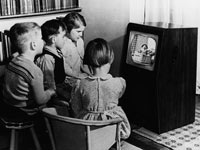 The Senate Commerce Committee held a hearing yesterday where a number of Senators as well as Julius Genachowski, the new Chairman of the Federal Communications Commission, did a lot of fretting about the state of the modern children’s television programming marketplace. According to the Wall Street Journal, Senate Commerce Committee Chairman Jay Rockefeller (D-WV):
suggested that a “little red button” be required on TVs so that a child could push the button to find out how a show is rated. Democratic Sen. Mark Pryor of Arkansas agreed that a red button might help since parents often have difficulties figuring out which shows are appropriate for their children to watch.
Well, I have some good news for the Senators: There are already quite a few little buttons on every remote control made today, and at least one of those buttons can pull up an on-screen guide to get more program info! (Another of them can turn the TV off!) Moreover, the ratings for just about every program already appear at the beginning of each show, and sometimes in between. And you can find out plenty more online about every TV show under the sun if you care to look. So, I’m not sure what that fuss is all about, and we certainly don’t need to mandate “little red buttons” on every TV set when program information can be found in so many other ways.
What is more troubling about all the hand-wringing taking place at the hearing, as well as the talk of reopening the Children’s Television Act of 1990 to potentially impose more content mandates on video programmers and distributors, is that: (1) there doesn’t seem to be much appreciation for just how much wonderful children’s programming is out there today compared to the past, and (2) there doesn’t seem to be much recognition of the serious First Amendment issues at stake when government gets involved in the messy business of regulating video programming.
Continue reading →
 Chairman Mao–er… Martin–has canceled (WSJ) the FCC’s December 18 meeting, when the Commission was set to vote on Martin’s proposal to rig an auction to give away a valuable piece of spectrum (“AWS-3”) to M2Z networks. In exchange for a sweetheart deal on the spectrum, the company would have been required to use a quarter of it to provide a free (but very slow) wireless broadband service. Martin had initially proposed to require that the service be made porn-free, but eventually suggested that users over 18 would be able to opt-out of network-level filtering.
Two weeks ago, when it became clear that Martin would attempt to ram this proposal through while he still could, I asked how the ascendant Left would respond:
Will the defenders of free expression triumph over those who see ensuring free broadband as a social justice issue? Or will those on the Left who usually joining us in opposing censorship simply remain silent as the government extends the architecture of censoring the “public airways” onto the Net (where the underlying rationale of traditional broadcast regulation–that parents are powerless–does not apply)?
I’m glad to see that the deathblow to this unconstitutional proposal did indeed come from the political Left–specifically, from Sen. John Rockefeller, (D-W.Va.) and Rep. Henry Waxman, (D-Calif.), who will be responsible for overseeing the FCC in the new Congress. (The Bush administration had already opposed the proposal, as with so many of Martin’s abuses, had failed to stop it.)
With President-elect Obama having declared that, “Here in the country that invented the Internet, every child should have the chance to get online,” it seems almost certain that the Administration will press ahead with some kind of universal broadband proposal of its own. But what would such a proposal look like? If it’s another public broadband utility, would it include network-level filtration like Martin’s proposal? If so, will the Democratic opponents of government censorship stick by their principles and fight that, too?
I suspect we may find that what’s constitutional is politically impossible (unfiltered free Internet) and what’s politically possible (filtered free Internet) is unconstitutional. Continue reading →
Well, I know I’m starting to sound like a broken record on this point, but it never ceases to amaze me how some policymakers get away with speaking so poorly of parents during policy debates about media content. First, you will recall that, in late April, the Federal Communications Commission released a report calling for the regulation of violent video content on the grounds that parental control tools and efforts were ineffective. (For details, see my essay: “FCC Violence Report Concludes that Parenting Doesn’t Work.”) Then, just last week, at a House Commerce hearing on “The Images Kids See on the Screen,” Rep. Ed Markey and several other members of the committee argued that parents just couldn’t cope with modern media and that government needed to step in on their behalf. But nothing could top the performance of Sen. John Rockefeller at today’s Senate Commerce Committee hearing on “The Impact of Media Violence on Children.”
Sen. Rockefeller opened the hearing with a verbal tirade “repeatedly bashing TV and its executives as though they were Dan Aykroyd’s Irwin Mainway SNL character out to sell bags-o-glass to unsuspecting kids,” as John Eggerton of Broadcasting & Cable noted. Sen. Rockefeller, who is planning to soon introduce legislation to regulate “excessively violent” television programming, said that the industry is being “cowardly” and “debasing our culture” in a “never-ending race to the bottom.”
Rockefeller went on to say that the industry was “blaming parents” for not dealing with the problem of objectionable content with private controls and methods instead of censoring content themselves before it ever got on air. “Parents do not want more tools,” he argued, “they want the content off the air.” Of course, that point is debatable as I’ll discuss more below.
Continue reading →
In Part 1 of this series, I argued that the Democratic Party seems to be gradually abandoning whatever claim it once had to being the party of the First Amendment. Regrettably, examples of Democrats selling out the First Amendment are becoming more prevalent and the few champions of freedom of speech and expression left in the party are getting more difficult to find.
For example, in my previous essay, I documented how Democratic politicians were leading the charge to reinstitute the so-called Fairness Doctrine. In today’s entry I will discuss how Democrats are now working hand-in-hand with Republicans to orchestrate what would constitute the most significant expansion of content regulation in decades–the regulation of “excessive violence” on television.
Continue reading →
The idea that the Democrats are the party of free speech and the great protectors of our nation’s First Amendment heritage has always been a bit of a myth. In reality, when you study battles over freedom of speech and expression throughout American history you quickly come to realize that there are plenty of people in both parties would like to serve as the den mothers of the American citizenry. That being said, it is generally true that there have been a few more voices in the Democratic party willing to stand in opposition to governmental attempts to regulate speech in the past.
But I’m starting to wonder where even that handful of First Amendment champions has gone. Sadly, examples of Democrats selling out the First Amendment are becoming so common that I’ve decided to start a new series to highlight recent examples of Dems actually leading the charge for increased government regulation of speech and expression. I want to stress that I’m not trying to pick on Democrats here, rather, I’m just trying to point out that–unless there is a sea change in their approach to these issues by Democrats in coming months and years–both parties now appear to be singing out of the same pro-regulatory hymnal. This constitutes an ominous threat to the future of free expression.
Today, as part of this new series, I’ll be focusing on the Democratic-led efforts to revive the hideously misnamed “Fairness Doctrine.”
Continue reading →

 The Technology Liberation Front is the tech policy blog dedicated to keeping politicians' hands off the 'net and everything else related to technology.