On December 13th, I will be participating in an Atlas Network panel on, “Big Tech, Free Speech, and Censorship: The Classical Liberal Approach.” In anticipation of that event, I have also just published a new op-ed for The Hill entitled, “Left and right take aim at Big Tech — and the First Amendment.” In this essay, I expand upon that op-ed and discuss the growing calls from both the Left and the Right for a variety of new content regulations. I then outline the classical liberal approach to concerns about free speech platforms more generally, which ultimately comes down to the proposition that innovation and competition are always superior to government regulation when it comes to content policy.
In the current debates, I am particularly concerned with calls by many conservatives for more comprehensive governmental controls on speech policies enforced by various private platforms, so I will zero in on those efforts in this essay. First, here’s what both the Left and the Right share in common in these debates: Many on both sides of the aisle desire more government control over the editorial decisions made by private platforms. They both advocate more political meddling with the way private firms make decisions about what types of content and communications are allowed on their platforms. In today’s hyper-partisan world,” I argue in my
Hill column, “tech platforms have become just another plaything to be dominated by politics and regulation. When the ends justify the means, principles that transcend the battles of the day — like property rights, free speech and editorial independence — become disposable. These are things we take for granted until they’ve been chipped away at and lost.”
Despite a shared objective for greater politicization of media markets, the Left and the Right part ways quickly when it comes to the underlying objectives of expanded government control. As I noted in my
Hill op-ed:
there is considerable confusion in the complaints both parties make about “Big Tech.” Democrats want tech companies doing more to limit content they claim is hate speech, misinformation, or that incites violence. Republicans want online operators to do less, because many conservatives believe tech platforms already take down too much of their content.
This makes life very lonely for free speech defenders and classical liberals. Usually in the past, we could count on the Left to be with us in some free speech battles (such as putting an end to “indecency” regulations for broadcast radio and television), while the Right would be with us on others (such as opposition to the “Fairness Doctrine,” or similar mandates). Today, however, it is more common for classical liberals to be fighting with both sides about free speech issues.
My focus is primarily on the Right because, with the rise of Donald Trump and “national conservatism,” there seems to be a lot of soul-searching going on among conservatives about their stance toward private media platforms, and the editorial rights of digital platforms in particular. Continue reading →
I was my pleasure to appear on the latest episode of the Dissed podcast to discuss economic liberty and the right to earn a living. The show was hosted by Anastasia Boden and Elizabeth Slattery of the Pacific Legal Foundation and it included legal scholars Hadley Arkes, Timothy Sandefur, and Clark Neily. I appear in the second half of the program.
Compliance paradox: The situation in which heightened legal or regulatory efforts fail to reverse unwanted behavior and instead lead to increased legal evasion and additional enforcement problems.
Demosclerosis: Growing government dysfunction brought on by the inability of public institutions to adapt to change, especially technological change.
Evasive entrepreneurs: Innovators who do not always conform to social or legal norms.
Free innovation: Bottom-up, noncommercial forms of innovation that often take on an evasive character. Free innovation is sometimes called “grassroots” or “household” innovation or “social entrepreneurialism.” Even though it is typically noncommercial in character, free innovation often involves regulatory entrepreneurialism and technological civil disobedience.
Innovation arbitrage: The movement of ideas, innovations, or operations to jurisdictions that provide legal and regulatory environments most hospitable to entrepreneurial activity. It can also be thought of as a form of jurisdictional shopping and can be facilitated by competitive federalism.
Innovation culture: The various social and political attitudes and pronouncements toward innovation, technology, and entrepreneurial activities that, taken together, influence the innovative capacity of a culture or nation.
Pacing problem: A term that generally refers to the inability of legal or regulatory regimes to keep up with the intensifying pace of technological change.
Permissionless innovation: The general notion that “it’s easier to ask forgiveness than it is to get permission.” As a policy vision, it refers to the idea that experimentation with new technologies and innovations should generally be permitted by default.
Precautionary principle: The practice of crafting public policies to control or limit innovations until their creators can prove that they will not cause any harm or disruptions.
Regulatory entrepreneurs: Evasive entrepreneurs who set out to intentionally challenge and change the law through their innovative activities. In essence, policy change is part of their business model.
Soft law: Informal, collaborative, and constantly evolving governance mechanisms that differ from hard law in that they lack the same degree of enforceability.
Technological civil disobedience: The technologically enabled refusal of individuals, groups, or businesses to obey certain laws or regulations because they find them offensive, confusing, time-consuming, expensive, or perhaps just annoying and irrelevant.
Technologies of freedom: Devices and platforms that let citizens openly defy (or perhaps just ignore) public policies that limit their liberty or freedom to innovate. Another term with the same meaning is “technologies of resistance.”
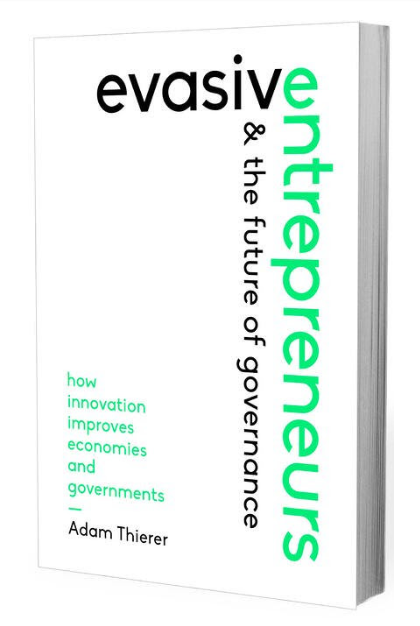
In coming days and weeks I will be occasionally blogging about different arguments made in the 368-page book, but here’s a quick summary of some of the key points I make in the book. These ten passages are pulled directly from the text:
“the freedom to innovate is essential to human betterment for each of us individually and for civilization as a whole. That freedom deserves to be taken more seriously today.”
“Entrepreneurialism and technological innovation are the fundamental drivers of economic growth and of the incredible advances in the everyday quality of life we have enjoyed over time. They are the key to expanding economic opportunities, choice, and mobility.”
“Unfortunately, many barriers exist to expanding innovation opportunities and our entrepreneurial efforts to help ourselves, our loved ones, and others. Those barriers include occupational licensing rules, cronyism-based industrial protectionist schemes, inefficient tax schemes, and many other layers of regulatory red tape at the federal, state, and local levels. We should not be surprised, therefore, when citizens take advantage of new technological capabilities to evade some of those barriers in pursuit of their right to earn a living, to tinker with or try doing new things, or just to learn about the world and serve it better.”
“Evasive entrepreneurs rely on a strategy of permissionless innovation in both the business world and the political arena. They push back against ‘the Permission Society,’ or the convoluted labyrinth of permits and red tape that often encumber entrepreneurial activities.”
“We should be willing to tolerate a certain amount of such outside-the-box thinking because entrepreneurialism expands opportunities for human betterment by constantly replenishing the well of important, life-enhancing ideas and applications.”
“we should better appreciate how creative acts and the innovations they give rise to can help us improve government by keeping public policies fresh, sensible, and in line with common sense and the consent of the governed.”
“Evasive entrepreneurialism is not so much about evading law altogether as it is about trying to get interesting things done, demonstrating a social or an economic need for new innovations in the process, and then creating positive leverage for better results when politics inevitably becomes part of the story. By acting as entrepreneurs in the political arena, innovators expand opportunities for themselves and for the public more generally, which would not have been likely if they had done things by the book.”
“Dissenting through innovation can help make public officials more responsive to the people by reining in the excesses of the administrative state, making government more transparent and accountable, and ensuring that our civil rights and economic liberties are respected.”
“In an age when many of the constitutional limitations on government power are being ignored or unenforced, innovation itself can act as a powerful check on the power of the state and can help serve as a protector of important human liberties.”
“Lawmakers and regulators need to consider a balanced response to evasive entrepreneurialism that is rooted in the realization that technology creators and users are less likely to seek to evade laws and regulations when public policies are more in line with common sense.”
Defining “privacy” is a legal and philosophical nightmare. Few concepts engender more definitional controversies and catfights. As someone who is passionate about his own personal privacy — but also highly skeptical of top-down governmental attempts to regulate and/or protect it — I continue to be captivated by the intellectual wrangling that has taken place over the definition of privacy. Here are some thoughts from a wide variety of scholars that make it clear just how frustrating this endeavor can be:
“Perhaps the most striking thing about the right to privacy is that nobody seems to have any very clear idea what it is.” – Judith Jarvis Thomson, “The Right to Privacy,” in Philosophical Dimensions of Privacy: An Anthology, 272, 272 (Ferdinand David Schoeman ed., 1984).
privacy is “exasperatingly vague and evanescent.” – Arthur Miller, The Assault on Privacy: Computers, Data Banks, and Dossiers, 25 (1971).
“[T]he concept of privacy is infected with pernicious ambiguities.” – Hyman Gross, The Concept of Privacy, 42 N.Y.U. L. REV. 34, 35 (1967).
“Attempts to define the concept of ‘privacy’ have generally not met with any success.” – Colin Bennett, Regulating Privacy: Data Protection and Public Policy In Europe and the United States, 25 (1992).
“When it comes to privacy, there are many inductive rules, but very few universally accepted axioms.” – David Brin, The Transparent Society: Will Technology Force Us To Choose Between Privacy and Freedom? 77(1998).
“Privacy is a value so complex, so entangled in competing and contradictory dimensions, so engorged with various and distinct meanings, that I sometimes despair whether it can be usefully addressed at all.” – Robert C. Post, Three Concepts of Privacy, 89 GEO. L.J. 2087, 2087 (2001).
“[privacy] can mean almost anything to anybody.” – Fred H. Cate & Robert Litan, Constitutional Issues in Information Privacy, 9Mich. Telecomm. & Tech. L. Rev. 35, 37 (2002).
privacy has long been a “conceptual jungle” and a “concept in disarray.” “[T]he attempt to locate the ‘essential’ or ‘core’ characteristics of privacy has led to failure.” – Daniel J. Solove, Understanding Privacy 196, 8 (2008).
“Privacy has really ceased to be helpful as a term to guide policy in the United States.” – Woodrow Hartzog, quoted in Cord Jefferson, Spies Like Us: We’re All Big Brother Now, Gizmodo, Sept. 27, 2012.
“for most consumers and policymakers, privacy is not a rational topic. It’s a visceral subject, one on which logical arguments are largely wasted.” – Larry Downes, A Rational Response to the Privacy “Crisis,” Cato Institute, Policy Analysis No. 716 (Jan. 7, 2013), at 6.
A report in the U.K. Telegraph notes that the European Union is seeking to create a so-called “right to be forgotten” online, and has “drafted potential legislation that would include new, unprecedented privacy rights for citizens sharing personal data.” Details are sparse at this point, but according to this new 20-page European Commission document, “A Comprehensive Approach on Personal Data Protection in the European Union,” the EU will be:
clarifying the so-called ‘right to be forgotten’, i.e. the right of individuals to have their data no longer processed and deleted when they are no longer needed for legitimate purposes. This is the case, for example, when processing is based on the person’s consent and when he or she withdraws consent or when the storage period has expired. (p.8)
What Unites Advocates of Speech Controls & Privacy Regulation? [pdf]
by Adam Thierer & Berin Szoka
The Progress & Freedom Foundation,
Progress on Point No. 16.19
Anyone who has spent time following debates about speech and privacy regulation comes to recognize the striking parallels between these two policy arenas. In this paper we will highlight the common rhetoric, proposals, and tactics that unite these regulatory movements. Moreover, we will argue that, at root, what often animates calls for regulation of both speech and privacy are two remarkably elitist beliefs:
People are too ignorant (or simply too busy) to be trusted to make wise decisions for themselves (or their children); and/or,
All or most people share essentially the same values or concerns and, therefore, “community standards” should trump household (or individual) standards.
While our use of the term “elitism” may unduly offend some understandably sensitive to populist demagoguery, our aim here is not to launch a broadside against elitism as
Time magazine culture critic William H. Henry once defined it: “The willingness to assert unyieldingly that one idea, contribution or attainment is better than another.”[1] Rather, our aim here is to critique that elitism which rises to the level of political condescension and legal sanction. We attack not so much the beliefs of some leaders, activists, or intellectuals that they have a better idea of what it in the public’s best interest than the public itself does, but rather the imposition of those beliefs through coercive, top-down mandates.
That sort of elitism—elitism enforced by law—is often the objective of speech and privacy regulatory advocates. Our goal is to identify the common themes that unite these regulatory movements, explain why such political elitism is unwarranted, and make it clear how it threatens individual liberty as well as the future of free and open Internet. As an alternative to this elitist vision, we advocate an empowerment agenda: fostering an environment in which users have the tools and information they need to make decisions for themselves and their families. Continue reading →
I was over at the Federal Communications Commission (FCC) the other day chatting with someone about various regulatory issues and Rush Limbaugh’s WSJ editorial came up. The person I was speaking with made a comment about how conservatives have really been energized and unified in opposition to the re-imposition to the Doctrine. I reminded them, however, that it wasn’t always the case that conservatives stood together in the fight over the Fairness Doctrine. In fact, when I first came to town almost 20 years ago, there were still plenty of conservatives who actually favored it. I was reminded of that fact when reading a new piece in Engage about “Broadcast ‘Fairness’ in the Twenty-First Century” by my friend Robert Corn-Revere. Bob is one America’s great First Amendment defenders and his new essay offers an excellent history of efforts to micro-manage speech on the broadcast airwaves over the years. In it, he reminds us that:
Given the recent vocal opposition to the Fairness Doctrine in the interest of preserving conservative talk radio, it is easy to forget that many prominent conservatives championed the doctrine before its demise. Phyllis Schlafly was a vocal proponent of the Fairness Doctrine because of what she described as “the outrageous and blatant anti-Reagan bias of the TV network newscasts,” and she testified at the FCC in the 1980s in support of the policy “to serve as a small restraint on the monopoly power wielded by Big TV Media.” Senator Jesse Helms was another long-time advocate of the Fairness Doctrine, and conservative groups Accuracy in Media and the American Legal Foundation actively pursued fairness complaints at the FCC against network newscasts.
Likewise, in our book, A Manifesto for Media Freedom, Brian Anderson and I note that some other prominent right-leaning politicians, such as Sen. Trent Lott, favored the Fairness Doctrine. Moreover, even though most of those conservative individuals and groups have now turned against the Fairness Doctrine, some Republicans still defend (or even seek to expand) the same underlying regulatory concepts that served as the foundation of the Fairness Doctrine. As Corn-Revere notes: Continue reading →
Bruce Owen, America’s preeminent media economist–with apologies to Harold Vogel, who at least deserves an honorable mention–has written another splendid piece for Cato’s Regulation magazine, this one entitled, “The Temptation of Media Regulation.”
This latest essay deals primarily with the many fallacies surrounding so-called “a la carte” regulation of the video marketplace, and I encourage you to read it to see Owen’s powerful refutation of the twisted logic behind that regulatory crusade. But I wanted to highlight a different point that Bruce makes right up front in his essay because it is something I am always stressing in my work too.
In some of my past work on free speech and media marketplace regulation, I have argued that there is very little difference between Republicans and Democrats when it comes to these issues. They are birds of feather who often work closely together to regulate speech and media. Whether it is broadcast ‘indecency’ controls; proposals to extend those controls to cable & satellite TV; campaign finance laws; efforts to limit or rollback ownership regulations; or even must carry and a la carte, the story is always the same: It’s one big bipartisan regulatory love fest. [And the same goes for regulation of the Internet, social networking sites, and video games.]
The Technology Liberation Front is the tech policy blog dedicated to keeping politicians' hands off the 'net and everything else related to technology. Learn more about TLF →


 The Technology Liberation Front is the tech policy blog dedicated to keeping politicians' hands off the 'net and everything else related to technology.