Posts tagged as:

Shane Greenstein, Kellogg Chair in Information Technology at Northwestern’s Kellogg School of Management, discusses his recent paper, Collective Intelligence and Neutral Point of View: The Case of Wikipedia , coauthored by Harvard assistant professor Feng Zhu. Greenstein and Zhu’s paper takes a look at whether Linus’ Law applies to Wikipedia articles. Do Wikipedia articles have a slant or bias? If so, how can we measure it? And, do articles become less biased over time, as more contributors become involved? Greenstein explains his findings.

Download

Related Links

If you follow me on Twitter, you’ll see in among the last several weeks’ dreck some Tweets skeptical of various themes about the Tea Party movement—chiefly that they’re significantly racist/xenophobic, or that they’re handmaidens of figures like Glenn Beck or Sarah Palin.

I may have been bending over backwards to resist attempts to define the Tea Party movement. In secret, I’ve thought about parallels to punk rock, which seemed at times to have as many strains as people. Part of being punk was not fitting into anyone else’s categories, and the Tea Party seems to have this quality—rejecting Washington, D.C.’s party labels and ideological affiliations.

Well, I’ve finally come across a careful assessment of the Tea Party movement. National Journal‘s Jonathan Rauch spent a good deal of time studying the Tea Party movement and came up with the article (and video), “How Tea Party Organizes Without Leaders.”

The winner paragraph for me:

“Essentially what we’re doing is crowd-sourcing,” says Meckler, whose vocabulary betrays his background as a lawyer specializing in Internet law. “I use the term open-source politics. This is an open-source movement.” Every day, anyone and everyone is modifying the code. “The movement as a whole is smart.”

I do believe there is something special about the Tea Party movement. Somewhat like the Internet regards censorship as damage and routes around it, the Tea Party routes around centralizers’ attempts to capture its mojo.

There are plenty working to capture its mojo: Right-wing and Republican leaders are using it to aggrandize themselves, marching in front of the Tea Party for TV cameras and newspapers. Left-wing groups and progressives are searching for—and finding—the racism and xenophobia that unfortunately does exist in any large collection of average Americans. The decentralized character of the Tea Party movement makes it easy for charlatans to claim its mantle and fund-raise deceptively on the “Tea Party” brand.

There are some bad people in the Tea Party movement, just like there are some bad users of the Internet. But overall a self-organizing political/cultural network will produce better things—and faster—than a hierarchical organization.

I’d love to have the Tea Party movement push for exquisitely libertarian outcomes, and I regret hearing Tea Party participants veer into anything resembling racism, fear of Islam, or anti-immigration rhetoric, but I don’t get to own the Tea Party either.

If there is a theme that doesn’t unfairly push the Tea Party movement into a box, I think it’s “self-government.” It seems like Tea Partiers are tired of being told how to do their politics, tired of being told how their government is going to run them. On the whole, I’ll stand up for a network of people who think like that—but don’t try to push me into a box either.

Update: David Boaz has written an excellent post at Cato@Liberty about the Tea Party movement’s relationships to libertarianism and social conservatism.

Cyber Shockwave FAIL

by on February 21, 2010 · 10 comments

From my undulating perch on an elliptical machine last night, I saw that CNN was broadcasting a strange roundtable event called “cyber.shockwave”—they occasionally displayed a subhead saying something like “you were warned.”

It was a group of (mostly) former Bush Administration officials sitting around making their pitch that we should be frightened about yet another menace and that our salvation is to run to the arms of government (especially if it’s controlled by their party). The CNN airing of it was illustration of how politics and public policy are collapsing together with entertainment—reality TV, specifically. The government “experts” were actors in a play dressed up as a newscast.

This post at “Crabbyolbastard Ruminates” captures my sense of what was going on. (“I see that we as a country are being led by blithering Luddites . . .”) As reported by Crabbyol’, the ideas they discussed included: pulling the plug on the Internet, pulling the plug on the cell phone networks, and nationalizing the telco and power companies.

D33PT00T tweets, cleverly, “ok my phn doesn’t work & Internet doesn’t work – ths guys R planning 2 run arnd w/ bullhorns ‘all is well remain calm!'”

Maybe it’s coincidence that Republicans dominated the scene. It was an event put together by the “Bipartisan Policy Center.” But that just goes to show that there is bipartisan agreement on one thing in Washington, D.C.: The government should control more of the society.

The U.S. federal government is not where the action is on “cybersecurity.” It is the responsibility of coders, device manufacturers, network operators, data holders, and ordinary computer users. The CNN broadcast of this event mislead viewers into thinking that cybersecurity is the government’s responsibility and that the government will lead any response to security failures.

Heaven help us if that becomes the reality.

Over at TVNewsday, Harry A. Jessell writes:

I don’t like the way the new FCC is shaping up. There’s something missing.

My concern has nothing to do with Julius Genachowski, whom the president has reportedly tapped for chairman….

What I’m having trouble with are the names popping up for the Republican seat….

All [the rumored candidates] work or used to work on Capitol Hill. They are basically experts on policymaking, crafting legislation and Washington politics, but not much else.

The seat is turning into a reward for loyalty and a test of whose boss has the most clout.

Bad idea.

As the professed champion of business, the Republicans should award the seat to a businessman or a businesswoman.

I’m talking about somebody who has actually done some hiring and firing, made a payroll in tough times, sweated a big sale, produced goods or services, acquired another company, got a loan to expand operations or survive a downturn and struggled to untangle and comply with federal regulations.

There’s a double standard here.

Ajit Pai, for example, who is one of the Republican candidates, is Deputy General Counsel of the FCC.  He served as Chief Counsel of the U.S. Senate Judiciary Committee’s Subcommittee on the Constitution, Senior Counsel at the Office of Legal Policy at the U.S. Department of Justice, Deputy Chief Counsel of the U.S. Senate Judiciary Committee’s Subcommittee on Administrative Oversight and the Courts, an Honors Program trial attorney in the Telecommunications Task Force at the U.S. Department of Justice’s Antitrust Division and a law clerk to Judge Martin L.C. Feldman of the U.S. District Court for the Eastern District of Louisiana. He graduated with honors from Harvard College and from the University of Chicago Law School, where he was an editor of the University of Chicago Law Review.

Continue reading →

When the history books are finally written, I think it’s clear that outgoing FCC Chairman Kevin Martin will likely go down as one of — if not the — most aggressively pro-regulatory Republican chairman in the agency’s history.  Despite his occasional claims of believing in free markets and his support for a couple of legitimately deregulatory decisions, his tenure at the FCC has generally been characterized by a growth of government power, spending, and bureaucracy. But don’t take my word for it; read the report he issued last week called “Moving Forward,” which to some of us looks more like moving backwards (or at least stuck in the same ol’ mud).

Martin, however, touts his regulatory actions and expansion of FCC power as uniformly pro-consumer. Martin is just another in the long line of statists who claims that consumer welfare can only be enhanced by adding layers of government mandates and regulatory red tape.  History teaches us a different lesson: That regulation and bureaucracy typically stifle innovation and competition and hurt consumer welfare in the process. Moreover, there are some constitutional considerations and limitations that should trump — or at least limit — the powers of unelected bureaucrats to run roughshod over our rights. But hey, who cares about those meddlesome little things like the First, Fifth, Tenth, or Fourteenth Amendments?!  Certainly not Kevin Martin.

What’s equally troubling about Martin’s tenure at the agency is the track record of mismanagement and the bad blood that seemingly surrounds everything and everyone he comes in contact with. The picture painted in the House Energy & Commerce Committee’s 110-page report, “Deception and  Distrust: The FCC Under Chairman Kevin J.Martin,” is not a pretty one — although the report failed to mention that waste, mismanagement, and other regulatory shenanigans have been going on at this agency under the days of Democratic rule, too.

Martin’s response to the House report was all too predictable: The evil corporate interests are out to get me!  “[M]ost of the criticisms contained in the Majority Staff Report,” Martin says in a letter released a few days ago, “reflect the vehement opposition of the cable and wireless industries to my policies to serve and protect consumers.”

Whatever.

I’m just glad this nightmare is over. Hopefully Martin’s tenure will serve as a cautionary tale for a future Republican administration: If you actually believe in free minds and free markets, try vetting the guy you install at the FCC to make sure he’s a true believer as well.

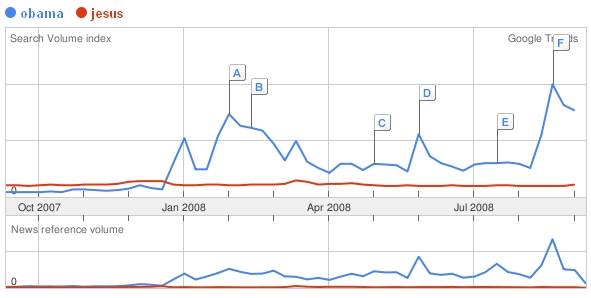
“Bigger than Jesus”

by on September 17, 2008 · 3 comments

In the beginning, there was Obamamania: