Posts tagged as:

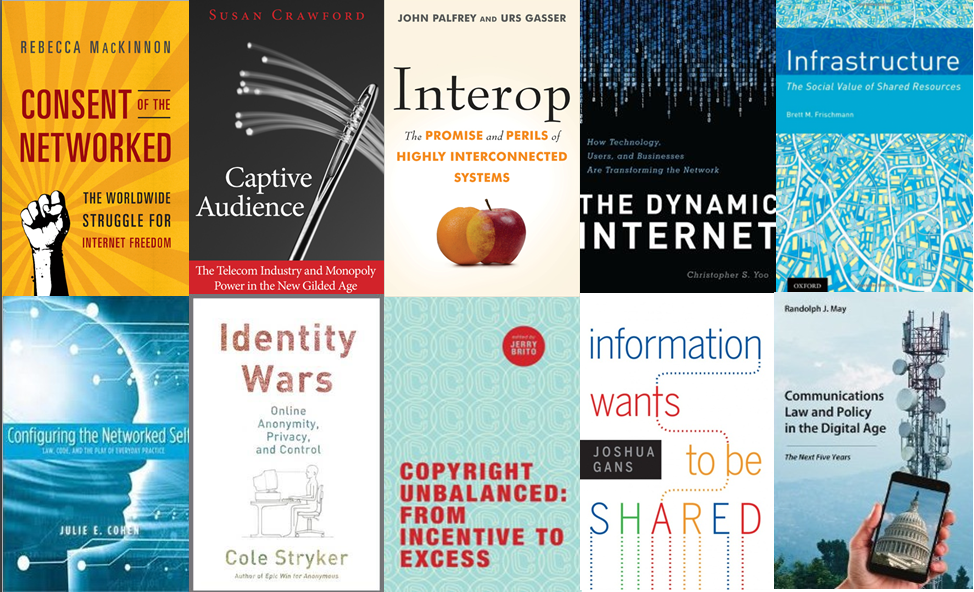
Interoperability is a topic that has long been of interest to me. How networks, platforms, and devices work with each other–or sometimes fail to–is an important engineering, business, and policy issue. Back in 2012, I spilled out over 5,000 words on the topic when reviewing John Palfrey and Urs Gasser’s excellent book, Interop: The Promise and Perils of Highly Interconnected Systems.

I’ve always struggled with the interoperability issues, however, and often avoided them became of the sheer complexity of it all. Some interesting recent essays by sci-fi author and digital activist Cory Doctorow remind me that I need to get back on top of the issue. His latest essay is a call-to-arms in favor of what he calls “adversarial interoperability.” “[T]hat’s when you create a new product or service that plugs into the existing ones without the permission of the companies that make them,” he says. “Think of third-party printer ink, alternative app stores, or independent repair shops that use compatible parts from rival manufacturers to fix your car or your phone or your tractor.”

Doctorow is a vociferous defender of expanded digital access rights of many flavors and his latest essays on interoperability expand upon his previous advocacy for open access and a general freedom to tinker. He does much of this work with the Electronic Frontier Foundation (EFF), which shares his commitment to expanded digital access and interoperability rights in various contexts.

I’m in league with Doctorow and EFF on some of these things, but also find myself thinking they go much too far in other ways. At root, their work and advocacy raise a profound question: should there be any general right to exclude on digital platforms? Although he doesn’t always come right out and say it, Doctorow’s work often seems like an outright rejection of any sort of property rights in networks or platforms. Generally speaking, he does not want the law to recognize any right for tech platforms to exclude using digital fences of any sort. Continue reading →

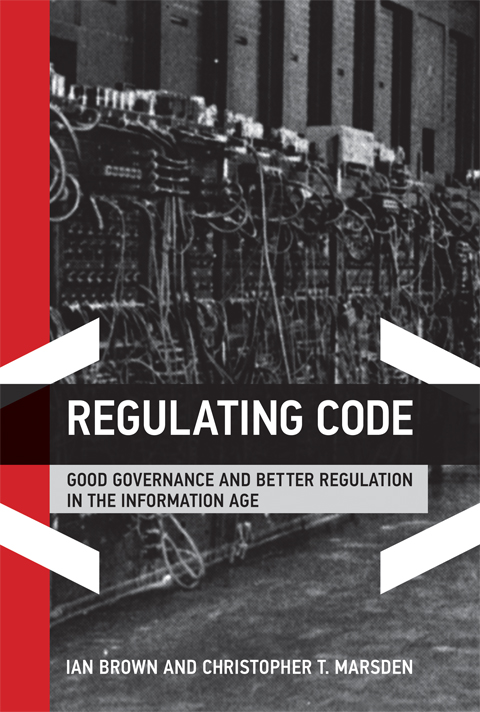
Regulating Code book coverIan Brown and Christopher T. Marsden’s new book, Regulating Code: Good Governance and Better Regulation in the Information Age, will go down as one of the most important Internet policy books of 2013 for two reasons. First, their book offers an excellent overview of how Internet regulation has unfolded on five different fronts: privacy and data protection; copyright; content censorship; social networks and user-generated content issues; and net neutrality regulation. They craft detailed case studies that incorporate important insights about how countries across the globe are dealing with these issues. Second, the authors endorse a specific normative approach to Net governance that they argue is taking hold across these policy arenas. They call their preferred policy paradigm “prosumer law” and it envisions an active role for governments, which they think should pursue “smarter regulation” of code.

In terms of organization, Brown and Marsden’s book follows the same format found in Milton Mueller’s important 2010 book Networks and States: The Global Politics of Internet Governance; both books feature meaty case studies in the middle bookended by chapters that endorse a specific approach to Internet policymaking. (Incidentally, both books were published by MIT Press.) And, also like Mueller’s book, Brown and Marsden’s Regulating Code does a somewhat better job using case studies to explore the forces shaping Internet policy across the globe than it does making the normative case for their preferred approach to these issues. Continue reading →

The number of major cyberlaw and information tech policy books being published annually continues to grow at an astonishing pace, so much so that I have lost the ability to read and review all of them. In past years, I put together end-of-year lists of important info-tech policy books (here are the lists for 2008, 2009, 2010, and 2011) and I was fairly confident I had read just about everything of importance that was out there (at least that was available in the U.S.). But last year that became a real struggle for me and this year it became an impossibility. A decade ago, there was merely a trickle of Internet policy books coming out each year. Then the trickle turned into a steady stream. Now it has turned into a flood. Thus, I’ve had to become far more selective about what is on my reading list. (This is also because the volume of journal articles about info-tech policy matters has increased exponentially at the same time.)

So, here’s what I’m going to do. I’m going to discuss what I regard to be the five most important titles of 2012, briefly summarize a half dozen others that I’ve read, and then I’m just going to list the rest of the books out there. I’ve read most of them but I have placed an asterisk next to the ones I haven’t.  Please let me know what titles I have missed so that I can add them to the list. (Incidentally, here’s my compendium of all the major tech policy books from the 2000s and here’s the running list of all my book reviews.)

Continue reading →

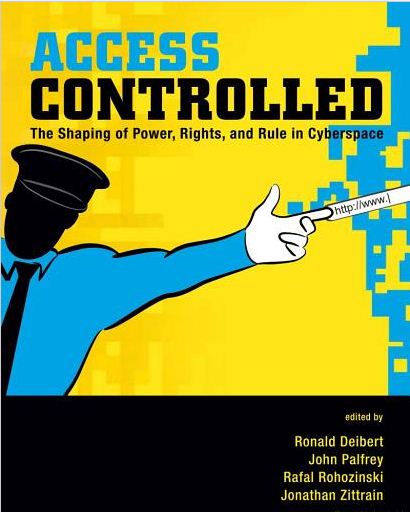
Faithful readers know of my geeky love for tech policy books. I read lots of ’em. There’s a steady stream of Amazon.com boxes that piles up on my doorstop some days because my mailman can’t fit them all in my mailbox.  But I go pretty hard on all the books I review. It’s rare for me pen a glowing review. Occasionally, however, a book will come along that I think is both worthy of your time and which demands a place on your bookshelf because it is such an indispensable resource.  Access Controlled: The Shaping of Power, Rights, and Rule in Cyberspace is one of those books.

Smartly organized and edited by Ronald J. Deibert, John G. Palfrey, Rafal Rohozinski, and Jonathan Zittrain, Access Controlled is essential reading for anyone studying the methods governments are using globally to stifle online expression and dissent. As I noted of their previous edition, Access Denied: The Practice and Policy of Global Internet Filtering, there is simply no other resource out there like this; it should be required reading in every cyberlaw or information policy program.

The book, which is a project of the OpenNet Initiative (ONI), is divided into two parts. Part 1 of the book includes six chapters on “Theory and Analysis.”  They are terrifically informative essays, and the editors have made them all available online here (I’ve listed them down below with links embedded). The beefy second part of the book provides a whopping 480 pages(!) of detailed regional and country-by-country overviews of the global state of online speech controls and discuss the long-term ramifications of increasing government meddling with online networks.

In their interesting chapter on “Control and Subversion in Russian Cyberspace,” Deibert and Rohozinski create a useful taxonomy to illustrate the three general types of speech and information controls that states are deploying today. What I find most interesting is how, throughout the book, various authors document the increasing movement away from “first generation controls,” which are epitomized by “Great Firewall of China”-like filtering methods, and toward second- and third-generation controls, which are more refined and difficult to monitor. Here’s how Deibert and Rohozinski define those three classes (or “generations”) of controls: Continue reading →

Faithful readers know of my geeky love of tech policy books [here are my “best of” lists for 2008 & 2009], and the intriguing battle taking place today between Internet optimists and pessimists in particular.  One of the things that I noticed when I was putting together my compendium, “The Digital Decade’s Definitive Reading List: Internet & Info-Tech Policy Books of the 2000s,” is that there are up years and down years. For example, there weren’t a lot of big tech policy titles in 2000 or 2005. By contrast, 2001, 2006 and 2008 were monster years.  I suppose that’s the case with any genre, of course.

Anyway, I was beginning to think that 2010 was shaping up to be one of those slow years, with Jaron Lanier’s You Are Not a Gadget being the only major release so far this year. [See my review of it here.] But there are some very important titles on the way that are worth picking up. I’ve already pre-ordered most of these and am looking forward to reviewing them all soon:

Please let me know others that I may be missing. [Note: Most of the books I’ve been reading this year have more to do with the future of media, the press, journalism, etc. It’s been a big year for books like that. For example, McChesney & Nichols’ The Death and Life of American Journalism; Lee Bollinger’s Uninhibited, Robust, and Wide-Open: A Free Press for a New Century; and Bob Garfield’s The Chaos Scenario. But it’s not clear any of these books belong in the “info-tech policy” genre, although they all have something to say about the impact of the Internet and digital technology on the media and journalism. So, who knows, maybe I will add them to my end of year list.]

By Adam Thierer & Berin Szoka

Short but very important essay here from Santa Clara University Law School Prof. Eric Goldman about calls to alter Sec. 230 of the Communications Decency Act (CDA) to address concerns about online harassment. Generally speaking, Sec. 230 immunizes online intermediaries from punishing liability for the content that travels over their networks / services. Specifically, Sec. 230 stipulates that “No provider or user of an interactive computer service shall be treated as the publisher or speaker of any information provided by another information content provider.” In other words: Don’t shoot the messenger!

As we’ve noted here before, it is probably not an overstatement to think of Sec. 230 as the very cornerstone of Internet Freedom, since it makes possible an online “utopia for utopias,” to borrow a phrase from our favorite modern political philosopher, the late Robert Nozick. Without Sec. 230, intermediaries would likely be forced to shut down many avenues of communication and would have to become deputized conduct and morality police for every cyber-street corner.

Goldman, America’s leading expert on Sec. 230-related jurisprudence, correctly notes that, “Frequently, § 230’s critics do not attack the immunization generally, but instead advocate a new limited exception for their pet concern.” He’s got that right. Indeed, we are increasingly hearing calls from numerous quarters these days to “tweak 230” for one pet concern after another. We’ve illustrated some of those concerns in this exhibit.

Deputization of the Middleman http://d1.scribdassets.com/ScribdViewer.swf Regulatory advocates can be found for each of these issues who like to see the protections afforded by Sec. 230 scaled back by Congress or he courts. But Goldman rightly warns: Continue reading →

Harvard’s Jonathan Zittrain has launched an interesting new project called “HerdictWeb,” which “seeks to gain insight into what users around the world are experiencing in terms of web accessibility; or in other words, determine the herdict.”  It’s a useful tool for determining whether governments are blocking certain websites for whatever reason.  Here’s Zittrain’s sock puppet video with all the details!

http://www.youtube.com/v/NggzBHSXdCo&hl=en&fs=1

The website is quite slick and very user-friendly, and they’ve even created a downloadable Firefox button that will automatically check site accessibility while you’re surfing the Net.

The information gathered from this effort will be useful for the OpenNet Initiative that Zittrain and John Palfrey co-created (with others from Univ. of Toronto, Oxford Univ., and Univ. of Cambridge) and wrote about in their excellent book, Access Denied: The Practice and Policy of Global Internet Filtering, which was one of my favorite technology policy books of the past year.  The data collected will give them, and us, a fuller picture of just how widespread global filtering and censorship efforts really are.  I encourage you to take a look and spread the word, especially to those in foreign countries who could probably use it more than us. (Of course, their governments will likely block Herdict once the word gets around!)

Blown to Bits coverI’ve just finished reading Blown to Bits: Your Life, Liberty, and Happiness After the Digital Explosion, by Hal Abelson, Ken Ledeen, and Harry Lewis, and it’s another title worth adding to your tech policy reading list. The authors survey a broad swath of tech policy territory — privacy, search, encryption, free speech, copyright, spectrum policy — and provide the reader with a wonderful history and technology primer on each topic.

I like the approach and tone they use throughout the book. It is certainly something more than “Internet Policy for Dummies.” It’s more like “Internet Policy for the Educated Layman”: a nice mix of background, policy, and advice. I think Ray Lodato’s Slashdot review gets it generally right in noting that, “Each chapter will alternatively interest you and leave you appalled (and perhaps a little frightened). You will be given the insight to protect yourself a little better, and it provides background for intelligent discussions about the legalities that impact our use of technology.”

Abelson, Ledeen, and Lewis aren’t really seeking to be polemical in this book by advancing a single thesis or worldview. To the extent the book’s chapters are guided by any central theme, it comes in the form of the “two basic morals about technology” they outline in Chapter 1:

The first is that information technology is inherently neither good nor bad — it can be used for good or ill, to free us or to shackle us. Second, new technology brings social change, and change comes with both risks and opportunities. All of us, and all of our public agencies and private institutions, have a say in whether technology will be used for good or ill and whether we will fall prey to its risks or prosper from the opportunities it creates. (p. 14)

Mostly, what they aim to show is that digital technology is reshaping society and, whether we like or it not, we better get used to it — and quick!  “The digital explosion is changing the world as much as printing once did — and some of the changes are catching us unaware, blowing to bits our assumptions about the way the world works… The explosion, and the social disruption that it will create, have barely begun.” (p 3)

In that sense, most chapters discuss how technology and technological change can be both a blessing and a curse, but the authors are generally more optimistic than pessimistic about the impact of the Net and digital technology on our society. What follows is a quick summary of some of the major issues covered in Blown to Bits.

Continue reading →