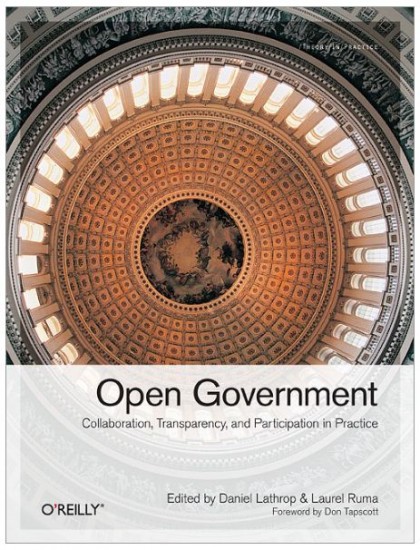
 Those of you interested in transparency and “Government 2.0” issues will absolutely want to pick up Open Government: Collaboration, Transparency, and Participation in Practice, a terrific collection of 34 essays edited by Daniel Lathrop and Laurel Ruma. Much like Access Controlled, the collection of essays on global Internet filtering and censorship that I praised here last month, Open Government is a resource like no other in its field. It offers an amazing diversity of viewpoints covering virtual every aspect of the debate over transparency and open government.
The collection was published by O’Reilly Media and Tim O’Reilly himself has one of the best chapters in the book on “Government as a Platform.” “The magic of open data is that the same openness that enables transparency also enables innovation, as developers build applications that reuse government data in unexpected ways.” (p. 25) This explains why in their chapter on “Enabling Innovation for Civic Engagement,” David G. Robinson, Harlan Yu, and Edward W. Felten, of the Center for Information Technology Policy at Princeton University, speak of “a new baseline assumption about the public response to government data: when government puts data online, someone, somewhere will do something valuable and innovative with it.” (p.84) “By publishing its data in a form that is free, open, and reusable,” they continue, “government will empower citizens to dream up and implement their own innovative ideas of how to best connect with their governments.” (p. 89)
Indeed, just think about some of the many exciting sites and projects (both public and private) that have been developed thanks to government data becoming more accessible in recent years. Here’s a short list of some of the best: Continue reading →
Just the other day, I complained about the fact that New York Federal district court overseeing the Google Books settlement apparently doesn’t plan to webcast the final public hearing that will take place on February 18 in this hugely important case about the future of digital books and copyright. Now I discover that the 11th Circuit Court of Appeals (which covers Florida, Georgia & Alabama) has issued a decision with even more far-reaching applications—allowing prosecutions for online obscenity distribution according to local “community standards” wherever a user might have downloaded the material—without even publishing the landmark decision!
Adam discussed this obscenity/localism issue in detail back in 2004. Eugene Volokh explains the substance of this decision:
United States v. Little concludes that Internet obscenity distribution prosecutions may rely on the community standard of the place in which the material was distributed — which means the government can try to download the material in the most restrictive community, and prosecute the distributor there.
If left to stand, this decision could essentially amount to a ban on hardcore pornography in the U.S.—with the definition of “obscenity” being left to local puritanical politicians in the country’s most socially traditionalist backwaters, subject only to some general restraint by the courts as to just how far the definition of “obscenity” can be pushed. Volokh continues: Continue reading →
Conversations about how the Internet can be used to increase the openness and accountability of government usually focuses on the Executive and Legislative branches of the Federal government. But on this week’s episode of Technology Policy Weekly, I hosted a discussion of the equally vital issue of public access to court records, joined by:
We discussed a wide range of issues, including:
- Why lay people should care—this is ultimately about reducing the legal profession’s monopoly over access to the courts!
- The philosophical reasons why better access to court records is important – little things like democracy, fairness, consistency, equality, the rule of law, etc.
- The copyrightability of legal records
- The history of the problem & what can be done about it
There are several ways to listen to the TLF Podcast. You can press play on the player below to listen right now, or download the MP3 file. You can also subscribe to the podcast by clicking on the button for your preferred service. And do us a favor, Digg this podcast!
[display_podcast]
 Those of you interested in transparency and “Government 2.0” issues will absolutely want to pick up Open Government: Collaboration, Transparency, and Participation in Practice, a terrific collection of 34 essays edited by Daniel Lathrop and Laurel Ruma. Much like Access Controlled, the collection of essays on global Internet filtering and censorship that I praised here last month, Open Government is a resource like no other in its field. It offers an amazing diversity of viewpoints covering virtual every aspect of the debate over transparency and open government.
 The Technology Liberation Front is the tech policy blog dedicated to keeping politicians' hands off the 'net and everything else related to technology.