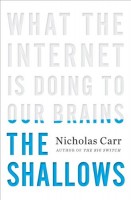
 Last Friday afternoon, as I was leaving my house to en route to the airport with the family for a short vacation, Nicholas Carr’s latest book, The Shallows: What the Internet is Doing to Our Brains, arrived in my mailbox. I grabbed it, jumped in the car, flipped it open during the drive to Dulles Airport (don’t worry, the wife was driving), and began devouring it. I say “devour” because once I started reading it, I didn’t stop. I was wholeheartedly absorbed in the text from start to finish.
I tell you all this not just because Carr’s book is that good, but because according to the thesis he sets forth in
The Shallows, fewer and fewer people are likely to be engaged in such contemplative, deep reading activities due to the highly distractive nature of the Internet and digital technologies. “With the exception of alphabets and number systems, the Net may well be the single most powerful mind-altering technology that has ever come into general use,” Carr claims. “At the very least, it’s the most powerful that has come along since the book.” (p. 116) The Net and multimedia “strains our cognitive abilities, diminishing our learning and weakening our understanding,” he says. (p. 129) And we have no one to blame for this mess but ourselves:
We want to be interrupted, because each interruption brings us a valuable piece of information… And so we ask the Internet to keep interrupting us, in ever more and different ways. We willingly accept the loss of concentration and focus, the division of our attention and the fragmentation of our thoughts, in return for the wealth of compelling or at least diverting information we receive. Tuning out is not an option many of us would consider. (p. 133-4)
Although, ultimately, Carr doesn’t quite convinced me that “The Web is a technology of forgetfulness” (p. 193), he has made a powerful case that its effects may not be as salubrious as many of us have assumed. Continue reading →
I was reading this Sun Magazine interview with the always-interesting Nick Carr and I liked what he had to say here about the public’s inconsistent views on privacy:
If you ask people whether they’re concerned about the ability of the government or corporations to gather information about them online, they’ll say yes. But if you look at how they behave online, they don’t display much fear of exposing themselves. What that says about people — and it’s true for most of us — is that we will readily forgo our privacy in exchange for convenient and useful services, particularly if they’re free. That’s a trade-off you make all the time on the Internet. Even if people were more conscious of how this information might be exploited, I doubt most would change their behavior.
This reminds me of the classic “hamburgers for DNA” quip from security expert Bruce Schneier who once famously noted that:
If McDonalds in the United States would give away a free hamburger for an DNA sample they would be handing out free lunches around the clock. So people care about their privacy, but they don’t care to pay for it. In the United States we have frequent shopper cards, which will track down people’s purchases for a 5 cents discount on a can of tuna fish. I don’t think you can convince the public to care about it.
Continue reading →
It’s been a big year for tech policy books. Several important titles were released in 2008 that offer interesting perspectives about the future of the Internet and the impact digital technologies are having on our lives, culture, and economy. Back in September, I compared some of the most popular technology policy books of the past five years and tried to group them into two camps: “Internet optimists” vs. “Internet pessimists.” That post generated a great deal of discussion and I plan on expanding it into a longer article soon. In this post, however, I will merely list what I regard as the most important technology policy books of the past year.
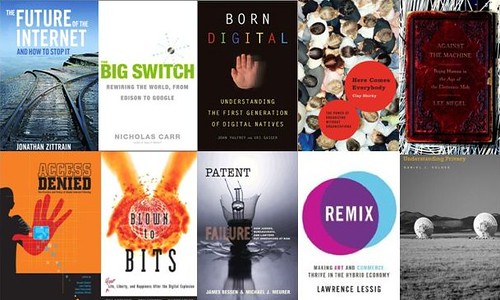
What qualifies as an “important” tech policy book? Basically, it’s a title that many people in this field are currently discussing and that we will likely be talking about for many years to come. I want to make it clear, however, that merely because a book appears on this list it does not necessarily mean I agree with everything said in it. In fact, I found much with which to disagree in my picks for the two most important books of 2008, as well as many of the other books on the list. [Moreover, after reading all these books, I am more convinced than ever that libertarians are badly losing the intellectual battle of ideas over Internet issues and digital technology policy. There’s just very few people defending a “Hands-Off-the-Net” approach anymore. But that’s a subject for another day!]
Another caveat: Narrowly focused titles lose a few points on my list. For example, as was the case in past years, a number of important IP-related books have come out this year. If a book deals exclusively with copyright or patent issues, it does not exactly qualify as the same sort of “tech policy book” as other titles found on this list since it is a narrow exploration of just one set of issues that have a bearing on digital technology policy. The same could be said of a book that deals exclusively with privacy policy, like Solove’s
Understanding Privacy. It’s an important book with implications for the future of tech policy, but I demoted it a bit because of its narrow focus.
With those caveats in mind, here are my Top 10 Most Important Tech Policy Books of 2008 (and please let me know about your picks for book of the year):
Continue reading →
 I just finished reading through The Economist’s new 14-page special report on cloud computing, “Let It Rise” in which Ludwig Siegele provides an outstanding overview of cloud computing and why it is so important:
The rise of the cloud is more than just another platform shift that gets geeks excited. It will undoubtedly transform the information technology (IT) industry, but it will also profoundly change the way people work and companies operate. It will allow digital technology to penetrate every nook and cranny of the economy and of society, creating some tricky political problems along the way.
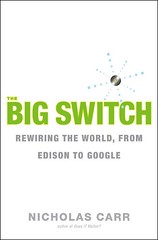
Even if you are very familiar with cloud computing, I recommend you take a look at the article. Anyway, while I was reading it, I was unsurprised to come across some comments from Nicholas Carr, whose new book
The Big Switch: Rewiring the World, from Edison to Google, is essentially an early history of cloud computing and an investigation into its effects on our economy, culture, and society. And that also reminded me that, even though I have mentioned Carr’s book here several times since it was released earlier this year, I have failed to give it a dedicated review. And it certain deserves one because “The Big Switch” is easily one of the most important technology policy books of 2008.
Continue reading →
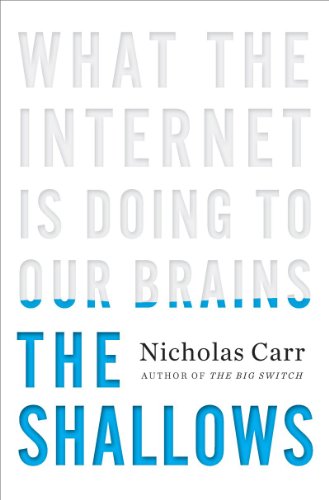 Last Friday afternoon, as I was leaving my house to en route to the airport with the family for a short vacation, Nicholas Carr’s latest book, The Shallows: What the Internet is Doing to Our Brains, arrived in my mailbox. I grabbed it, jumped in the car, flipped it open during the drive to Dulles Airport (don’t worry, the wife was driving), and began devouring it. I say “devour” because once I started reading it, I didn’t stop. I was wholeheartedly absorbed in the text from start to finish.
 The Technology Liberation Front is the tech policy blog dedicated to keeping politicians' hands off the 'net and everything else related to technology.