While preparing my latest Forbes column, “Does the Internet Need a Global Regulator?” I collected some excellent resources. I figured I would just post all the links here since others might find them useful as we work our way up to the big U.N. International Telecommunication Union (ITU) World Conference on International Telecommunications (WCIT) in Dubai this December. Please let me know of other things that I should add to this resource database. I’ve divided the database into “General Resources” and “Opinion Pieces”: Continue reading →
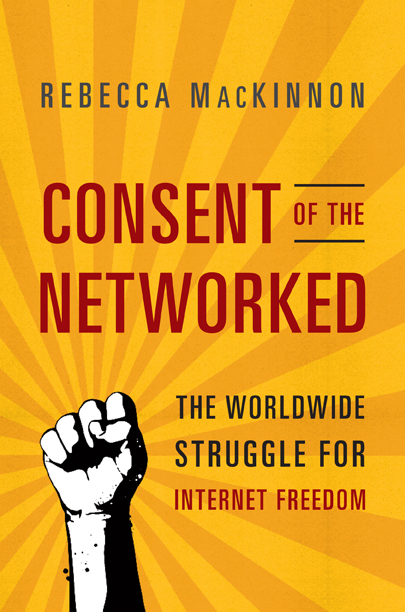 Rebecca MacKinnon’s new book, Consent of the Networked: The Worldwide Struggle for Internet Freedom, is well-researched exploration of the forces driving Internet developments and policy across the globe today. She serves up an outstanding history of recent global protest movements and social revolutions and explores the role that Internet technologies and digital networks played in those efforts. She also surveys some of the recent policy fights here and abroad over issues such as online privacy, Net neutrality regulation, free speech matters, and the copyright wars. The Consent of the Networked is certainly worth reading and will go down as one of the most important Internet policy books of 2012.
A Call to Action
Of course, it’s not just a history lesson. MacKinnon has also issued a call-to-arms here. As a well-known web activist, MacKinnon has emerged as a leading force in the broad-based, if loosely-defined, “Net freedom” movement. The term “Net freedom,” she notes, means very different things to different people. It’s “like a Rorschach inkblot test: different people look at the same ink splotch and see very different things.” (p. 188) Nonetheless, on the global stage, the Internet freedom movement is fundamentally tied up with efforts to hold both governments and corporate actors more accountable for their actions toward the Netizens, digital networks, and online speech and expression. Continue reading →
 Sorry if it seems like I am beating a dead horse here, but the folks at the City Journal asked me a pen a review of Jonathan Zittrain’s new book, The Future of the Internet and How to Stop It. Faithful readers here will no doubt remember that I have already penned a review of the book and several follow-up essays. (Part 1, 2, 3, 4). I swear I am not picking on Jonathan, but his book is probably the most important technology policy book of the year–Nick Carr’s Big Switch would be a close second–and deserves attention. Specifically, I think it deserves attention because I believe that Jonathan’s provocative thesis is wildly out of touch with reality. As I state in the City Journal review of his book:
[C]ontrary to what Zittrain would have us believe, reports of the Internet’s death have been greatly exaggerated. […] Not only is the Net not dying, but there are signs that digital generativity and online openness are thriving as never before. […]
Essentially, Zittrain creates a false choice regarding the digital future we face. He doesn’t seem to believe that a hybrid future is possible or desirable. In reality, however, we can have a world full of some tethered appliances or even semi-closed networks that also includes generative gadgets and open networks. After all, millions of us love our iPhones and TiVos, but we also take full advantage of the countless other open networks and devices at our disposal. […]
Continue reading →

 The Technology Liberation Front is the tech policy blog dedicated to keeping politicians' hands off the 'net and everything else related to technology.