Posts tagged as:

Everywhere you look in tech policy land these days, people decry China as a threat to America’s technological supremacy or our national security. Many of these claims are well-founded, while others are somewhat overblown. Regardless, as I argue in a new piece for National Review this week, “America Won’t Beat China by Becoming China.” Many pundits and policymakers seem to think that only a massive dose of central planning and Big Government technocratic bureaucracy can counter the Chinese threat. It’s a recipe for a great deal of policy mischief.

Some of these advocates for a ‘let’s-be-more-like-China’ approach to tech policy also engage in revisionist histories about America’s recent success stories in the personal computing revolution and internet revolution. As I note in my essay, “[t]he revisionists instead prefer to believe that someone high up in government was carefully guiding this decentralized innovation. In the new telling of this story, deregulation had almost nothing to do with it.” In fact, I was asked by  National Review to write this piece in response to a recent essay by Wells King of American Compass, who has penned some rather remarkable revisionist tales of government basically being responsible for all the innovation in digital tech sectors over the past quarter century. Markets and venture capital had nothing to do with it by his reasoning. It’s what Science writer Matt Ridley correctly labels “innovation creationism,” or the notion that it basically takes a village to raise an innovator. Continue reading →

A growing number of conservatives are calling for Big Government censorship of social media speech platforms. Censorship proposals are to conservatives what price controls are to radical leftists: completely outlandish, unworkable, and usually unconstitutional fantasies of controlling things that are ultimately much harder to control than they realize. And the costs of even trying to impose and enforce such extremist controls are always enormous.

Earlier this year, The Wall Street Journal ran a response I wrote to a proposal set forth by columnist Peggy Noonan in which she proposed banning everyone under 18 from all social-media sites (“We Can Protect Children and Keep the Internet Free,” Apr. 15). I expanded upon that letter in an essay here entitled, “Should All Kids Under 18 Be Banned from Social Media?” National Review also recently published an article penned by Christine Rosen in which she also proposes to “Ban Kids from Social Media.” And just this week, Zach Whiting of the Texas Public Policy Foundation published an essay on “Why Texas Should Ban Social Media for Minors.”

I’ll offer a few more thoughts here in addition to what I’ve already said elsewhere. First, here is my response to the Rosen essay. National Review gave me 250 words to respond to her proposal:

While admitting that “law is a blunt instrument for solving complicated social problems,” Christine Rosen (“Keep Them Offline,” June 27) nonetheless downplays the radicalness of her proposal to make all teenagers criminals for accessing the primary media platforms of their generation. She wants us to believe that allowing teens to use social media is the equivalent of letting them operate a vehicle, smoke tobacco, or drink alcohol. This is false equivalence. Being on a social-media site is not the same as operating two tons of steel and glass at speed or using mind-altering substances. Teens certainly face challenges and risks in any new media environment, but to believe that complex social pathologies did not exist before the Internet is folly. Echoing the same “lost generation” claims made by past critics who panicked over comic books and video games, Rosen asks, “Can we afford to lose another generation of children?” and suggests that only sweeping nanny-state controls can save the day. This cycle is apparently endless: Those “lost generations” grow up fine, only to claim it’s the  next generation that is doomed! Rosen casually dismisses free-speech concerns associated with mass-media criminalization, saying that her plan “would not require censorship.” Nothing could be further from the truth. Rosen’s prohibitionist proposal would deny teens the many routine and mostly beneficial interactions they have with their peers online every day. While she belittles media literacy and other educational and empowerment-based solutions to online problems, those approaches continue to be a better response than the repressive regulatory regime she would have Big Government impose on society.

I have a few more things to say beyond these brief comments. Continue reading →

Does anyone remember Blockbuster and Hollywood Video? I assume most of you do, but wow, doesn’t it seem like forever ago when we actually had to drive to stores to get movies to watch at home? What a drag that was!

Yet, just 15 years ago, that was the norm and those two firms were the titans of video distribution, so much so that federal regulators at the Federal Trade Commission looked to stop their hegemony through antitrust intervention. But then those firms and whatever “market power” they possessed quickly evaporated as a wave of Schumpeterian creative destruction swept through video distribution markets. Both those firms and antitrust regulators had completely failed to anticipate the tsunami of technological and marketplace changes about to hit in the form of alternative online video distribution platforms as well as the rise of smartphones and robust nationwide mobile networks.

Today, this serves as a cautionary tale of what happens when regulatory hubris triumphs over policy humility, as Trace Mitchell and I explain in this new essay for  National Review Online entitled, “The Crystal Ball of Antitrust Regulators Is Cracked.” As we note:

There is no discernable end point to the process of entrepreneurial-driven change. In fact, it seems to be proliferating rapidly. To survive, even the most successful companies must be willing to quickly dispense with yesterday’s successful business plans, lest they be steamrolled by the relentless pace of technological change and ever-shifting consumer demands. It is easy to understand why some people find it hard to imagine a time when Amazon, Apple, Facebook, and Google won’t be quite as dominant as they are today. But it was equally challenging 20 years ago to imagine that those same companies could disrupt the giants of that era.

Hopefully today’s policymakers will have a little more patience and trust competition and continued technological innovation to bring us still more wonderful video choices.

[OC] Blockbuster Video US store locations between 1986 and 2019 from r/dataisbeautiful
//embed.redditmedia.com/widgets/platform.js

“Government’s view of the economy could be summed up in a few short phrases: If it moves, tax it. If it keeps moving, regulate it. And if it stops moving, subsidize it.” Thus did Ronald Reagan capture the essence of big government. The two biggest challenges facing defenders of free markets in technology policy lie in Reagan’s second point:

  • Telling the “Good News Story” about how “it” (human ingenuity—what the great economist Julian Simon called our “Ultimate Resource”) keeps “moving” (by inventing new hardware, software, services, etc.)
  • Holding the line against efforts to extend the regulatory regimes of the past over new technologies, and chipping away at those regimes as best we can

So one might think that believers in limited government would celebrate a company like Google as a great American success story: A university research program launched by two smart kids (one of whom fled Communist oppression) that grew from a garage start-up into a global tech titan whose wide-ranging innovations are revolutionizing more and more of the economy. Surely free marketeers would rally to the defense of such a company when, say, the New York Times—that if-it-moves-regulate-it bastion—calls for bringing “into the regulatory fold,” right?

Unfortunately, all too many free marketeers seem willing to hang Google out to dry, or at least stay silent because they resent the pro-regulatory policy positions taken by the company or the political leanings of its employees and leadership. The company has hardly been a champion of digital capitalism in Washington, allying itself with a number tax/regulate/subsidize groups, pushing for net neutrality regulation, and using antitrust as a sword against its rivals (some of whom seem willing to return the favor). But the principles at stake are too important for free marketeers to gloat, as Adam Thierer argued in an op/ed for National Review Online earlier this week: Government vs. Google: Why Free Marketeers Should Rally Against “Search Neutrality.” Continue reading →

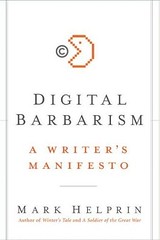
Last month, Digital Barbarism book cover National Review magazine published a review that I penned of Mark Helprin’s new book, Digital Barbarism: A Writer’s Manifesto.  Helprin’s book is both a passionate defense of copyright law as well as a mini-autobiography.  Helprin is one of the great novelists and essayists of the past half-century, and his book A Soldier of a Great War is one of my all-time favorite novels.  I cannot in strong enough words encourage you to read that book; it is profoundly moving. (I almost named my son after the lead character in the book!)

Thus, I was quite excited when I learned that Helprin had penned a defense of copyright and I jumped at the chance to review it when the folks at National Review asked me to do so.  Alas, as you will see in my review, I was terribly disappointed.  I wish Helprin would have stuck with the very reasonable tone he adopted in this excellent podcast interview he did recently with John J. Miller of National Review Online. Unfortunately, he went a different direction in the book, as I make clear in my review:


National Review July 20, 2009

“Man, Machine, and Copyright” a review of Digital Barbarism: A Writer’s Manifesto, by Mark Helprin by Adam Thierer

It would be difficult to think of anyone more ideally suited to pen a passionate defense of copyright law than novelist Mark Helprin.  Helprin has written several of the finest works of modern literature, including his masterpiece, A Soldier of the Great War, a narrative of transcendent beauty. In Digital Barbarism, Helprin sets out to use his formidable gift for the written word to repel the “cyber mob” that has attacked copyright law and called for its curtailment, or even abolition.

Unfortunately, while Helprin occasionally rises to great heights in his defense of copyright, he too often sinks to lamentable lows — by resorting to the same unbecoming rhetorical tactics used by the mob he seeks to condemn. Indeed, his book is filled with gratuitous vitriol and neo-Luddite ramblings about the Internet and Information Age that severely detract from his defense of copyright. This is a shame, because, in places, Digital Barbarism makes a fine case against those critics who wrongly view copyright as an impediment to the creation and diffusion of content. “The availability of information is not and will not be restrained by the copyright system any more than it is or will be restrained by the delivery systems that make it possible,” Helprin argues. Why, he asks, “must ‘content’ be free” when everything else — access to the Internet, digital devices, etc. — costs good money? He notes that the movement that advocates “free,” universal access to all copyrighted material in the name of “openness” and “the public good” would, ironically, “destroy the dream it advocates”: Continue reading →

Unfortunately, as I predicted would be the case in my National Review editorial earlier this morning, today’s hearing on video games in the Senate Judiciary Committee turned out to be quite a one-sided show trial.

Senator Sam Brownback called the hearing to blast the game industry for what he called “graphic,” “horrific,” and even “barbaric” level of violence we supposedly see in games today. Violent video games, he argued, are becoming “simulators” that train kids to behave violently and even kill cops.

And his proof? As I suspected would be the case (and, again, predicted in my editorial) it largely came down to two key games: “Grand Theft Auto” and “25 to Life.” Sen. Brownback decided to show a few clips from these games and one other title (“Postal”) to supposedly illustrate just how violent games are today. Now make no doubt about it, these games do contain some truly sickening, despicable acts of simulated violence. I don’t know why a game developer feels compelled to show thugs beating prostitutes with a baseball bat, or a criminal shooting cops with a sniper rifle, or someone torching a dead corpse and then urinating on it to put out the fire. It’s all very sick and it’s quite sad that someone is squandering their creative talents on the depiction of such disgusting, disrespectful acts of violence.

But let’s get back to the key point and ask a question that ABSOLUTELY NO ONE EVEN BOTHERED DISCUSSING AT THE HEARING. Namely: Are these games indicative of all video games out there today?

Continue reading →