 Ian Brown and Christopher T. Marsden’s new book, Regulating Code: Good Governance and Better Regulation in the Information Age, will go down as one of the most important Internet policy books of 2013 for two reasons. First, their book offers an excellent overview of how Internet regulation has unfolded on five different fronts: privacy and data protection; copyright; content censorship; social networks and user-generated content issues; and net neutrality regulation. They craft detailed case studies that incorporate important insights about how countries across the globe are dealing with these issues. Second, the authors endorse a specific normative approach to Net governance that they argue is taking hold across these policy arenas. They call their preferred policy paradigm “prosumer law” and it envisions an active role for governments, which they think should pursue “smarter regulation” of code.
In terms of organization, Brown and Marsden’s book follows the same format found in Milton Mueller’s important 2010 book Networks and States: The Global Politics of Internet Governance; both books feature meaty case studies in the middle bookended by chapters that endorse a specific approach to Internet policymaking. (Incidentally, both books were published by MIT Press.) And, also like Mueller’s book, Brown and Marsden’s Regulating Code does a somewhat better job using case studies to explore the forces shaping Internet policy across the globe than it does making the normative case for their preferred approach to these issues. Continue reading →
Ever wonder about this? In researching COPPA, I noticed the following definition of “Internet”
collectively the myriad of computer and telecommunications facilities, including equipment and operating software, which comprise the interconnected world-wide network of networks that employ the Transmission Control Protocol/Internet Protocol, or any predecessor or successor protocols to such protocol, to communicate information of all kinds by wire, radio, or other methods of transmission.
16 CFR § 312.2 (added in 1999). This definition comes from the COPPA law itself.
My quick and by no means exhaustive research (looked for the term “Internet means” in the CFR and U.S. Code) suggests that this is one of two definitions used, with slight variations, in Federal law (in less than a dozen places total).
The earliest reference I can find to this definition is from the Internet Tax Freedom Act of 1998 (the sales tax moratorium), which differed only slightly: “comprise” instead of “constitute” and omitting the “or other methods of transmission” part. This definition appears again in the child pornography rules issued in 2005 (28 CFR § 75.1).
The other definition I see is appears in the bankruptcy code (15 USCS § 163) and in the 2005 Internet gambling ban (31 CFR § 132.2 and 12 CFR § 233.2): “the international computer network of both Federal and non-Federal interoperable packet switched data networks.”
So which definition is better? Do both suck? Should we care? “Discuss amongst yourselves!”
But no kvetching about the use of the word “myriad.” Someone already beat you to the punch—and got smacked down: Continue reading →
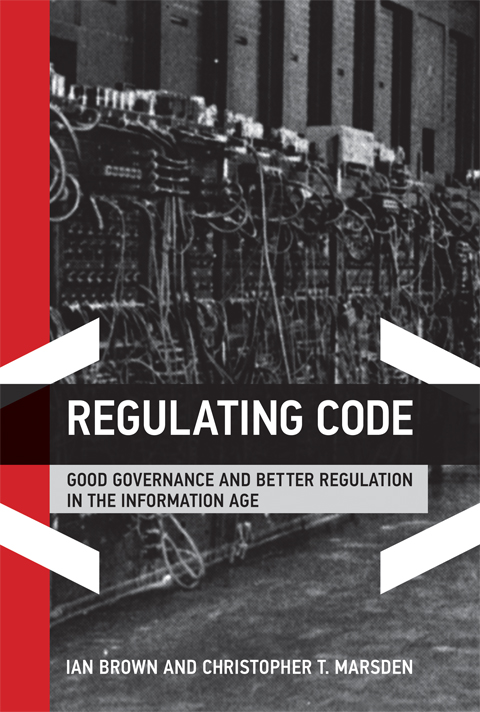 Ian Brown and Christopher T. Marsden’s new book, Regulating Code: Good Governance and Better Regulation in the Information Age, will go down as one of the most important Internet policy books of 2013 for two reasons. First, their book offers an excellent overview of how Internet regulation has unfolded on five different fronts: privacy and data protection; copyright; content censorship; social networks and user-generated content issues; and net neutrality regulation. They craft detailed case studies that incorporate important insights about how countries across the globe are dealing with these issues. Second, the authors endorse a specific normative approach to Net governance that they argue is taking hold across these policy arenas. They call their preferred policy paradigm “prosumer law” and it envisions an active role for governments, which they think should pursue “smarter regulation” of code.
 The Technology Liberation Front is the tech policy blog dedicated to keeping politicians' hands off the 'net and everything else related to technology.