I cannot in strong enough terms recommend that everyone read Gordon Crovitz’s latest Wall Street Journal column, “Free Speech, Now that Speech is Free.” It perfectly encapsulates everything we stand for here and makes the case that I have made again and again: Speech regulation — of all flavors — makes less and less sense in a world of information abundance and user empowerment, and it is a complete affront to our First Amendment rights. As Crovitz argues:
The Constitution was drafted at a time when there were few media outlets, and few people could be heard. Since then, technology has made it possible for everyone to express their views. The cost of expressing opinions continues to fall. Now that speech is no longer expensive, it’s time to return to the Founders’ intention that speech be free and that Congress not abridge anyone’s right to speak.
Amen brother! In his essay today, Crovitz specifically takes on America’s increasingly insane campaign finance laws, which make a mockery of the First Amendment. In the wake of last week’s Supreme Court arguments in the Citizens United case, Crovitz points out the insulting stupidity and sheer futility of these analog era, scarcity-oriented laws:
Continue reading →
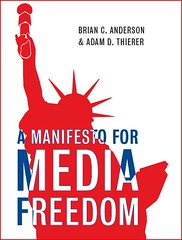 I’m pleased to announce the publication of A Manifesto for Media Freedom, which I co-authored with Brian C. Anderson of the Manhattan Institute. Brian serves as editor of Manhattan Institute’s excellent City Journal and he is the author of best-selling books like South Park Conservatives and Democratic Capitalism and Its Discontents.
In this little manifesto, we highlight one of the central ironies of the Information Age. Namely, that despite “the breathtaking abundance of new and old media outlets for obtaining news, information, and entertainment…”
many people hate this profusion, and never more than when it involves political speech. The current media market, they charge, doesn’t represent true diversity, or isn’t fair, or is subject to manipulation by a small and shrinking group of media barons. They want the government to regulate it into better shape, which just happens to be a shape that benefits them. Doing so… would be a disaster, a kind of soft or not-so-soft tyranny that would wipe out whole sectors of media, curtailing free speech and impoverishing our democracy.
In other words, instead of celebrating the unprecedented cornucopia of media choices at our collective disposal, many policymakers and media critics are calling for just as much media regulation as ever. We itemize these threats in our chapters and they include: efforts to revive the “Fairness Doctrine”, media ownership regulations, “localism” requirements, Net neutrality mandates, a la carte regulations, cable and satellite censorship, video game censorship, regulation of social networking sites, campaign finance-related speech restrictions, and so on.
In each case, we advance a pro-freedom paradigm to counter the advocates of media control. What do we mean by the “media freedom” that we advocate as the alternative to these new regulatory crusades? Here’s how we put it in the book:
Continue reading →
Writing at Slate, Tim Wu tries to make Obama out to be the real Big Government candidate on media policy, who will deliver “if not a chicken in every pot, a fiber-optic cable in every home.” By contrast, Wu implies that McCain is just another pro-big business lackey who doesn’t understand “that the media and information industries are special—that like the transportation, energy, or financial industries, they are deeply entwined with the public interest.” Wu goes on to say:
Ultimately, most of the difference in Obama’s and McCain’s media policies boils down to questions about whether the media is special and a dispute over how much to trust the private sector. Camp McCain would tend to leave the private sector alone, with faith that it will deliver to most Americans what they want and deserve. The Obama camp would probably administer a more frequent kick in the pants, in the belief that good behavior just isn’t always natural.
First, as a factual matter, Wu is just wrong about McCain being some sort of a radical hands-off, pro-market liberalizer on media policy issues. Oh, if only that were true! But for those of us who have been in DC covering telecom and media policy for many years, it is widely understood there is no nailing down John McCain on any tech, telecom or media policy issue. He’s been all over the board. While he has sponsored or supported
some deregulatory initiatives on the telecom front in the past, he’s also been a supporter of other regulatory causes. His battles with broadcasters and cable, for example, are well-known. Most recently, McCain has been leading the effort to impose a la carte mandates on cable and satellite operators.
Continue reading →

 The Technology Liberation Front is the tech policy blog dedicated to keeping politicians' hands off the 'net and everything else related to technology.