Last Friday I attended a fascinating conference hosted by the Duke Law School’s Center for Innovation Policy about television regulation and competition. It’s remarkable how quickly television competition has changed and how online video providers are putting pressure on old business models.
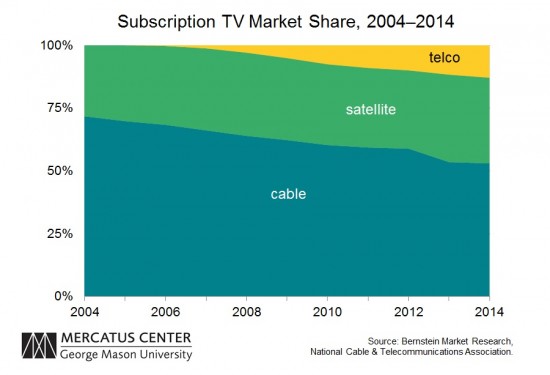
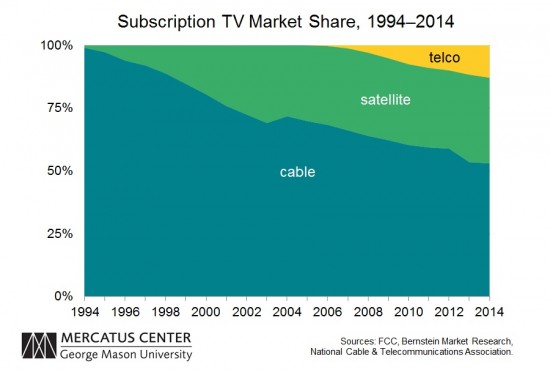
I’ve been working on a project about competition in technology, communications, and media and one chart that stands out is one that shows increasing competition in pay television, below. Namely, that cable providers have lost nearly 15 million subscribers since 2002. Cable was essentially the only game in town in 1990 for pay television (about 100% market share). Yet today, cable’s market share approaches 50%. This competitive pressure accounts for some cable companies trying to merge in recent years.
Much of this churn by subscribers was to satellite providers but it’s the “telephone” companies providing TV that’s really had a competitive impact in recent years. Telcos went from about 0% market share in 2005 to 13% in 2014. This new competition can be tied to Congress finally allowing telephone companies to provide TV in 1996. However, these new services didn’t really get started until a decade ago when 1) digital and IP technology improved, and 2) the FCC made it clear by deregulating DSL ISPs that telephone companies could expect a market return for investing in fiber broadband nationwide.
UPDATE:
And below is market share data going back ten more years to 1994 using FCC data, which uses a slightly different measurement methodology (hence the kink around 2003-2004). I’ve also omitted market share of Home Satellite Dish (those large dishes you sometimes see in rural areas). Though HSD has negligible market share today, it had a few million subscribers in the mid-1990s. I may add HSD later.
The NYT reports that Google has recently disclosed in an SEC filing that it had 1 million advertisers as of 2007. Some analysts suggest that Google’s growing scale will lead to higher ad prices:
Ben Schachter, an analyst with UBS, said he expects the current number is likely to be between 1.3 million and 1.5 million. Google declined to comment on the current size of its advertising base.
“It is a number that people have wanted to know for a long time,” Mr. Schachter said. More advertisers means more revenue — and more revenue, on average, for every search query — for a couple of reasons: a larger number of queries will have ads matched against them; and on popular queries, competition for placement will be more intense, and as a result, ad prices, which are set by auction, will be higher.
But is Google’s success really driving up ad prices? The same piece also notes that:
Interestingly, each advertiser, on average, spent a little more than $16,000 a year on Google. That figure changed little between 2003 and 2007.
As one of the commenters on the piece noted:
If average advertiser expenses hasn’t really changed in the last 5 years, maybe Google’s argument that it’s not a monopoly because prices are determined by ad auctions, not Google’s search share, holds some weight.
Meanwhile, Google Watch notes Microsoft’s recent success in signing up Verizon, Dell, Sun and Hewlett-Packard as partners for Microsoft’s Live Search engine and asks whether Google’s success is driving potential partners into Microsoft’s arms, as Microsoft appears to be working harder to gain market share for its own search and advertising products. So can Microsoft—and Yahoo!—regain momentum?
Perhaps 2009 will bring some answers to these questions—and more hard data about ad prices. But whatever happens, it’s a safe bet that speculation and fierce argument will abound with every new development in the search/advertising wars.
Microsoft’s share of the browser market across all versions of Internet Explorer has dropped, by one estimate, dropped from 78.58% in December 2007 to 68.15% in December 2008 (or by just under 8% in another estimate).
[IE’s] share dropped from 69.77% in November to 68.15% in December. [During the same period,] Firefox gained more than half a point and ended up at 21.34%, Safari approaches the [10%] hurdle with 7.93% and Chrome came in at 1.04%, the first time Google was able to cross the 1% mark.
This is particularly interesting:
Since IE6 is used primarily within corporations, its market share is much higher during the week than it is on weekends. As a result, all other browsers gain on weekends and especially during a holiday. Because of that circumstance, Net Applications noted that the December numbers should be taken with a grain of salt. However, it is worth the note that IE6 achieved … market share numbers of about 28% during the week and about 21% on weekends in early 2008. In December, these numbers were down to about 20% during the week and 15% on weekends.
So, Microsoft still has an established base among corporate users, where IT administrators generally prevent employees from installing new applications (including browsers) and the sysadmins often don’t roll out alternative browsers across a corporate network for any one of several possible reasons, including:
- They just don’t want to bother having to install, regularly upgrade and support another piece of software;
- They may overestimate the security vulnerability of such alternative browsers compared to Internet Explorer;
- The crustier sysadmins may not realize that today’s browsers are not only free for individual users, but also for corporate users–unlike the old Netscape Navigator; and
- Corporate intranets may be designed for IE, in which case rolling out an alternative browser might cause confusion among less tech-savvy employees.
Microsoft may still have an advantage that could be considered “unfair,” but so what? Continue reading →


 The Technology Liberation Front is the tech policy blog dedicated to keeping politicians' hands off the 'net and everything else related to technology.