On December 13th, I will be participating in an Atlas Network panel on, “Big Tech, Free Speech, and Censorship: The Classical Liberal Approach.” In anticipation of that event, I have also just published a new op-ed for The Hill entitled, “Left and right take aim at Big Tech — and the First Amendment.” In this essay, I expand upon that op-ed and discuss the growing calls from both the Left and the Right for a variety of new content regulations. I then outline the classical liberal approach to concerns about free speech platforms more generally, which ultimately comes down to the proposition that innovation and competition are always superior to government regulation when it comes to content policy.
In the current debates, I am particularly concerned with calls by many conservatives for more comprehensive governmental controls on speech policies enforced by various private platforms, so I will zero in on those efforts in this essay. First, here’s what both the Left and the Right share in common in these debates: Many on both sides of the aisle desire more government control over the editorial decisions made by private platforms. They both advocate more political meddling with the way private firms make decisions about what types of content and communications are allowed on their platforms. In today’s hyper-partisan world,” I argue in my
Hill column, “tech platforms have become just another plaything to be dominated by politics and regulation. When the ends justify the means, principles that transcend the battles of the day — like property rights, free speech and editorial independence — become disposable. These are things we take for granted until they’ve been chipped away at and lost.”
Despite a shared objective for greater politicization of media markets, the Left and the Right part ways quickly when it comes to the underlying objectives of expanded government control. As I noted in my
Hill op-ed:
there is considerable confusion in the complaints both parties make about “Big Tech.” Democrats want tech companies doing more to limit content they claim is hate speech, misinformation, or that incites violence. Republicans want online operators to do less, because many conservatives believe tech platforms already take down too much of their content.
This makes life very lonely for free speech defenders and classical liberals. Usually in the past, we could count on the Left to be with us in some free speech battles (such as putting an end to “indecency” regulations for broadcast radio and television), while the Right would be with us on others (such as opposition to the “Fairness Doctrine,” or similar mandates). Today, however, it is more common for classical liberals to be fighting with both sides about free speech issues.
My focus is primarily on the Right because, with the rise of Donald Trump and “national conservatism,” there seems to be a lot of soul-searching going on among conservatives about their stance toward private media platforms, and the editorial rights of digital platforms in particular. Continue reading →
Thirteen years ago I penned an essay entitled, “Your Soapbox is My Soapbox!” It was condensed from a 2005 book I had released at the same time called Media Myths. My research and writing during that period and for fifteen years prior to that was focused on the dangers associated with calls by radical Left-leaning media scholars and policy activists for a veritable regulatory revolution in the way information and communication technology (ICT) platforms were operated. They pushed this revolution using noble-sounding rhetoric like “fairness in coverage,” “right of reply,” “integrity of public debate,” “preserving the public square,” and so on. Their advocacy efforts were also accompanied by calls for a host of new regulatory controls including a “Bill of Media Rights” to grant the public a litany of new affirmative rights over media and communications providers and platforms.
But no matter how much the so-called “media access” movement sought to sugarcoat their prescriptions, in the end, what those Left-leaning scholars and advocates were calling for was sweeping state control of media and communications technologies and platforms. In essence, they wanted to socialize private soapboxes and turn them into handmaidens of the state.
Here’s the way I began my old “soapbox” essay:
Imagine you built a platform in your backyard for the purpose of informing or entertaining your friends of neighbors. Now further imagine that you are actually fairly good at what you do and manage to attract and retain a large audience. Then one day, a few hecklers come to hear you speak on your platform. They shout about how it’s unfair that you have attracted so many people to hear you speak on your soapbox and they demand access to your platform for a certain amount of time each day. They rationalize this by arguing that it is THEIR rights as listeners that are really important, not YOUR rights as a speaker or the owner of the soapbox.
That sort of scenario could never happen in America, right? Sadly, it’s been the way media law has operated for several decades in this country. This twisted “media access” philosophy has been employed by federal lawmakers and numerous special interest groups to justify extensive and massively unjust regime of media regulation and speech redistributionism. And it’s still at work today.
That was 2005. What’s amazing today is that this same twisted attitude is still on display, but it is
conservatives who are now the ring-leaders of the push to socialize soapboxes! Continue reading →
What Unites Advocates of Speech Controls & Privacy Regulation? [pdf]
by Adam Thierer & Berin Szoka
The Progress & Freedom Foundation,
Progress on Point No. 16.19
Anyone who has spent time following debates about speech and privacy regulation comes to recognize the striking parallels between these two policy arenas. In this paper we will highlight the common rhetoric, proposals, and tactics that unite these regulatory movements. Moreover, we will argue that, at root, what often animates calls for regulation of both speech and privacy are two remarkably elitist beliefs:
- People are too ignorant (or simply too busy) to be trusted to make wise decisions for themselves (or their children); and/or,
- All or most people share essentially the same values or concerns and, therefore, “community standards” should trump household (or individual) standards.
While our use of the term “elitism” may unduly offend some understandably sensitive to populist demagoguery, our aim here is not to launch a broadside against elitism as
Time magazine culture critic William H. Henry once defined it: “The willingness to assert unyieldingly that one idea, contribution or attainment is better than another.”[1] Rather, our aim here is to critique that elitism which rises to the level of political condescension and legal sanction. We attack not so much the beliefs of some leaders, activists, or intellectuals that they have a better idea of what it in the public’s best interest than the public itself does, but rather the imposition of those beliefs through coercive, top-down mandates.
That sort of elitism—elitism enforced by law—is often the objective of speech and privacy regulatory advocates. Our goal is to identify the common themes that unite these regulatory movements, explain why such political elitism is unwarranted, and make it clear how it threatens individual liberty as well as the future of free and open Internet. As an alternative to this elitist vision, we advocate an empowerment agenda: fostering an environment in which users have the tools and information they need to make decisions for themselves and their families. Continue reading →
I was over at the Federal Communications Commission (FCC) the other day chatting with someone about various regulatory issues and Rush Limbaugh’s WSJ editorial came up. The person I was speaking with made a comment about how conservatives have really been energized and unified in opposition to the re-imposition to the Doctrine. I reminded them, however, that it wasn’t always the case that conservatives stood together in the fight over the Fairness Doctrine. In fact, when I first came to town almost 20 years ago, there were still plenty of conservatives who actually favored it. I was reminded of that fact when reading a new piece in Engage about “Broadcast ‘Fairness’ in the Twenty-First Century” by my friend Robert Corn-Revere. Bob is one America’s great First Amendment defenders and his new essay offers an excellent history of efforts to micro-manage speech on the broadcast airwaves over the years. In it, he reminds us that:
Given the recent vocal opposition to the Fairness Doctrine in the interest of preserving conservative talk radio, it is easy to forget that many prominent conservatives championed the doctrine before its demise. Phyllis Schlafly was a vocal proponent of the Fairness Doctrine because of what she described as “the outrageous and blatant anti-Reagan bias of the TV network newscasts,” and she testified at the FCC in the 1980s in support of the policy “to serve as a small restraint on the monopoly power wielded by Big TV Media.” Senator Jesse Helms was another long-time advocate of the Fairness Doctrine, and conservative groups Accuracy in Media and the American Legal Foundation actively pursued fairness complaints at the FCC against network newscasts.
Likewise, in our book, A Manifesto for Media Freedom, Brian Anderson and I note that some other prominent right-leaning politicians, such as Sen. Trent Lott, favored the Fairness Doctrine. Moreover, even though most of those conservative individuals and groups have now turned against the Fairness Doctrine, some Republicans still defend (or even seek to expand) the same underlying regulatory concepts that served as the foundation of the Fairness Doctrine. As Corn-Revere notes: Continue reading →
Over the past year or so, many market-oriented critics of Google, like Scott Cleland and Richard Bennett, have criticized the company for aligning itself with Left-leaning causes and intellectuals. Lately, however, what I find interesting is how many leading leftist intellectuals and organizations have begun turning on the company and becoming far more critical of the America’s greatest capitalist success story of the past decade. The reason this concerns me is that I see a unholy Right-Left alliance slowly forming that could lead to more calls for regulation not just of Google, but the entire search marketplace. In other words, “Googlephobia” could bubble over into something truly ugly.
Consider the comments of Tim Wu and Lawrence Lessig in Jeff Rosen’s huge
New York Times Magazine article this weekend, “Google’s Gatekeepers.” Along with Yochai Benkler, Lessig and Wu form the Holy Trinity of the Digital Left; they set the intellectual agenda for the Left on information technology policy issues. Rosen quotes both Wu and Lessig in his piece going negative on Google. Wu tells Rosen that “To love Google, you have to be a little bit of a monarchist, you have to have faith in the way people traditionally felt about the king.” Moreover:
Continue reading →
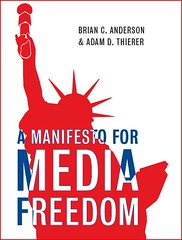 I’m pleased to announce the publication of A Manifesto for Media Freedom, which I co-authored with Brian C. Anderson of the Manhattan Institute. Brian serves as editor of Manhattan Institute’s excellent City Journal and he is the author of best-selling books like South Park Conservatives and Democratic Capitalism and Its Discontents.
In this little manifesto, we highlight one of the central ironies of the Information Age. Namely, that despite “the breathtaking abundance of new and old media outlets for obtaining news, information, and entertainment…”
many people hate this profusion, and never more than when it involves political speech. The current media market, they charge, doesn’t represent true diversity, or isn’t fair, or is subject to manipulation by a small and shrinking group of media barons. They want the government to regulate it into better shape, which just happens to be a shape that benefits them. Doing so… would be a disaster, a kind of soft or not-so-soft tyranny that would wipe out whole sectors of media, curtailing free speech and impoverishing our democracy.
In other words, instead of celebrating the unprecedented cornucopia of media choices at our collective disposal, many policymakers and media critics are calling for just as much media regulation as ever. We itemize these threats in our chapters and they include: efforts to revive the “Fairness Doctrine”, media ownership regulations, “localism” requirements, Net neutrality mandates, a la carte regulations, cable and satellite censorship, video game censorship, regulation of social networking sites, campaign finance-related speech restrictions, and so on.
In each case, we advance a pro-freedom paradigm to counter the advocates of media control. What do we mean by the “media freedom” that we advocate as the alternative to these new regulatory crusades? Here’s how we put it in the book:
Continue reading →
Bruce Owen, America’s preeminent media economist–with apologies to Harold Vogel, who at least deserves an honorable mention–has written another splendid piece for Cato’s Regulation magazine, this one entitled, “The Temptation of Media Regulation.”
This latest essay deals primarily with the many fallacies surrounding so-called “a la carte” regulation of the video marketplace, and I encourage you to read it to see Owen’s powerful refutation of the twisted logic behind that regulatory crusade. But I wanted to highlight a different point that Bruce makes right up front in his essay because it is something I am always stressing in my work too.
In some of my past work on free speech and media marketplace regulation, I have argued that there is very little difference between Republicans and Democrats when it comes to these issues. They are birds of feather who often work closely together to regulate speech and media. Whether it is broadcast ‘indecency’ controls; proposals to extend those controls to cable & satellite TV; campaign finance laws; efforts to limit or rollback ownership regulations; or even must carry and a la carte, the story is always the same: It’s one big bipartisan regulatory love fest. [And the same goes for regulation of the Internet, social networking sites, and video games.]
Owen explains why that is the case:
Continue reading →

 The Technology Liberation Front is the tech policy blog dedicated to keeping politicians' hands off the 'net and everything else related to technology.