The White House has announced a new effort to help prepare workers for the challenges they will face in the future. While it’s a well-intentioned effort, and one that I hope succeeds, I’m skeptical about it for a simple reason: It’s just really hard to plan for the workforce needs of the future and train people for jobs that we cannot possibly envision today.
Writing in the Wall Street Journal today, Ivanka Trump, senior adviser to the president, outlines the elements of new Executive Order that President Trump is issuing “to prioritize and expand workforce development so that we can create and fill American jobs with American workers.” Toward that end, the Administration plans on:
establishing a National Council for the American Worker, “composed of senior administration officials, who will develop a national strategy for training and retraining workers for high-demand industries.” This is meant to bring more efficiency and effectiveness to the “more than 40 workforce-training programs in more than a dozen agencies, and too many have produced meager results.”
“facilitat[ing] the use of data to connect American businesses, workers and educational institutions.” This is meant to help workers find “what jobs are available, where they are, what skills are required to fill them, and where the best training is available.”
launching a nationwide campaign “to highlight the growing vocational crisis and promote careers in the skilled trades, technology and manufacturing.”
The Administration also plans on creating a new advisory board of experts to address these issues, and the administration is also “asking companies and trade groups throughout the country to sign our new Pledge to America’s Workers—a commitment to invest in the current and future workforce.” They hope to encourage companies to take additional steps “to educate, train and reskill American students and workers.”
Perhaps some of these steps make sense, and perhaps a few will even help workers deal with the challenges of our more complex, fast-evolving, global economy. But I doubt it.
Continue reading →
If the techno-pessimists are right and robots are set to take all the jobs, shouldn’t employment in Amazon warehouses be plummeting right now? After all, Amazon’s sorting and fulfillment centers have been automated at a rapid pace, with robotic technologies now being integrated into almost every facet of the process. (Just watch the video below to see it all in action.)
And yet according to this
Wall Street Journal story by Laura Stevens, Amazon is looking to immediately fill 50,000 new jobs, which would mean that its U.S. workforce “would swell to around 300,000, compared with 30,000 in 2011.” According to the article, “Nearly 40,000 of the promised jobs are full-time at the company’s fulfillment centers, including some facilities that will open in the coming months. Most of the remainder are part-time positions available at Amazon’s more than 30 sorting centers.”
How can this be? Shouldn’t the robots have eaten all those jobs by now?
I recently finishedLearning by Doing: The Real Connection between Innovation, Wages, and Wealth, by James Bessen of the Boston University Law School. It’s a good book to check out if you are worried about whether workers will be able to weather this latest wave of technological innovation. One of the key insights of Bessen’s book is that, as with previous periods of turbulent technological change, today’s workers and businesses will obviously need find ways to adapt to rapidly-changing marketplace realities brought on by the Information Revolution, robotics, and automated systems.
That sort of adaptation takes time, but for technological revolutions to take hold and have meaningful impact on economic growth and worker conditions, it requires that large numbers of ordinary workers acquire new knowledge and skills, Bessen notes. But, “that is a slow and difficult process, and history suggests that it often requires social changes supported by accommodating institutions and culture.” (p 223) That is not a reason to resist disruptive forms of technological change, however. To the contrary, Bessen says, it is crucial to allow ongoing trial-and-error experimentation and innovation to continue precisely because it represents a learning process which helps people (and workers in particular) adapt to changing circumstances and acquire new skills to deal with them. That, in a nutshell, is “learning by doing.” As he elaborates elsewhere in the book:
Major new technologies become ‘revolutionary’ only after a long process of learning by doing and incremental improvement. Having the breakthrough idea is not enough. But learning through experience and experimentation is expensive and slow. Experimentation involves a search for productive techniques: testing and eliminating bad techniques in order to find good ones. This means that workers and equipment typically operate for extended periods at low levels of productivity using poor techniques and are able to eliminate those poor practices only when they find something better. (p. 50)
Luckily, however, history also suggests that, time and time again, that process has happened and the standard of living for workers and average citizens alike improved at the same time. Continue reading →
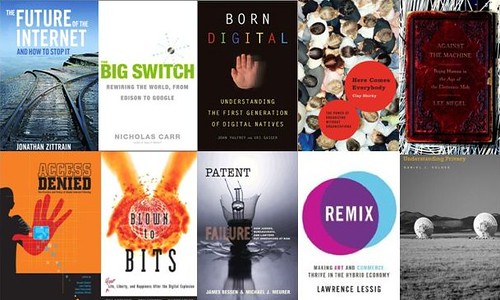
It’s been a big year for tech policy books. Several important titles were released in 2008 that offer interesting perspectives about the future of the Internet and the impact digital technologies are having on our lives, culture, and economy. Back in September, I compared some of the most popular technology policy books of the past five years and tried to group them into two camps: “Internet optimists” vs. “Internet pessimists.” That post generated a great deal of discussion and I plan on expanding it into a longer article soon. In this post, however, I will merely list what I regard as the most important technology policy books of the past year.
What qualifies as an “important” tech policy book? Basically, it’s a title that many people in this field are currently discussing and that we will likely be talking about for many years to come. I want to make it clear, however, that merely because a book appears on this list it does not necessarily mean I agree with everything said in it. In fact, I found much with which to disagree in my picks for the two most important books of 2008, as well as many of the other books on the list. [Moreover, after reading all these books, I am more convinced than ever that libertarians are badly losing the intellectual battle of ideas over Internet issues and digital technology policy. There’s just very few people defending a “Hands-Off-the-Net” approach anymore. But that’s a subject for another day!]
Another caveat: Narrowly focused titles lose a few points on my list. For example, as was the case in past years, a number of important IP-related books have come out this year. If a book deals exclusively with copyright or patent issues, it does not exactly qualify as the same sort of “tech policy book” as other titles found on this list since it is a narrow exploration of just one set of issues that have a bearing on digital technology policy. The same could be said of a book that deals exclusively with privacy policy, like Solove’s
Understanding Privacy. It’s an important book with implications for the future of tech policy, but I demoted it a bit because of its narrow focus.
With those caveats in mind, here are my Top 10 Most Important Tech Policy Books of 2008 (and please let me know about your picks for book of the year):
The Technology Liberation Front is the tech policy blog dedicated to keeping politicians' hands off the 'net and everything else related to technology. Learn more about TLF →

 The Technology Liberation Front is the tech policy blog dedicated to keeping politicians' hands off the 'net and everything else related to technology.