 Two great articles today about the dangers of government getting too involved in the newspaper business as the industry experiences serious marketplace difficulties. Slate’s Jack Shafer (“Saving Newspapers From Their Saviors“) and Mark Hopkins of Silicon Angle (“Obama Administration ‘Open’ to State Run Newspapers“) both raise concerns about President Obama’s recent comments hinting that he is open to legislation that might grant struggling news organizations tax breaks if they were to restructure as nonprofit businesses.
In a piece for the
City Journal back in March entitled “Socializing Media in Order to Save It,” I discussed the specific proposal in question, Senator Benjamin L. Cardin’s (D-MD) bill, S. 673, the “Newspaper Revitalization Act,” which would allow newspapers to become nonprofit organizations in an effort to help them stay afloat. Importantly, however, the measure would also disallow political endorsements on their editorial pages as part of the deal. In my essay, I pointed out how “If the FCC received grant-making authority to dole out subsidies to media operators… it’s hard to imagine how journalists won’t be expected to surrender something in exchange.” And that something would be their journalistic independence.
Shafer and Hopkins raise similar concerns in their essays. Continue reading →
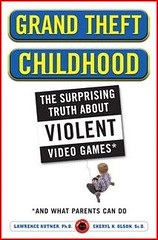 Don’t judge a book by its cover (or its title, for that matter). I’m usually faithful to that maxim, but I must admit that when I first saw the title and cover of “<a href="http://www.amazon.com/Grand-Theft-Childhood-Surprising-Violent/dp/0743299515/ref=pd_bbs_sr_1?ie=UTF8&s=books&qid=1208179493&sr=8-1″>Grand Theft Childhood: The Surprising Truth About Violent Video Games and What Parents Can Do,” I rolled my eyes and thought to myself, “here we go again.” I figured that I was in for another tedious anti-gaming screed full of myths and hysteria about games and gamers. Boy, was I wrong. Massively wrong.
Lawrence Kutner, PhD, and Cheryl K. Olson, ScD, cofounders and directors of the Harvard Medical School Center for Mental Health and Media, have written the most thoroughly balanced and refreshingly open-minded book about video games ever penned. They cut through the stereotypes and fear-mongering that have thus far pervaded the debate over the impact of video games and offer parents and policymakers common-sense advice about how to approach these issues in a more level-headed fashion. They argue that:
Today, an amalgam of politicians, health professionals, religious leaders and children’s advocates are voicing concerns about video games that are identical to the concerns raised one, two and three generations ago with the introduction of other new media. Most of these people have the best of intentions. They really want to protect children from evil influences. As in the past, a few have different agendas and are using the issue manipulatively. Unfortunately, many of their claims are based on scanty evidence, inaccurate assumptions, and pseudoscience. Much of the current research on violent video games is both simplistic and agenda driven. (p. 55)
They note that these groups, “probably worry too much about the wrong things and too little about more subtle issues and complex effects that are much more likely to affect our children.” They continue:
Continue reading →

 The Technology Liberation Front is the tech policy blog dedicated to keeping politicians' hands off the 'net and everything else related to technology.