
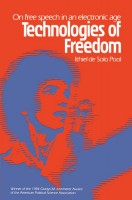
 I was honored to be asked by the editors at Reason magazine to be a part of their “Revolutionary Reading” roundup of “The 9 Most Transformative Books of the Last 45 Years.” Reason is celebrating its 45th anniversary and running a wide variety of essays looking back at how liberty has fared over the past half-century. The magazine notes that “Statism has hardly gone away, but the movement to roll it back is stronger than ever.” For this particular feature, Reason’s editors “asked seven libertarians to recommend some of the books in different fields that made [the anti-statist] cultural and intellectual revolution possible.”
When Jesse Walker of
Reason first contacted me about contributing my thoughts about which technology policy books made the biggest difference, I told him I knew exactly what my choices would be: Ithiel de Sola Pool’s Technologies of Freedom (1983) and Virginia Postrel’s The Future and Its Enemies (1998). Faithful readers of this blog know all too well how much I love these two books and how I am constantly reminding people of their intellectual importance all these years later. (See, for example, this and this.) All my thinking and writing about tech policy over the past two decades has been shaped by the bold vision and recommendations set forth by Pool and Postrel in these beautiful books.
As I note in my
Reason write-up of the books: Continue reading →
This year marks the 30th anniversary of the publication of Technologies of Freedom: On Free Speech in an Electronic Age by the late communications theorist Ithiel de Sola Pool. It was, and remains, a remarkable book that is well worth your time whether you read it long ago or are just hearing about it for the first time. It was the book that inspired me when I first read in 1994 to abandon my chosen field of study (trade policy) and do a deep dive into the then uncharted waters of information technology policy.
A Technological Nostradamus
Long before most of the world had heard about this thing called “the Internet” or using terms like “cyberspace” or even “electronic superhighway,” Pool was describing this emerging medium, thinking about its ramifications, and articulating the optimal policies that should govern it. In
Technologies of Freedom, Pool set forth both a predictive vision of future communications and “electronic publishing” markets as well as a policy vision for how those markets should be governed. “Networked computers will be the printing presses of the twenty-first century,” Pool argued in a remarkably prescient chapter on the future of electronic publishing. “Soon most published information will disseminated electronically,” and “there will be networks on networks on networks,” he predicted. “A panoply of electronic devices puts at everyone’s hands capacities far beyond anything that the printing press could offer.” As if staring into a crystal ball, Pool predicted: Continue reading →
 On numerous occasions here at the TLF over the past eight years, I’ve noted the profound influence that the late Ithiel de Sola Pool had on my thinking about the interaction of technology, information, and public policy. In fact, when I needed to pick a thematic title for my weekly Forbes column, it only took me a second to think of the perfect one: “Technologies of Freedom.” I borrowed that from the title of Pool’s 1983 masterpiece, Technologies of Freedom: On Free Speech in an Electronic Age. As I noted in my short Amazon.com review, Pool’s technological tour de force is simply breathtaking in its polemical power and predictive capabilities. Reading this book three decades after it was published, one comes to believe that Pool must have possessed a crystal ball or had a Nostradamus-like ability to foresee the future.
I felt that same was this week when I was re-reading some chapters from his posthumous book,
Technologies without Boundaries: On Telecommunications in a Global Age–a collection of his remaining essays nicely edited and tied together by Eli Noam after Pool’s death in 1984. Re-reading it again reminded me of Pool’s remarkable predictive powers. In particular, the closing chapter on “Technology and Culture” includes some of Pool’s thoughts on the future of copyright. As you read through that passage below, please try to remember he wrote these words back in the early 1980s, long before most people had even heard of the Internet and when home personal computing was only just beginning to take off. Yet, from what he already knew about networked computers and digital methods of transmitting information, Pool was able to paint a prescient portrait of the future copyright wars that we now find ourselves in the midst of. Here’s what he had to say almost 30 years ago about how things would play out: Continue reading →
I’m very excited to announce that I now have a regular Forbes column that will fly under the banner, “Technologies of Freedom.” My first essay for them is already live and it addresses a topic I’ve dealt with here extensively through the years: Irrational fears about tech monopolies and “information empires.” Jump over to Forbes to read the whole thing.
Regular readers of this blog will understand why I chose “Technologies of Freedom” as the title for my column, but I thought it was worth reiterating. No book has had a more formative impact on my thinking about technology policy than Ithiel de Sola Pool’s 1983 masterpiece,
Technologies of Freedom: On Free Speech in an Electronic Age. As I noted in my short Amazon.com review, Pool’s technological tour de force is simply breathtaking in its polemical power and predictive capabilities. Reading this book almost three decades after it was published, one comes to believe that Pool must have possessed a crystal ball or had a Nostradamus-like ability to foresee the future.
For example, long before anyone else had envisioned what we now refer to as “cyberspace,” Pool was describing it in this book. “Networked computers will be the printing presses of the twenty-first century,” he argued in his remarkably prescient chapter on electronic publishing. “Soon most published information will disseminated electronically,” and “there will be networks on networks on networks,” he predicted. “A panoply of electronic devices puts at everyone’s hands capacities far beyond anything that the printing press could offer.” Few probably believed his prophecies in 1983, but no one doubts him now! Continue reading →
Stephen Schultze is an up-and-coming technology policy analyst who is a fellow at the Berkman Center for Internet and Society at Harvard University. He is also finishing up his Masters of Science in Comparative Media Studies up at MIT. He’s been kind enough to stop by here at the TLF on occasion and comment on some of the things we have written — usually to give us grief, but we welcome that too! He’s very sharp and always has something of substance to say, and he says it in a respectful way. So I look forward to many years of intellectual combat with him. (Incidentally, we also share a mutual admiration for the work of Ithiel de Sola Pool, especially his 1983 classic, “Technologies of Freedom: On Free Speech in an Electronic Age , which I have noted is my favorite tech policy book of all-time.]
Anyway, Stephen has just posted his master’s thesis: “The Business of Broadband and the Public Interest: Media Policy for the Network Society.” It’s a noble attempt to defend and extend the “public interest” concept in the Digital Age. Stephen attempts to “identify the several dimensions in which it remains relevant today.” In his thesis, Stephen cites some of my past work on the issue since I have articulated a very different view on the issue. Specifically, he cites a line of mine that I have used in multiple studies and essays on the issue:
“The public interest standard is not really a “standard” at all since it has no fixed meaning; the definition of the phrase has shifted with the political winds to suit the whims of those in power at any given time.”
I stand by that quote and down below I have pasted a lengthy passage on the mythology surrounding the public interest standard, which I pulled directly from my old 2005 “Media Myths” book. It explains in more detail why I feel that way.
“Right now is a critical point of media in transition that will affect the shape communications ecosystem going forward,” Stephen states in his thesis. I couldn’t agree more, but I completely disagree that that somehow justifies breathing new life into a standard-less standard that justifies open-ended, arbitrary governance of the Internet and digital media. Read on to understand why I feel that way…
Continue reading →
 I was honored to be asked by the editors at Reason magazine to be a part of their “Revolutionary Reading” roundup of “The 9 Most Transformative Books of the Last 45 Years.” Reason is celebrating its 45th anniversary and running a wide variety of essays looking back at how liberty has fared over the past half-century. The magazine notes that “Statism has hardly gone away, but the movement to roll it back is stronger than ever.” For this particular feature, Reason’s editors “asked seven libertarians to recommend some of the books in different fields that made [the anti-statist] cultural and intellectual revolution possible.”
 The Technology Liberation Front is the tech policy blog dedicated to keeping politicians' hands off the 'net and everything else related to technology.