My latest Forbes column is a celebration of 47 U.S.C. §230, otherwise known as “Section 230.” Sec. 230 turns 15 years old this year and I argue that this important law has “helped foster the abundance of informational riches that lies at our fingertips today” and has served as “the foundation of our Internet freedoms.” Sadly, however, few people have even heard of it. Worse yet, as I note in my essay, this important law is under attack from various academics and organizations who want it modified to address a variety of online problems. But, as I note:
If the threat of punishing liability is increased, the chilling effect on the free exchange of views and information would likely be quite profound. Many site administrators would immediately start removing massive amounts of content to avoid liability. More simply, they might just shut down any interactive features on their sites or limit service in other ways.
Head over to
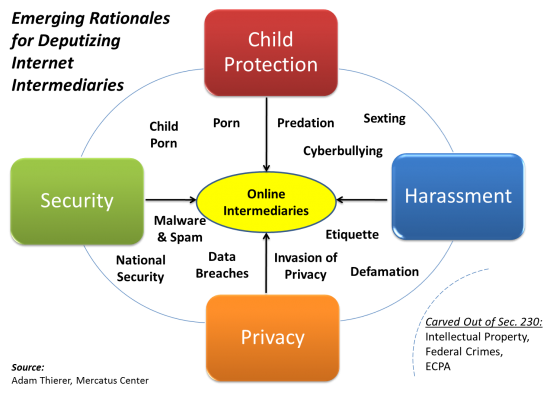
Forbes to read the rest. And here’s a graphic I put together illustrating all the new fault lines in the war against Sec. 230. It will be included in a new paper on the issue that I am wrapping up right now.
Like Milton, I’m very worried about the political vulnerabilities that might arise if the wireless sector grows more concentrated. Still, I think it’s a big mistake to legitimize one repressive incarnation of coercive state power (antitrust intervention) to reduce the likelihood that another incarnation (information control) will intensify. This approach is not only defeatist, as Hance argues, but it also requires a tactical assessment that rests on several dubious assumptions.
First, Milton overestimates the marginal risk that the AT&T – T-Mobile deal will pave the way for an information control regime. The wireless market isn’t static; the disappearance of T-Mobile as an independent entity (which may well occur regardless of whether this deal goes through) hardly means we’re forever “doomed” to live with 3 nationwide wireless players. With major spectrum auctions likely on the horizon, and the possibility of existing spectrum holdings being combined in creative ways, the eventual emergence of one or more nationwide wireless competitors is quite possible — especially if, as skeptics of the AT&T – T-Mobile deal often argue, the wireless market underperforms in the years following the acquisition.
More importantly, network operators, like almost all Internet gatekeepers, face mounting pressure from their users not to facilitate censorship, surveillance, and repression. Case in point: AT&T is a leading member of the Digital Due Process coalition (to which I also belong) that’s urging Congress to substantially strengthen the 1986 federal statute that governs law enforcement access to private electronic communications. Consider that AT&T’s position on this major issue is officially at odds with the official position of the same Justice Department that’s currently reviewing the AT&T – T-Mobile deal. Would a docile, subservient network operator challenge its state overseers so publicly?
Continue reading →
In the latest example of big government run amok, several politicians think they ought to be in charge of which applications you should be able to install on your smartphone.
On March 22, four U.S. Senators sent a letter to Apple, Google, and Research in Motion urging the companies to disable access to mobile device applications that enable users to locate DUI checkpoints in real time. Unsurprisingly, in their zeal to score political points, the Senators—Harry Reid, Chuck Schumer, Frank Lautenberg, and Tom Udall—got it dead wrong.
Had the Senators done some basic fact-checking before firing off their missive, they would have realized that the apps they targeted actually
enhance the effectiveness
of DUI checkpoints while reducing their intrusiveness. And had the Senators glanced at the Constitution – you know, that document they swore an oath to support and defend – they would have seen that sobriety checkpoint apps are almost certainly protected by the First Amendment.

While Apple has stayed mum on the issue so far, Research in Motion quickly yanked the apps in question. This is understandable; perhaps RIM doesn’t wish to incur the wrath of powerful politicians who are notorious for making a public spectacle of going after companies that have the temerity to stand up for what is right.
Google has refused to pull the DUI checkpoint finder apps from the Android app store, reports Digital Trends. Google’s steadfastness on this matter reflects well on its stated commitment to free expression and openness. Not that Google’s track record is perfect on this front – it’s made mistakes from time to time – but it’s certainly a cut above several of its competitors when it comes to defending Internet freedom. Continue reading →
That will be the subject of a Cato on Campus session this afternoon entitled: “The Internet and Social Media: Tools of Freedom or Tools of Oppression?” Watch live online at the link starting at 3:30 p.m., or attend in person. A reception follows.
The delight that so many felt to see protesters in Iran using social media has given way to delight about the use of Facebook to organize for freedom in Egypt. But this serial enthusiasm omits that the “Twitter revolution” in Iran did not succeed. The fiercest skeptics even suggest that the Tweeting during Iran’s suppressed uprising was mostly Iranian ex-pats goosing excitable westerners and not any organizing force within Iran itself. Coming to terms with the Internet, dictatorships are learning to use it for surveillance and control, possibly with help from American tech companies.
So is the cause of freedom better off with the Internet? Or is social media a shiny bauble that distracts from the long, heavy slog of liberating the people of the world?
Joining the discussion will be Chris Preble, Director of Foreign Policy Studies at Cato; Alex Howard, Government 2.0 Correspondent for O’Reilly Media; and Tim Karr, Campaign Director at Free Press. More info here.

Chalk up another victim to unwarranted political intimidation by state attorneys general. On Friday evening, Craigslist, which has long been under intense pressure to crack down on sex crimes, replaced its adult services section in the U.S. with a black censor bar. This move comes on the heels of a scathing letter sent to Craigslist by seventeen state AGs insinuating that Craigslist is culpable for the “victimization of children.” While the state attorneys general are likely celebrating victory this holiday weekend, all they’ve really done is to stifle free speech online and complicate efforts by law enforcement authorities to go after the real bad guys — you know, the ones who are forcing kids into sex slavery.
This isn’t the first time states have publicly attacked Craigslist for its involvement in sex crimes. Various AGs been trying to intimidate the site into eliminating avenues of adult content for years, as Alex Harris and Jim Harper have chronicled on these pages. In response to state AGs’ relentless saber-rattling, Craigslist made several major changes last year aimed at curbing illegal postings. The site shut down its notorious “erotic services” section and began charging $10 for every posting made to the adult services section. Craigslist even began manually screening all posts submitted to the adult services section. Since May 2009, over 700,000 postings have been rejected.
Apparently none of these concessions were enough for state AGs, always eager to score political points. Despite the safeguards Craigslist implemented last year, users continued to use the site in the commission of sex crimes. This is hardly surprising; given the sheer volume of user submissions and the increasingly complex measures taken by criminals to obfuscate their unlawful solicitations, some illegal postings are bound to circumvent any filtering regime. Now that Craigslist has censored its adult services section, former users of the section will invariably flock to other sites, as has happened every single time a major Bittorrent site has been taken offline or crippled by litigation. Craigslist is just one of many, many websites on the Internet that’s frequented by criminals, after all. From popular sites like Google and Yahoo! to small blogs that accept user comments, nearly any site that allows user submissions can be used to break the law.
Such websites generally aren’t legally liable for crimes committed by their users, as courts across the country have held time and time again (1,2,3,4). That’s because when Congress overhauled America’s telecom laws in 1996, it enacted the Communications Decency Act, which grants “providers” of “interactive computer service” immunity from state criminal prosecution for illegal content posted by users. Thus, while prosecutors can and do pursue criminal charges against individuals who post illegal content to Craigslist, they can’t go after Craigslist itself, as long as the site complies with enforceable governmental requests and promptly removes content it knows to be illegal.
Continue reading →
Earlier this week, The Daily Show’s Jon Stewart summed up the debate over net neutrality by stating, “On one side [are] those who want the marketplace to remain a wide open market of ideas, and on the other side [is] a larger group who have no idea what net neutrality means.”
Stewart may have been joking, but he was right about one thing – many folks are confused about what net neutrality actually is and what it would mean for Internet users.
That’s why I decided to enter the America’s Got Net video contest, sponsored by the Open Internet Coalition, a pro-net neutrality trade association. In a short video entitled, “The Open Internet and Lessons from the Ma Bell Era,” I explain how mandating net neutrality would endanger the networks of tomorrow and insulate entrenched firms from competition. Enjoy!
http://www.youtube.com/v/ZS_udd5K91o?fs=1&hl=en_US
By Adam Thierer & Berin Szoka
Short but very important essay here from Santa Clara University Law School Prof. Eric Goldman about calls to alter Sec. 230 of the Communications Decency Act (CDA) to address concerns about online harassment. Generally speaking, Sec. 230 immunizes online intermediaries from punishing liability for the content that travels over their networks / services. Specifically, Sec. 230 stipulates that “No provider or user of an interactive computer service shall be treated as the publisher or speaker of any information provided by another information content provider.” In other words: Don’t shoot the messenger!
As we’ve noted here before, it is probably not an overstatement to think of Sec. 230 as the very cornerstone of Internet Freedom, since it makes possible an online “utopia for utopias,” to borrow a phrase from our favorite modern political philosopher, the late Robert Nozick. Without Sec. 230, intermediaries would likely be forced to shut down many avenues of communication and would have to become deputized conduct and morality police for every cyber-street corner.
Goldman, America’s leading expert on Sec. 230-related jurisprudence, correctly notes that, “Frequently, § 230’s critics do not attack the immunization generally, but instead advocate a new limited exception for their pet concern.” He’s got that right. Indeed, we are increasingly hearing calls from numerous quarters these days to “tweak 230” for one pet concern after another. We’ve illustrated some of those concerns in this exhibit.
Deputization of the Middleman http://d1.scribdassets.com/ScribdViewer.swf
Regulatory advocates can be found for each of these issues who like to see the protections afforded by Sec. 230 scaled back by Congress or he courts. But Goldman rightly warns:
Continue reading →
By Berin Szoka & Adam Thierer
 We learned from The Wall Street Journal yesterday that “Federal Communications Commission Chairman Julius Genachowski gets a little peeved when people suggests that he wants to regulate the Internet.” He told a group of Journal reporters and editors today that: “I don’t see any circumstances where we’d take steps to regulate the Internet itself,” and “I’ve been clear repeatedly that we’re not going to regulate the Internet.”
We’re thankful to hear Chairman Julius Genachowski to make that promise. We’ll certainly hold him to it. But you will pardon us if we remain skeptical (and, in advance, if you hear a constant stream of “I told you so” from us in the months and years to come). If the Chairman is “peeved” at the suggestion that the FCC might be angling to extend its reach to include the Internet and new media platforms and content, perhaps he should start taking a closer look at what his own agency is doing—and think about the precedents he’s setting for future Chairmen who might not share his professed commitment not to regulate the ‘net. Allow us to cite just a few examples:
Net Neutrality Notice of Proposed Rulemaking
We’re certainly aware of the argument that the FCC’s proposed net neutrality regime is not tantamount to Internet regulation—but we just don’t buy it. Not for one minute.
First, Chairman Genachowski seems to believe that “the Internet” is entirely distinct from the physical infrastructure that brings “cyberspace” to our homes, offices and mobile devices. The WSJ notes, “when pressed, [Genachowski] admitted he was referring to regulating Internet content rather than regulating Internet lines.” OK, so let’s just make sure we have this straight: The FCC is going to enshrine in law the principle that “gatekeepers” that control the “bottleneck” of broadband service can only be checked by having the government enforce “neutrality” principles in the same basic model of “common carrier” regulation that once applied to canals, railroads, the telegraph and telephone. But when it comes to accusations of “gatekeeper” power at the content/services/applications “layers” of the Internet, the FCC is just going to step back and let markets sort things out? Sorry, we’re just not buying it. Continue reading →
WAR IS PEACE
FREEDOM IS SLAVERY
IGNORANCE IS STRENGTH
So declared the Party in George Orwell’s classic novel
1984. The corruption of language with a constant theme of Orwell’s work, most notably his 1946 essay “Politics and the English Language.” So Orwell would not have been surprised to see the term “Internet Freedom” captured by those who advocate an increased role for government (i.e., Big Brother) online. Nor would Orwell had been surprised to see these advocates claim Orwell for themselves, insisting that opponents of government regulation are the ones corrupting language. There is perhaps no better example of this than MSNBC’s Rachel Maddow’s comments in an interview with Boing Boing’s Xeni Jardin about the divisive issue of “Net Neutrality” regulations:
Rachel Maddow [dripping with sarcasm]: Sen. McCain’s bill, as you mentioned, is actually called the “Internet Freedom Act of 2009,” and he’s deriding the government effort to keep telecoms from walling off the Internet as “government intrusion” and “trying to regulate the Internet.” What that means is that he’s picked better branding, he’s picked better names. It doesn’t really relate the facts of what he’s doing. I’m wondering if it’s too late for a rebranding of the other side here. We need to get better about talking about this, because the language seems sort of corrupt at this point.
What makes Maddow’s comments so stunning is
not her view that corporate America, rather than government, is the real enemy of freedom. That view is simply part of the long-regnant political orthodoxy. No, what’s stunning is that she actually thinks that her side is losing the “war of words” just because Sen. McCain had the gall to use the term “Internet Freedom” as a rallying-cry for the outdated, bourgeois notion that “freedom” means the absence of coercion by the one entity that can enforce its commands at the point of a gun and call it “justice”: that coldest of all cold monsters, the State. That’s precisely what “liberalism” used to be about until people like Rachel appropriated that word and words like “liberty” and “freedom” as slogans for control. Xeni Jardin picks up where Rachel left off by appropriating the concept of rights, too:
Xeni Jardin: the Internet really is a basic right, it’s a necessity,such a fundamental way for communicating and accessing information now. Telecoms shouldn’t be able to throttle, to block, to slow down our access to something that might not be in their corporate interests.
This is pure, unadulterated cyber-socialism: Rights become not the sacred defense of the individual, but a positive assertion of entitlement to a vaguely defined principle of access: by guaranteeing this access through ever-expanding “neutrality regulation”, government gains unlimited control over the Internet itself.
As Adam Thierer and I have warned, that way lies madness: Inviting the government to regulate online content and services in the name of “neutrality” (or “privacy” or any of the many “glittering generalities” ending in “-y” Orwell would have denounced) would be the death of real
Internet Freedom, which requires a strict “Separation of Web and State.” Continue reading →
by Berin Szoka & Adam Thierer, Progress Snapshot 5.11 (PDF)
Ten years ago, Nobel Prize-winning economist Milton Friedman lamented the “Business Community’s Suicidal Impulse:” the persistent propensity to persecute one’s competitors through regulation or the threat thereof. Friedman asked: “Is it really in the self-interest of Silicon Valley to set the government on Microsoft?” After yesterday’s FCC vote’s to open a formal “Net Neutrality” rule-making, we must ask whether the high-tech industry—or consumers—will benefit from inviting government regulation of the Internet under the mantra of “neutrality.”
The hatred directed at Microsoft in the 1990s has more recently been focused on the industry that has brought broadband to Americans’ homes (Internet Service Providers) and the company that has done more than any other to make the web useful (Google). Both have been attacked for exercising supposed “gatekeeper” control over the Internet in one fashion or another. They are now turning their guns on each other—the first strikes in what threatens to become an all-out, thermonuclear war in the tech industry over increasingly broad neutrality mandates. Unless we find a way to achieve “Digital Détente,” the consequences of this increasing regulatory brinkmanship will be “mutually assured destruction” (MAD) for industry and consumers.
New Fronts in the Neutrality Wars
The FCC’s proposed rules would apply to all broadband providers, including wireless, but not to Google or many other players operating in other layers of the Net who favor such broadband-specific rules. With this rulemaking looming, AT&T came after Google with letters to the FCC in late September and then another last week accusing the company of violating neutrality principles in their business practices and arguing that any neutrality rules that apply to ISPs should apply equally to Google’s panoply of popular services. In particular, AT&T accused Google of “search engine bias,” suggesting that only government-enforced neutrality mandates could protect consumers from Google’s supposed “monopolist” control.
The promise made yesterday by the FCC—to only apply neutrality principles to the infrastructure layer of the Net—is hollow and will ultimately prove unenforceable. Continue reading →

 The Technology Liberation Front is the tech policy blog dedicated to keeping politicians' hands off the 'net and everything else related to technology.