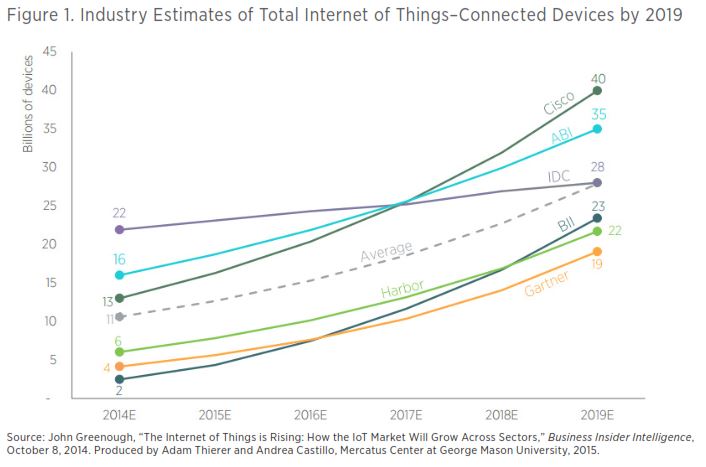
The “Internet of Things” (IoT) is already growing at a breakneck pace and is expected to continue to accelerate rapidly. In a short new paper (“Projecting the Growth and Economic Impact of the Internet of Things“) that I’ve just released with my Mercatus Center colleague Andrea Castillo, we provide a brief explanation of IoT technologies before describing the current projections of the economic and technological impacts that IoT could have on society. In addition to creating massive gains for consumers, IoT is projected to provide dramatic improvements in manufacturing, health care, energy, transportation, retail services, government, and general economic growth. Take a look at our paper if you’re interested, and you might also want to check out my 118-page law review article, “The Internet of Things and Wearable Technology: Addressing Privacy and Security Concerns without Derailing Innovation” as well as my recent congressional testimony on the policy issues surrounding the IoT.)
As Berin mentioned last week, we have a new paper out on proposals to expand the Children’s Online Privacy Protection Act (COPPA) of 1998. We generically refer to those COPPA-expansion efforts as “COPPA 2.0.” Hence, the title of our paper: “COPPA 2.0: The New Battle over Privacy, Age Verification, Online Safety & Free Speech.” To recap what Berin already noted, in the name of improving online child safety, some legislators and state attorneys general (AGs) are advocating the expansion of COPPA’s “verifiable parental consent” model of age verification before certain sites or services may collect, or enable the sharing of, personal information for children.
Unlike “COPPA 1.0,” however, which only applied to children under the age of 13, “COPPA 2.0” would apply to all minors up to age 17. Moreover, the range of sites covered by the new law would generally be expanded to include just about any site or service with social networking functionality.
Since Berin has already summarized our general concerns with efforts to expand COPPA’s “verifiable parental consent” online age verification system to cover more online users and sites, I thought I would focus here on what I believe will be the most controversial (and important) part of our paper — our discussion about how COPPA 2.0 affects the speech rights of both adults
and adolescents.
Continue reading →

 The Technology Liberation Front is the tech policy blog dedicated to keeping politicians' hands off the 'net and everything else related to technology.