Here’s a new DC EKG podcast I recently appeared on to discuss the current state of policy development surrounding artificial intelligence. In our wide-ranging chat, we discussed:
- why a sectoral approach to AI policy is superior to general purpose licensing
- why comprehensive AI legislation will not pass in Congress
- the best way to deal with algorithmic deception
- why Europe lost its tech sector
- how a global AI regulator threatens our safety
- the problem with Biden’s AI executive order
- will AI policy follow same path as nuclear policy?
- global innovation arbitrage & the innovation cage
- AI, health care & FDA regulation
- AI regulation vs trade secrets
- is AI transparency / auditing the solution?
Listen to the full show here or here. To read more about current AI policy developments, check out my “Running List of My Research on AI, ML & Robotics Policy.”
In a new essay in The Dallas Morning News (“Licensing restrictions for health care workers need to be flexible to fight coronavirus“),
Trace Mitchell
and I discuss recent efforts to reform occupational licensing restrictions for health care workers to help fight the coronavirus.
Trace and I have written extensively about the need for licensing flexibility over the past couple of years, but it is needed now more than ever. Luckily, some positive reforms are now underway.
We highlight efforts in states like Massachusetts and Texas to reform their occupational licensing rules in response to the crisis, as well as federal reforms aimed at allowing reciprocity across state lines. We conclude by noting that:
It should not take a crisis of this magnitude for policymakers to reconsider the way we prevent fully qualified medical professionals from going where they are most needed. But that moment is now upon us. More leaders would be wise to conduct a comprehensive review of regulatory burdens that hinder sensible, speedy responses to the coronavirus crisis.
If nothing else, the relaxation of these rules should give us a better feel for how necessary strict licensing requirements truly are. Chances are, we will learn just how costly the regulations have been all along.
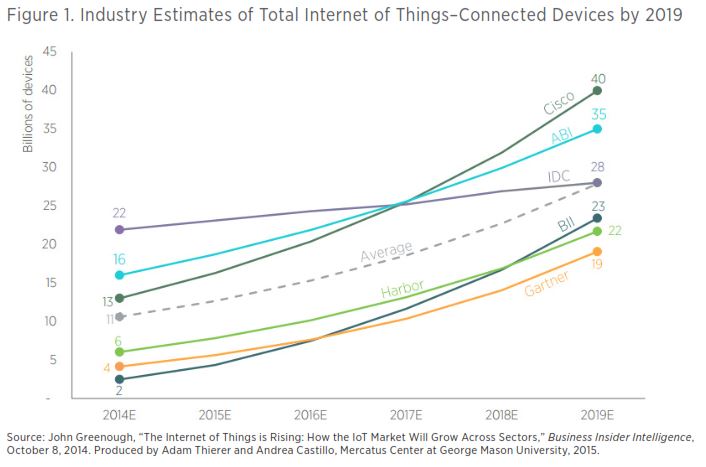
The “Internet of Things” (IoT) is already growing at a breakneck pace and is expected to continue to accelerate rapidly. In a short new paper (“Projecting the Growth and Economic Impact of the Internet of Things“) that I’ve just released with my Mercatus Center colleague Andrea Castillo, we provide a brief explanation of IoT technologies before describing the current projections of the economic and technological impacts that IoT could have on society. In addition to creating massive gains for consumers, IoT is projected to provide dramatic improvements in manufacturing, health care, energy, transportation, retail services, government, and general economic growth. Take a look at our paper if you’re interested, and you might also want to check out my 118-page law review article, “The Internet of Things and Wearable Technology: Addressing Privacy and Security Concerns without Derailing Innovation” as well as my recent congressional testimony on the policy issues surrounding the IoT.)
 I want to bring to everyone’s attention an important new white paper by Dr. Robert Graboyes, a colleague of mine at the Mercatus Center at George Mason University who specializes in the economics of health care. His new 67-page study, Fortress and Frontier in American Health Care, seeks to move away from the tired old dichotomies that drive health care policy discussions: Left versus Right, Democrat versus Republican, federal versus state, and public versus private, and so on. Instead, Graboyes seeks to reframe the debate over the future of health care innovation in terms of “Fortress versus Frontier” and to highlight what lessons we can learn from the Internet and the Information Revolution when considering health care policy.
What does Graboyes mean by “Fortress and Frontier”? Here’s how he explains this conflict of visions:
The Fortress is an institutional environment that aims to obviate risk and protect established producers (insiders) against competition from newcomers (outsiders). The Frontier, in contrast, tolerates risk and allows outsiders to compete against established insiders. . . . The Fortress-Frontier divide does not correspond neatly with the more familiar partisan or ideological divides. Framing health care policy issues in this way opens the door for a more productive national health care discussion and for unconventional policy alliances. (p. 4)
He elaborates in more detail later in the paper: Continue reading →
Well, you got it! Here’s a essay of mine that The Daily Caller ran today discussing the ramifications of the decision.
___________
Internet freedom got a reprieve Tuesday when the U.S. Court of Appeals for the District of Columbia slapped down a brazen attempt by the Federal Communications Commission (FCC) to ignore the rule of law and begin imposing onerous regulations on broadband network operators. The decision,
Comcast v. FCC, deals with arcane matters of regulatory agency jurisdiction, but the stakes were profound and the ramifications for the future of the Internet will reverberate for years to come.
In a nutshell, the FCC argued it had the right to impose so-called “Net neutrality” regulations on a private broadband operator based merely on a handful of principles that the agency had previously said it would
not be enforcing as law. Net neutrality regulations would put FCC bureaucrats in the Internet’s driver’s seat and let them determine what was “just and reasonable” of private networks. Critics have rightly feared that Net neutrality sounded all too much a Fairness Doctrine for the Internet since similar language had been used in the broadcast era to justify all sorts of FCC meddling and micromanagement.
Regardless, the FCC’s original position—that its Net neutrality principles were
only principles and nothing more—made sense since even a high school civics student can tell you that only Congress can make laws. Moreover, for a brief time, even the FCC seem to realize that laws that would comprehensively regulate such an important sector of the American economy, as Net neutrality rules would, almost certainly require our elected leaders in Congress to reopen and tweak existing statutes like the Telecommunications Act of 1996. After all, Congress had never authorized wide-reaching regulation of the Net or broadband networks, and so, if the agency wanted to extend its regulatory tentacles and wrap them around the Internet it only seems reasonable they get the blessing of lawmakers before doing so. And, for a time, the FCC stuck to a “Hands Off the Net” approach.
Continue reading →
Over on the WashingtonWatch.com blog, I’ve laid out in the simplest terms I could what’s going on in terms of procedure with health care overhaul legislation. The post, called “What is Deeming, Anyway?“, comes in at a mere 900 words… If you’re a real public policy junkie, you might like it.
But what about the transparency oriented processes that President Obama and leaders like Speaker Pelosi promised the public? Recall that the Speaker promised to post the health care bill online for 72 hours before a vote back in September.
There was debate about whether she stuck to her promise then. And it was probably a one-time promise. It’s almost certain that she will not do so now. If she lines up the votes to pass the bill, the vote will happen. Right. Then.
What about President Obama’s promise to put health care negotiations on C-SPAN? The daylong roundtable debate on health care was an engaging illustration of what happens when you do transparent legislating. Voters got a clearer picture of where each side stands—and perhaps saw that there actually is some competence on both sides of the aisle. Some competence.
The health care negotiations going on right now are the ones that matter. This is when the most important details are being hammered out. This is when the bargaining that draws the public’s ire is happening. But I’m not seeing it on C-SPAN.
President Obama’s promise may have been naive, but that doesn’t excuse it. The inside negotiations going on this week represent an ongoing violation of the president’s C-SPAN promise.
And there’s good reason to anticipate that the president will violate his Sunlight Before Signing promise as well. This was his promise to post bills online for five days after he receives them from Congress before signing them into law. Continue reading →
Over at “Convergences,” I write on the origins of the idea of a “public option” for health insurance. In part, I note:
At a superficial level, the “public option” for health care is both appealing and puzzling. From a competition policy standpoint, the entry into the market of a subsidized competitor offering a wide array of benefits certainly might put downward pressure on prices as well as easing humanitarian concerns about access. Equally obvious, though, are objections. What mechanism of accountability would exist to ensure that this subsidized entity is well run? It cannot be allowed to go bankrupt; nor is it likely that unhappy customers would have much leeway in suing it. How would it avoid driving private insurers out of the market for low-end service entirely? How much of a subsidy would it get, and how is this to be funded?
Since the party and administration that sponsored this proposal are associated with the intelligentsia, however, people hoping to improve the health care system probably felt entitled to trust that these questions had good answers. Somewhere, someone deep in the bowels of the brain trust had considered these issues. Curious about this, I found myself reading one of the more serious works to address the public option, a paper by Randall D. Cebul, James B. Rebitzer, Lowell J. Taylor and Mark E. Votruba entitled, “Unhealthy Insurance Markets: Search Frictions and the Cost and Quality of Health Insurance,” identified as NBER Working Paper No. 14455, from October 2008.
Read my whole piece, here.
See my take on the election and the prospects for capitalism in today’s Wall Street Journal:
If Barack Obama ran for president by calling for a heavier hand of government, he also won by running one of the most entrepreneurial campaigns in history.
Will he now grasp the lesson his campaign offers as he crafts policies aimed at reigniting the national economy? Amid a recession, two wars, and a global financial crisis, will he come to see that unleashing the entrepreneur is the best way to raise the revenue he needs for his lofty priorities?

 The Technology Liberation Front is the tech policy blog dedicated to keeping politicians' hands off the 'net and everything else related to technology.