Over at Computerworld, Ben Rothke makes the case for “Why Information Must Be Destroyed.” “Given the vast amount of paper and digital media that amasses over time,” he argues, “effective information destruction policies and practices are now a necessary part of doing business and will likely save organizations time, effort and heartache, legal costs as well as embarrassment and more.” He continues:
Every organization has data that needs to be destroyed. Besides taxes, what unites every business is that they possess highly sensitive information that should not be seen by unauthorized persons. While some documents can be destroyed minutes after printing, regulations may require others to be archived from a few years to permanently. But between these two ends of the scale, your organization can potentially have a large volume of hard copy data occupying space as a liability, both from a legal and information security perspective. Depending on how long you’ve been in business, the number of physical sites and the number of people you employ, it’s possible to have hundreds of thousands, if not millions, of pages of hard copy stored throughout your company — much of which is confidential data that can be destroyed.
He’s no doubt correct that it makes good business sense to routinely purge data — both physical and digital — to guard against theft, misplacement, leaks, abuse, or whatever else. Of course, in the context of digital information, there are many folks who would like to see digital records purged more frequently to avoid growing concerns about online privacy. I think most of those concerns are over-stated, but it can’t hurt to destroy most collected information after a certain period to play it safe and keep customers happy.
Problem is, as we discussed here last week, if some lawmakers in Washington get their way, it might be illegal to do that! Quite obviously, data retention mandates are at odds with data destruction efforts. [Mitch Wagner has more coverage of the data retention debate over at Information Week and he quotes my PFF colleague Sid Rosenzweig.]
Many folks are discussing Christopher Ferguson’s latest paper on “The School Shooting / Violent Video Game Link: Causal Relationship or Moral Panic?” And with good reason. It’s an important look at how “moral panics” develop in modern society, in this case around video games. [Moral panics is a subject I have written on at length here many times
before. Alice Marwick’s brilliant article on “technopanics” is also worth reading in this regard].
As I’ve noted here before, Ferguson has penned many important articles raising questions about the claims made by some other psychologists (and politicians) that there is causal relationship between exposure to violent video games and youth aggression. Ferguson has shown there are reasons to be skeptical of such claims — both methodologically and practically-speaking. More on that down below.
In his latest piece, however, Ferguson, a professor at Texas A&M’s Department of Behavioral, Applied Sciences and Criminal Justice, is more fully developing moral panic theory, which he describes as follows: “A moral panic occurs when a segment of society believes that the behavior or moral choices of others within that society poses a significant risk to the society as a whole.” To illustrate the various forces at work that drive moral panics, Ferguson uses this “Moral Panic Wheel”:
![Moral Panic Wheel [Ferguson]](http://farm4.static.flickr.com/3080/3219688961_6d255b309f.jpg) Continue reading →
Continue reading →

My Kid is the Man of Steel! ... in his mind.
Regular readers will recall my great interest in video games and the public policy debates surrounding efforts to regulate “violent” games in particular. One thing I bring up in almost every essay I write on this subject is how fears about kids and video games are almost always overblown and that kids can typically separate fantasy from reality. Nonetheless, kids have active imaginations and adults sometimes fear that which they cannot understand or appreciate. Friendly mentoring and open-minding parenting can go a long way to encouraging kids to make smart choices and understand where to draw lines, whereas efforts to demonize video games and youth culture almost always backfire.
Anyway, what got me thinking about all this again was an entertaining column in today’s
Washington Post by Ron Stanley (“Who Needs a TV to Play Video Games“), which describes the author’s experiences with his nephew when they played out video game-like scenarios using traditional toys and household items. It’s a wonderful piece worth reading in its entirety, but here’s the key takeaway that I’d like to discuss:
There was no evidence that television and video games had stifled the kids’ creativity. Nor was there any evidence that technology had made them smarter than earlier generations. They simply had a different frame of reference, one that included video games and computers as well as ponies, pet stores and sword fights. Children play with the tools at hand, and they’re great at thinking metaphorically — at imagining that a landspeeder is a sentient robot or that a stick is a gun or that salt-and-pepper shakers are a bride and groom or that a card table is a horse’s stable.
They’re also geniuses at figuring out simple mechanics. My 6-year-old nephew had to explain to me that miniature low-rider cars don’t roll very well on carpet and will flip over more than if racing on hardwood floors. Novice that I was, I was choosing cars that looked the coolest. And they are geniuses at intuiting rules and systems, and at re-creating these rules and systems in their own play. Children who play lots of card games will invent their own card games. Children who play lots of board games will invent their own board games. And children who play lots of video games will invent their own video-game-like games when they don’t have access to the game controllers.
Continue reading →
 Dr. Kourosh Dini is a Chicago-based adolescent and adult psychiatrist who has just published a new book entitled, Video Game Play and Addiction: A Guide for Parents. [You can learn more about him and his many talents and interests at his blog, “Mind, Music and Technology.“] Dini’s book arrives fresh on the heels of the fine book, “Grand Theft Childhood: The Surprising Truth About Violent Video Games and What Parents Can Do,” by Drs. Lawrence Kutner and Cheryl K. Olson. [See my review of that book here.]
Like Kutner & Olson’s book, Dini’s provides a refreshingly balanced and open-minded look at the impact of video games on our kids. One of the things I liked about it is how Dr. Dini tells us right up front that he has been a gamer his entire life and explains how that has helped him frame the issues he discusses in his book. “I have played games both online and off since I was about six years of age, and I have also been involved in child psychiatry, so I felt that I would be in a good position to discuss some inherent positives and negatives associated with playing games,” he says. Dini goes into greater detail about his gaming habits later in the book and it makes it clear that he still enjoys games very much.
Some may find Dini’s gaming background less relevant than his academic credentials, but I think it is important if for no other reason than it shows how we are seeing more and more life-long gamers attain positions of prominence in various professions and writing about these issues using a sensible frame of reference that begins with their own personal experiences. For far too long now, nearly every book and article I have read about video games and their impact on society at some point includes a line like, “I’ve never really played many games” or even “I don’t much care for video games,” but then–without missing a breath–the author or analyst goes on to tell us how imminently qualified they are to be discussing the impact of video games on kids or culture. Whenever I read or hear things like that, I’m reminded of the famous line from an old TV commercial: “I’m not a doctor, but I play one on TV.” Seriously, why is it that we should continue to listen to those critics who denounce video games but who have never picked up a controller in their lives? It’s really quite insulting. Would you take automotive advice from someone who’s never tinkered with cars in their lives but instead based their opinions merely upon watching them pass by on the road? I think not.
Continue reading →
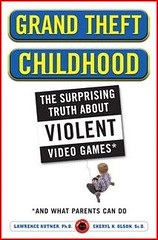 Don’t judge a book by its cover (or its title, for that matter). I’m usually faithful to that maxim, but I must admit that when I first saw the title and cover of “<a href="http://www.amazon.com/Grand-Theft-Childhood-Surprising-Violent/dp/0743299515/ref=pd_bbs_sr_1?ie=UTF8&s=books&qid=1208179493&sr=8-1″>Grand Theft Childhood: The Surprising Truth About Violent Video Games and What Parents Can Do,” I rolled my eyes and thought to myself, “here we go again.” I figured that I was in for another tedious anti-gaming screed full of myths and hysteria about games and gamers. Boy, was I wrong. Massively wrong.
Lawrence Kutner, PhD, and Cheryl K. Olson, ScD, cofounders and directors of the Harvard Medical School Center for Mental Health and Media, have written the most thoroughly balanced and refreshingly open-minded book about video games ever penned. They cut through the stereotypes and fear-mongering that have thus far pervaded the debate over the impact of video games and offer parents and policymakers common-sense advice about how to approach these issues in a more level-headed fashion. They argue that:
Today, an amalgam of politicians, health professionals, religious leaders and children’s advocates are voicing concerns about video games that are identical to the concerns raised one, two and three generations ago with the introduction of other new media. Most of these people have the best of intentions. They really want to protect children from evil influences. As in the past, a few have different agendas and are using the issue manipulatively. Unfortunately, many of their claims are based on scanty evidence, inaccurate assumptions, and pseudoscience. Much of the current research on violent video games is both simplistic and agenda driven. (p. 55)
They note that these groups, “probably worry too much about the wrong things and too little about more subtle issues and complex effects that are much more likely to affect our children.” They continue:
Continue reading →

 The Technology Liberation Front is the tech policy blog dedicated to keeping politicians' hands off the 'net and everything else related to technology.