Dennis McCauley of Gamepolitics.com takes on that issue today in a column:
In the United States, the FBI tracks annual statistics on police officer slayings as well as assaults on police officers. I compared these figures to the various release dates for the three major GTA console game releases to date (GTA III, GTA Vice City, GTA San Andreas) and plotted the whole thing on the chart below. It’s a bit like the well-known video games vis-a-vis juvenile crime graph created by Duke Ferris of GameRevolution a few years back, although with a much narrower focus.The FBI statistics portray a much different picture than that painted by critics like Thompson and Grossman.
 In the chart, I’ve plotted FBI figures for police officers feloniously killed (blue line) and police officers assaulted (red line, listed in thousands). As can be seen, police officer murders peaked at 70 in 1997 (i.e., four years
before GTA III) and again in 2001. GTA III was released in late October that year, so if the game caused that year’s spike, it would have had only two months in which to do so. (also, the 2001 figures don’t count the 72 officers lost when the World Trade Centers collapsed).
The chart shows that since GTA III was released police killings have been trending downward to a low of 48 in 2006. Although the FBI has not yet posted 2007 numbers, the National Law Enforcement Officers Memorial Fund lists 68 police officers as having been shot to death in 2007. But it’s worth pointing out that while there may have been a spike in police slayings last year, there was no corresponding GTA release. There hasn’t been a new Grand Theft Auto console title issued since San Andreas in October, 2004.
In the chart, I’ve plotted FBI figures for police officers feloniously killed (blue line) and police officers assaulted (red line, listed in thousands). As can be seen, police officer murders peaked at 70 in 1997 (i.e., four years
before GTA III) and again in 2001. GTA III was released in late October that year, so if the game caused that year’s spike, it would have had only two months in which to do so. (also, the 2001 figures don’t count the 72 officers lost when the World Trade Centers collapsed).
The chart shows that since GTA III was released police killings have been trending downward to a low of 48 in 2006. Although the FBI has not yet posted 2007 numbers, the National Law Enforcement Officers Memorial Fund lists 68 police officers as having been shot to death in 2007. But it’s worth pointing out that while there may have been a spike in police slayings last year, there was no corresponding GTA release. There hasn’t been a new Grand Theft Auto console title issued since San Andreas in October, 2004.
I’ve commented more on these issues in my essay on “Why hasn’t violent media turned us into a nation of killers?”
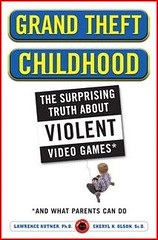 Don’t judge a book by its cover (or its title, for that matter). I’m usually faithful to that maxim, but I must admit that when I first saw the title and cover of “<a href="http://www.amazon.com/Grand-Theft-Childhood-Surprising-Violent/dp/0743299515/ref=pd_bbs_sr_1?ie=UTF8&s=books&qid=1208179493&sr=8-1″>Grand Theft Childhood: The Surprising Truth About Violent Video Games and What Parents Can Do,” I rolled my eyes and thought to myself, “here we go again.” I figured that I was in for another tedious anti-gaming screed full of myths and hysteria about games and gamers. Boy, was I wrong. Massively wrong.
Lawrence Kutner, PhD, and Cheryl K. Olson, ScD, cofounders and directors of the Harvard Medical School Center for Mental Health and Media, have written the most thoroughly balanced and refreshingly open-minded book about video games ever penned. They cut through the stereotypes and fear-mongering that have thus far pervaded the debate over the impact of video games and offer parents and policymakers common-sense advice about how to approach these issues in a more level-headed fashion. They argue that:
Today, an amalgam of politicians, health professionals, religious leaders and children’s advocates are voicing concerns about video games that are identical to the concerns raised one, two and three generations ago with the introduction of other new media. Most of these people have the best of intentions. They really want to protect children from evil influences. As in the past, a few have different agendas and are using the issue manipulatively. Unfortunately, many of their claims are based on scanty evidence, inaccurate assumptions, and pseudoscience. Much of the current research on violent video games is both simplistic and agenda driven. (p. 55)
They note that these groups, “probably worry too much about the wrong things and too little about more subtle issues and complex effects that are much more likely to affect our children.” They continue:
Continue reading →
Unfortunately, as I predicted would be the case in my National Review editorial earlier this morning, today’s hearing on video games in the Senate Judiciary Committee turned out to be quite a one-sided show trial.
Senator Sam Brownback called the hearing to blast the game industry for what he called “graphic,” “horrific,” and even “barbaric” level of violence we supposedly see in games today. Violent video games, he argued, are becoming “simulators” that train kids to behave violently and even kill cops.
And his proof? As I suspected would be the case (and, again, predicted in my editorial) it largely came down to two key games: “Grand Theft Auto” and “25 to Life.” Sen. Brownback decided to show a few clips from these games and one other title (“Postal”) to supposedly illustrate just how violent games are today. Now make no doubt about it, these games do contain some truly sickening, despicable acts of simulated violence. I don’t know why a game developer feels compelled to show thugs beating prostitutes with a baseball bat, or a criminal shooting cops with a sniper rifle, or someone torching a dead corpse and then urinating on it to put out the fire. It’s all very sick and it’s quite sad that someone is squandering their creative talents on the depiction of such disgusting, disrespectful acts of violence.
But let’s get back to the key point and ask a question that ABSOLUTELY NO ONE EVEN BOTHERED DISCUSSING AT THE HEARING. Namely: Are these games indicative of all video games out there today?
Continue reading →

 The Technology Liberation Front is the tech policy blog dedicated to keeping politicians' hands off the 'net and everything else related to technology.