Posts tagged as:

Congress is considering reforming television laws and solicited comment from the public last month. On Friday, I submitted a letter encouraging the reform effort. I attached the paper Adam and I wrote last year about the current state of video regulations and the need for eliminating the complex rules for television providers.

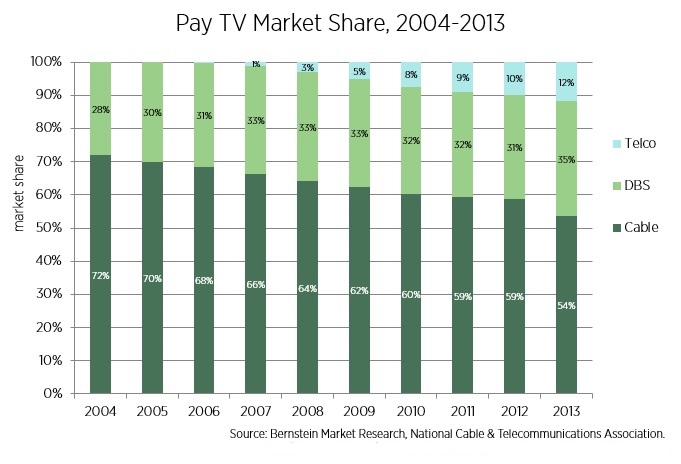
As I say in the letter, excerpted below, pay TV (cable, satellite, and telco-provided) is quite competitive, as this chart of pay TV market share illustrates. In addition to pay TV there is broadcast, Netflix, Sling, and other providers. Consumers have many choices and the old industrial policy for mass media encourages rent-seeking and prevents markets from evolving.

Pay TV Market Share

Continue reading →

There are several “flavors” of net neutrality–Eli Noam at Columbia University estimates there are seven distinct meanings of the term–but most net neutrality proponents agree that reinterpreting the 1934 Communications Act and “classifying” Internet service providers as Title II “telecommunications” companies is the best way forward. Proponents argue that ISPs are common carriers and therefore should be regulated much like common carrier telephone companies. Last week I filed a public interest comment about net neutrality and pointed out why the Title II option is unwise and possibly illegal. Continue reading →

The outrage over the FCC’s attempt to write new open Internet rules has caught many by surprise, and probably Chairman Wheeler as well. The rumored possibility of the FCC authorizing broadband “fast lanes” draws most complaints and animus. Gus Hurwitz points out that the FCC’s actions this week have nothing to do with fast lanes and Larry Downes reminds us that this week’s rules don’t authorize anything. There’s a tremendous amount of misinformation because few understand how administrative law works. Yet many net neutrality proponents fear the worst from the proposed rules because Wheeler takes the consensus position that broadband provision is a two-sided market and prioritized traffic could be pro-consumer.

Fast lanes have been permitted by the FCC for years and they can benefit consumers. Some broadband services–like video and voice over Internet protocol (VoIP)–need to be transmitted faster or with better quality than static webpages, email, and file syncs. Don’t take my word for it. The 2010 Open Internet NPRM, which led to the recently struck-down rules, stated,

As rapid innovation in Internet-related services continues, we recognize that there are and will continue to be Internet-Protocol-based offerings (including voice and subscription video services, and certain business services provided to enterprise customers), often provided over the same networks used for broadband Internet access service, that have not been classified by the Commission. We use the term “managed” or “specialized” services to describe these types of offerings. The existence of these services may provide consumer benefits, including greater competition among voice and subscription video providers, and may lead to increased deployment of broadband networks.

I have no special knowledge about what ISPs will or won’t do. I wouldn’t predict in the short term the widespread development of prioritized traffic under even minimal regulation. I think the carriers haven’t looked too closely at additional services because net neutrality regulations have precariously hung over them for a decade. But some of net neutrality proponents’ talking points (like insinuating or predicting ISPs will block political speech they disagree with) are not based in reality.

We run a serious risk of derailing research and development into broadband services if the FCC is cowed by uninformed and extreme net neutrality views. As Adam eloquently said, “Living in constant fear of hypothetical worst-case scenarios — and premising public policy upon them — means that best-case scenarios will never come about.” Many net neutrality proponents would like to smear all priority traffic as unjust and exploitative. This is unfortunate and a bit ironic because one of the most transformative communications developments, cable VoIP, is a prioritized IP service.

There are other IP services that are only economically feasible if jitter, latency, and slow speed are minimized. Prioritized traffic takes several forms, but it could enhance these services:

VoIP. This prioritized service has actually been around for several years and has completely revolutionized the phone industry. Something unthinkable for decades–facilities-based local telephone service–became commonplace in the last few years and undermined much of the careful industrial planning in the 1996 Telecom Act. If you subscribe to voice service from your cable provider, you are benefiting from fast lane treatment. Your “phone” service is carried over your broadband cable, segregated from your television and Internet streams. Smaller ISPs could conceivably make their phone service more attractive by pairing up with a Skype- or Vonage-type voice provider, and there are other possibilities that make local phone service more competitive.

Cloud-hosted virtual desktops. This is not a new idea, but it’s possible to have most or all of your computing done in a secure cloud, not on your PC, via a prioritized data stream. With a virtual desktop, your laptop or desktop PC functions mainly as a dumb portal. No more annoying software updates. Fewer security risks. IT and security departments everywhere would rejoice. Google Chromebooks are a stripped-down version of this but truly functional virtual desktops would be valued by corporations, reporters, or government agencies that don’t want sensitive data saved on a bunch of laptops in their organization that they can’t constantly monitor. Virtual desktops could also transform the device market, putting the focus on a great cloud and (priority) broadband service and less on the power and speed of the device. Unfortunately, at present, virtual desktops are not in widespread use because even small lag frustrates users.

TV. The future of TV is IP-based and the distinction between “TV” and “the Internet” is increasingly blurring, with Netflix leading the way. In a fast lane future, you could imagine ISPs launching pared-down TV bundles–say, Netflix, HBO Go, and some sports channels–over a broadband connection. Most ISPs wouldn’t do it, but an over-the-top package might interest smaller ISPs who find acquiring TV content and bundling their own cable packages time-consuming and expensive.

Gaming. Computer gamers hate jitter and latency. (My experience with a roommate who had unprintable outbursts when Diablo III or World of Warcraft lagged is not uncommon.) Game lag means you die quite frequently because of your data connection and this depresses your interest in a game. There might be gaming companies out there who would like to partner with ISPs and other network operators to ensure smooth gameplay. Priority gaming services could also lead the way to more realistic, beautiful, and graphics-intensive games.

Teleconferencing, telemedicine, teleteaching, etc. Any real-time, video-based service could reach critical mass of subscribers and become economical with priority treatment. Any lag absolutely kills consumer interest in these video-based applications. By favoring applications like telemedicine, providing remote services could become attractive to enough people for ISPS to offer stand-alone broadband products.

This is just a sampling of the possible consumer benefits of pay-for-priority IP services we possibly sacrifice in the name of strict neutrality enforcement. There are other services we can’t even conceive of yet that will never develop. Generally, net neutrality proponents don’t admit these possible benefits and are trying to poison the well against all priority deals, including many of these services.

Most troubling, net neutrality turns the regulatory process on its head. Rather than identify a market failure and then take steps to correct the failure, the FCC may prevent commercial agreements that would be unobjectionable in nearly any other industry. The FCC has many experts who are familiar with the possible benefits of broadband fast lanes, which is why the FCC has consistently blessed priority treatment in some circumstances.

Unfortunately, the orchestrated reaction in recent weeks might leave us with onerous rules, delaying or making impossible new broadband services. Hopefully, in the ensuing months, reason wins out and FCC staff are persuaded by competitive analysis and possible innovations, not t-shirt slogans.
Adam and I recently published a Mercatus research paper titled Video Marketplace Regulation: A Primer on the History of Television Regulation And Current Legislative Proposals, now available on SSRN. I presented the paper at a Silicon Flatirons academic conference last week.

We wrote the paper for a policy audience and students who want succinct information and history about the complex world of television regulation. Television programming is delivered to consumers in several ways, including via cable, satellite, broadcast, IPTV (like Verizon FiOS), and, increasingly, over-the-top broadband services (like Netflix and Amazon Instant Video). Despite their obvious similarities–transmitting movies and shows to a screen–each distribution platform is regulated differently.

The television industry is in the news frequently because of problems exacerbated by the disparate regulatory treatment. The Time Warner Cable-CBS dispute last fall (and TWC’s ensuing loss of customers), the Aereo lawsuit, and the Comcast-TWC proposed merger were each caused at least indirectly by some of the ill-conceived and antiquated TV regulations we describe. Further, TV regulation is a “thicket of regulations,” as the Copyright Office has said, which benefits industry insiders at the expense of most everyone else.

We contend that overregulation of television resulted primarily because past FCCs, and Congress to a lesser extent, wanted to promote several social objectives through a nationwide system of local broadcasters:

1) Localism 2) Universal Service 3) Free (that is, ad-based) television; and 4) Competition

These objectives can’t be accomplished simultaneously without substantial regulatory mandates. Further, these social goals may even contradict each other in some respects.

For decades, public policies constrained TV competitors to accomplish those goals. We recommend instead a reliance on markets and consumer choice through comprehensive reform of television laws, including repeal of compulsory copyright laws, must-carry, retransmission consent, and media concentration rules.

At the very least, our historical review of TV regulations provides an illustrative case study of how regulations accumulate haphazardly over time, demand additional “correction,” and damage dynamic industries. Congress and the FCC focused on attaining particular competitive outcomes through industrial policy, unfortunately. Our paper provides support for market-based competition and regulations that put consumer choice at the forefront.

The Mercatus Center at George Mason University has released a new working paper by Daniel A. Lyons, professor at Boston College Law School, entitled “Innovations in Mobile Broadband Pricing.”

In 2010, the FCC passed net neutrality rules for mobile carriers and ISPs that included a “no blocking” provision (since struck down in FCC v. Verizon). The FCC prohibited mobile carriers from blocking Internet content and promised to scrutinize carriers’ non-standard pricing decisions. These broad regulations had a predictable chilling effect on firms trying new business models. For instance, Lyons describes how MetroPCS was hit with a net neutrality complaint because it allowed YouTube but not other video streaming sites on its budget LTE plan (something I’ve written on). Some critics also allege that AT&T’s Sponsored Data program is a net neutrality violation.

In his paper, Lyons explains that the FCC might still regulate mobile networks but advises against a one-size-fits-all net neutrality approach. Instead, he encourages regulatory humility in order to promote investment in mobile networks and devices and to allow new business models. For support, he points out that several developing and rich countries have permitted commercial arrangements between content companies and carriers that arguably violate principles of net neutrality. Lyons makes the persuasive argument that these “non-neutral” service bundles and pricing decisions on the whole, rather than harming consumers, expand online access and ease non-connected populations into the Internet Age. As Lyons says,

The wide range of successful wireless innovations and partnerships at the international level should prompt U.S. regulators to rethink their commitment to a rigid set of rules that limit flexibility in American broadband markets. This should be especially true in the wireless broadband space, where complex technical considerations, rapid change, and robust competition make for anything but a stable and predictable business environment.

Further,

In the rapidly changing world of information technology, it is sometimes easy to forget that experimental new pricing models can be just as innovative as new technological developments. By offering new and different pricing models, companies can provide better value to consumers or identify niche segments that are not well-served by dominant pricing strategies.

Despite the January 2014 court decision striking down the FCC’s net neutrality rules, it’s an issue that hasn’t died. Lyons’ research provides support for the position that a fixation on enforcing net neutrality, however defined, distracts policymakers from serious discussion of how to expand online access. Rules should be written with consumers and competition in mind. Wired ISPs get the lion’s share of scholars’ attention when discussing net neutrality. In an increasingly wireless world, Lyon’s paper provides important research to guide future US policies.

The Internet is abuzz with news that Federal Communications Commission Chairman Tom Wheeler favors a case-by-case approach to addressing Internet competition issues. It is the wisest course, and perhaps the most courageous. Some on the right will say he is going too far, and some on the left will say he isn’t going far enough. That is one reason Wheeler’s approach should be commended. Staunch disagreements about net neutrality and other Internet governance issues reflect the uncertainty inherent in a dynamic market.

Chairman Wheeler’s comments this week echoed Socrates (“I’m not smart enough to know what comes next [in innovation]”) and, to my surprise, Virginia Postrel (the Chairman favors addressing Internet issues “in a dynamic rather than a static way”). He recognizes that, in a two-sided market, there is no reason to assume that ISPs will necessarily have the ability to charge content providers rather than the other way around. The potential for strategic behavior on the Internet today is radically different than in the dial-up Internet era, and the Chairman appears prepared to consider those differences in his approach to communications regulation. Continue reading →

Join TechFreedom on Thursday, December 19, the 100th anniversary of the Kingsbury Commitment, AT&T’s negotiated settlement of antitrust charges brought by the Department of Justice that gave AT&T a legal monopoly in most of the U.S. in exchange for a commitment to provide universal service.

The Commitment is hailed by many not just as a milestone in the public interest but as the bedrock of U.S. communications policy. Others see the settlement as the cynical exploitation of lofty rhetoric to establish a tightly regulated monopoly — and the beginning of decades of cozy regulatory capture that stifled competition and strangled innovation. Continue reading →

Last week, the House held a hearing about the so-called IP Transition. The IP Transition refers to the telephone industry practice of carrying all wire-based consumer services–voice, Internet, and television–via faster, better fiber networks and not on the traditional copper wires that had fewer capabilities. Most consumers have not and will not notice the change. The completed IP Transition, however, has enormous implications for how the FCC regulates. As one telecom watcher said, “What’s at stake? Everything in telecom policy.”

For 100 years or so, phone service has had a special place in regulatory law given its importance in connecting the public. Phone service was almost exclusively over copper wires, a service affectionately called “plain old telephone service” (POTS). AT&T became the government-approved POTS national monopolist in 1913 (which ended with the AT&T antitrust breakup in the 1980s). The deal was: AT&T got to be a protected monopolist while the government got to require AT&T provide various public benefits. The most significant of these is universal service–AT&T had to serve virtually every US household and charge reasonable rates even to remote (that is, expensive) customers.

To create more phone competitors to the Baby Bells–the phone companies spun off from the AT&T break-up in the 1980s–the Congress passed the 1996 Telecom Act and the FCC put burdens on the Baby Bells to allow new phone companies to lease the Baby Bells’ AT&T-created copper wires at regulated rates. The market changed in ways never envisioned in the 1990s however. Today, phone companies face competition–not from the new phone companies leasing the old monopoly infrastructure but from entirely different technologies. You can receive voice service from your cable company (“digital voice”), your “phone” company (POTS), your wireless company, and even Internet-based providers like Vonage and Skype. Increasingly, households are leaving POTS behind in favor of voice service from cable or wireless providers. Yet POTS providers–like Verizon and AT&T (which also offer wireless service)–must abide by monopoly-era regulations that their cable and wireless competitors–Comcast, Sprint, and others–don’t have to abide by.

Understanding the significance of the IP Transition requires (unfortunately) knowing a little bit about Title I and Title II of the Communications Act. “Telecommunications services,” which are the phone companies with copper networks, are heavily regulated by the FCC under Title II. On the other hand, “information services,” which includes Internet service, are lightly regulated under Title I. This division made some sense in the 1990s. It is increasingly under stress now because burdened “telecommunications” companies like AT&T and Verizon are offering “information services” like Internet via DSL, FiOS, and U-Verse. Conversely, lightly-regulated “information services” companies like Comcast, Charter, and Time-Warner Cable are entering the regulated telephone market but face few of the regulatory burdens.

Which brings us to the IP Transition. As Title II phone companies replace their copper wires with fiber and deploy broadband networks to compete with cable companies, their customers’ phone service is being carried via IP packets. Functionally, these new networks act like a heavily-regulated Title II service since they carry voice, but they also act like the Title I broadband networks that cable providers built. So should these new fiber networks be burdened like Title II services or deregulated like Title I services? Or is it possible to achieve some middle ground using existing law? Those are the questions before the FCC and policymakers. Billions of dollars of investment will be accelerated or slowed and many firms will live or die depending on how the FCC and Congress act. Stay tuned.

Aereo LogoThere are few things more likely to get constituents to call their representative than TV programming blackouts, and the increase in broadcasting disruptions arising from licensing disputes in recent years means Congress may be forced to once again fix television and copyright laws. As Jerry Brito explains at Reason, the current standoff between CBS and Time Warner Cable is the result of bad regulations, which contribute to more frequent broadcaster blackouts. While each type of TV distributor (cable, satellite, broadcasters, telcos) is both disadvantaged and advantaged through regulation, broadcasters are particularly favored. As the US Copyright Office has said, the rule at issue in CBS-TWC is “part of a thicket of communications law requirements aimed at protecting and supporting the broadcast industry.”
But as we approach a damaging tipping point of rising programming costs and blackouts, Congress’ potential rescuer–Aereo–appears on the horizon, possibly buying more time before a major regulatory rewrite. Aereo, for the uninitiated, is a small online company that sets up tiny antennas in certain cities to capture broadcast television station signals–like CBS, NBC, ABC, Fox, the CW, and Univision–and streams those signals online to paying customers, who can watch live or record the local signals captured by their own “rented” Aereo antenna. Broadcasters hate this because the service deprives them of lucrative retransmission fees and unsuccessfully sued to get Aereo to cease operations. Continue reading →

WP coverThe Mercatus Center at George Mason University has just released a new paper by Brent Skorup and me entitled, “A History of Cronyism and Capture in the Information Technology Sector.” In this 73-page working paper, which we hope to place in a law review or political science journal shortly, we document the evolution of government-granted privileges, or “cronyism,” in the information and communications technology marketplace and in the media-producing sectors. Specifically, we offer detailed histories of rent-seeking and regulatory capture in: the early history of the telephony and spectrum licensing in the United States; local cable TV franchising; the universal service system; the digital TV transition in the 1990s; and modern video marketplace regulation (i.e., must-carry and retransmission consent rules, among others.

Our paper also shows how cronyism is slowly creeping into new high-technology sectors.We document how Internet companies and other high-tech giants are among the fastest-growing lobbying shops in Washington these days. According to the Center for Responsive Politics, lobbying spending by information technology sectors has almost doubled since the turn of the century, from roughly $200 million in 2000 to $390 million in 2012.  The computing and Internet sector has been responsible for most of that growth in recent years. Worse yet, we document how many of these high-tech firms are increasingly seeking and receiving government favors, mostly in the form of targeted tax breaks or incentives. Continue reading →