“Rent-Seeking Consultants, Inc.,” a subsidiary of the Strategies and Tactics to Annoy Neighbors (SATAN) Group, is pleased to announce its latest product for clients looking to exploit well-intentioned regulation to serve their own ends. Our new report, “Raising Rivals’ Costs Using the GDPR: A Strategic Guide to Thwarting Competition, Expanding Market Share & Enhancing Profits with Minimal Effort,” is available for immediate download for just $1,999 (discounted to just $999 for our loyal “Dante’s Ninth Circle” club members).
Over the last three decades, our experts at Rent-Seeking Consultants have dedicated themselves to the mission of advancing narrow interests at the expense of public welfare. We have done so by creatively exploiting laws and regulations that — while often implemented with the very best of intentions in mind — we recognized could be converted into a tool to advantage the few at the expense of the many.
Our motto:
Where others see good intentions, we see good opportunities!
Our “Raising Rivals’ Costs Using the GDPR” report continues our latest line of new products, which aim to take Europe’s bold new privacy regulatory regime and convert it into a rent-seeker’s paradise. Our previous report outlined, “How to Pretend Compliance Costs Will Destroy Your Big Company, While Also Letting Your Shareholders Know It is Actually an Amazing Way to Crush the Competition.” Continue reading →
We hear a lot today about the importance of “disruptive innovation,” “deep technologies,” “moonshots,” and even “technological miracles.” What do these terms mean and how are they related? Are they just silly clichés used to hype techno-exuberant books, articles, and speeches? Or do these terms have real meaning and importance?
This article explores those questions and argues that, while these terms are confronted with definitional challenges and occasional overuse, they retain real importance to human flourishing, economic growth, and societal progress.
Basic Concepts
Don Boudreaux defines moonshots as, “radical but feasible solutions to important problems” and Mike Cushing has referred to them as “innovation that achieves the previously unthinkable.” “Deep technology” is another buzzword being used to describe such revolutionary and important innovations. Swati Chaturvedi of investment firm Propel[x] says deep technologies are innovations that are “built on tangible scientific discoveries or engineering innovations” and “are trying to solve big issues that really affect the world around them.”
“Disruptive technology” or “game-changing innovations” are other terms that are often used in reference to technologies and inventions with major societal impacts. “Transformative technologies” is another increasingly popular term, albeit one focused mostly on health and wellness-related innovations. Continue reading →
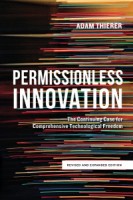
I am pleased to announce the release of the second edition of my book, Permissionless Innovation: The Continuing Case for Comprehensive Technological Freedom. As with the first edition, the book represents a short manifesto that condenses — and attempts to make more accessible — arguments that I have developed in various law review articles, working papers, and blog posts over the past few years. The book attempts to accomplish two major goals.
First, I attempt to show how the central fault line in almost all modern technology policy debates revolves around “the permission question,” which asks:
Must the creators of new technologies seek the blessing of public officials before they develop and deploy their innovations? How that question is answered depends on the disposition one adopts toward new inventions. Two conflicting attitudes are evident.
One disposition is known as the “precautionary principle.” Generally speaking, it refers to the belief that new innovations should be curtailed or disallowed until their developers can prove that they will not cause any harms to individuals, groups, specific entities, cultural norms, or various existing laws, norms, or traditions.
The other vision can be labeled “permissionless innovation.” It refers to the notion that experimentation with new technologies and business models should generally be permitted by default. Unless a compelling case can be made that a new invention will bring serious harm to society, innovation should be allowed to continue unabated and problems, if they develop at all, can be addressed later.
I argue that we are witnessing a grand clash of visions between these two mindsets today in almost all major technology policy discussions today. Continue reading →
Writing last week in The Wall Street Journal, Matt Moffett noted how many European countries continue to struggle with chronic unemployment and general economic malaise. (“New Entrepreneurs Find Pain in Spain“) It’s a dismal but highly instructive tale about how much policy incentives matter when it comes to innovation and job creation–especially the sort of entrepreneurial activity from small start-ups that is so essential for economic growth. Here’s the key takeaway:
Scarce capital, dense bureaucracy, a culture deeply averse to risk and a cratered consumer market all suppress startups in Europe. The Global Entrepreneurship Monitor, a survey of startup activity, found the percentage of the adult population involved in early stage entrepreneurial activity last year was just 5% in Germany, 4.6% in France and 3.4% in Italy. That compares with 12.7% in the U.S. Even once they are established, European businesses are, on average, smaller and slower growing than those in the U.S. The problems of entrepreneurs are one reason Europe’s economy continues to struggle after six years of crisis. The European Union this month cut its growth forecasts for the region for this year and next, citing weaker than expected performance in the eurozone’s biggest economies, Germany, France and Italy. This week, the Organization for Economic Cooperation and Development delivered its own pessimistic appraisal, with chief economist Catherine Mann saying, “The eurozone is the locus of the weakness in the global economy.”
[…]
Europe’s unemployment crisis may be eroding a deeply ingrained fear of failure that is a bigger impediment to entrepreneurship on the Continent than in other regions, according to academic surveys. “Fear of failure is less of an issue because the whole country is a failure, and most of us are out of business or have a hard time paying our bills,” said Nick Drandakis of Athens, who in 2011 founded Taxibeat, an app that provides passenger ratings on taxi drivers.
I am pleased to announce the release of my latest book, “Permissionless Innovation: The Continuing Case for Comprehensive Technological Freedom.” It’s a short manifesto (just under 100 pages) that condenses — and attempts to make more accessible — arguments that I have developed in various law review articles, working papers, and blog posts over the past few years. I have two goals with this book.
First, I attempt to show how the central fault line in almost all modern technology policy debates revolves around “the permission question,” which asks:
Must the creators of new technologies seek the blessing of public officials before they develop and deploy their innovations? How that question is answered depends on the disposition one adopts toward new inventions. Two conflicting attitudes are evident.
One disposition is known as the “precautionary principle.” Generally speaking, it refers to the belief that new innovations should be curtailed or disallowed until their developers can prove that they will not cause any harms to individuals, groups, specific entities, cultural norms, or various existing laws, norms, or traditions.
The other vision can be labeled “permissionless innovation.” It refers to the notion that experimentation with new technologies and business models should generally be permitted by default. Unless a compelling case can be made that a new invention will bring serious harm to society, innovation should be allowed to continue unabated and problems, if they develop at all, can be addressed later.
I argue that we are witnessing a grand clash of visions between these two mindsets today in almost all major technology policy discussions today. Continue reading →
What works well as anethical directive might not work equally well as a policy prescription. Stated differently, what one ought to do it certain situations should not always be synonymous with what they must do by force of law.
I’m going to relate this lesson to tech policy debates in a moment, but let’s first think of an example of how this lesson applies more generally. Consider the Ten Commandments. Some of them make excellent ethical guidelines (especially the stuff about not coveting neighbor’s house, wife, or possessions). But most of us would agree that, in a free and tolerant society, only two of the Ten Commandments make good law:
Thou shalt not kill and Thou shalt not steal.
In other words, not every sin should be a crime. Perhaps
some should be; but most should not. Taking this out of the realm of religion and into the world of moral philosophy, we can apply the lesson more generally as: Not every wise ethical principle makes for wise public policy. Continue reading →
I somehow missed this excellent ITIF paper by Robert D. Atkinson and George Ou when it came out at this point last year, but George has just dusted it off, made a couple of updates, and re-posted it over at the Digital Society blog. Worth reading. It touches on a lot of the same case studies I have been documenting in my ongoing series, “Problems in Public Utility Paradise.” In particular, it focuses on the UTOPIA and iProvo fiascos out in Utah. Here’s a key takeaway from those case studies:
The lessons learned in Utah is that projected uptake models and deployment plans don’t always come to fruition, and when that happens the consequence is failure. For UTOPIA, the project was projected to reach 35% uptake rates by February 2008 but the reality was less than 17% uptake. UTOPIA had also hoped for 17% uptake from lucrative business customers but the reality was only 2 to 3 percent. Provo County’s iProvo was hoping for 10,000 subscribers by July 2006 with the assumption that 75% of those customers would subscribe to lucrative triple play services, but the reality was 10,000 customers in late 2007 with only 17% of those customers subscribing to triple play. Many consumers were quite happy to subscribe to existing broadband cable or telecom providers. The consistent theme in Utah was an overestimation of the uptake rates and the underestimation of competition from incumbent cable operator Comcast and telecom operator Qwest which led to consistent underperformance.
Ouch. For more details, see this old essay of mine about UTOPIA from 2008, and this piece from last Sept about iProvo. Not a pretty picture. As I say every time I pen a piece about the latest muni failure du jour, these case studies should serve as a cautionary tale about the dangers of grandiose, centrally planned broadband schemes. There is no such thing as a free lunch. Network-building is hard, and politicians usually aren’t that good at doing it.
Seems like everywhere I turn someone is gushing about their new Droid phone, including my TLF colleagues Berin Szoka, Braden Cox, and Ryan Radia, who all had great fun rubbing their new toys in my nose over the past couple of days. And why not, it’s a very cool little device. It makes my HTC Touch seems positively archaic in some ways, and it’s only a year old. Apparently, 100,000 people already picked up a Droid in just its first weekend on the market.
But here’s the first thing that pops in my mind every time I see someone showing off their new Droid: How can a device like this even exist when America’s leading cyberlaw experts have been telling us that the whole digital world is increasingly going to hell because of “closed” devices, proprietary code, and managed networks? I’m speaking, of course, about the lamentations of Harvard professors Lawrence Lessig, Jonathan Zittrain, and their many disciples. As faithful readers will recall, I have relentlessly hammered this crew for their unwarranted cyber-Chicken Little-ism and hyper techno-pessimism. (See my many battles with Zittrain [1, 2, 3, 4, 5, 6 + video] and my 2-part debate with Lessig earlier this year).
“Left to itself,” Lessig warned in Code, “cyberspace will become a perfect tool of control.” He went on to forecast a dystopian future in which nefarious corporate schemers would quash our digital liberties unless benevolent public philosopher kings stepped in to save our poor souls. Code was the Old Testament of cyber-collectivism. The New Testament arrived last year with Zittrain’s The Future of the Internet and How to Stop It. In it, we hear the grim prediction that “sterile and tethered” digital technologies and networks will triumph over the more “open and generative” devices and systems of the past. The iPhone and TiVo are cast as villains in Zittrain’s drama since they apparently represent the latest manifestations of Lessig’s “perfect control” paranoia.
The Technology Liberation Front is the tech policy blog dedicated to keeping politicians' hands off the 'net and everything else related to technology. Learn more about TLF →




 The Technology Liberation Front is the tech policy blog dedicated to keeping politicians' hands off the 'net and everything else related to technology.