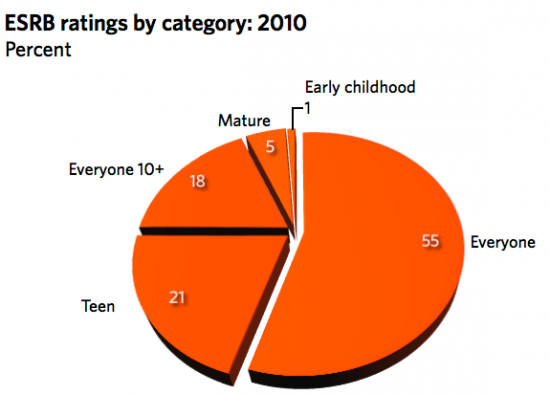
 Five years ago this month, I penned a white paper on “Fact and Fiction in the Debate over Video Game Regulation” that I have been meaning to update ever since but just never seem to get around to it. One of the myths I aimed to debunk in the paper was the belief that most video games contain intense depictions of violence or sexuality. This argument drives many of the crusades to regulate video games. In my old study, I aggregated several years worth of data about video game ratings and showed that the exact opposite was the case: the majority of games sold each year were rating “E” for everyone or “E10+” (Everyone 10 and over) by the Entertainment Software Rating Board (ESRB).
Thanks to this new article by Ars Technica‘s Ben Kuchera, we know that this trend continues. Kuchera reports that out of 1,638 games rated by the ESRB in 2010, only 5% were rated “M” for Mature. As a percentage of top sellers, the percentage of “M”-rated games is a bit higher, coming in at 29%. But that’s hardly surprising since there are always a few big “M”-rated titles that are the power-sellers among young adults each year. Still, most of the best sellers don’t contain extreme violence or sexuality.
Continue reading →
I’ve been meaning to say something about this new paper by Renee Newman Knake of Michigan State University College of Law, which calls for a new paradigm to analyze, and then likely regulate, video game content. Knake’s paper is entitled, “From Research Conclusions to Real Change: Understanding the First Amendment’s (Non)Response to Negative Effects of Mass Media on Children by Looking to the Example of Violent Video Game Regulations.” In it, she proposes to extend an emerging legal philosophy known as “ecogenerism” to the field of video games and the First Amendment treatment thereof. “Ecogenerism” is largely the creation of Barbara Bennett Woodhouse and the theory argues that we should apply lessons or legal frameworks from the field of environmental law to the area of media and children. “Under an ecogenerist model,” states Knake, “media harm decisions should prioritize concern about the level of ‘toxic’ media which children are exposed over free speech interests.” Simply stated, we should treat “toxic media” like toxic chemicals.
There have been other efforts to get courts to relax the legal scrutiny applied to video game content from “strict” to something more relaxed or intermediate in character. For example, there is the “violence as obscenity” approach proposed by Kevin Saunders, who, like Knake, is also with the Michigan State University College of Law. But whereas Saunders has proposed applying an adjacent legal theory or framework (obscenity law) to legal analysis of the constitutionality of regulation of video game content, Woodhouse and now Knake propose a much broader, and more radical, reformulation of First Amendment law along the lines of entirely different body of jurisprudence — again, environment law and regulation.
Of course, this is nuts. The notion that words or images are as “toxic” as chemicals is preposterous, and yet that is exactly what Knake and Woodhouse want us to accept. We can determine with a great deal of certainly the physiological impact of too much mercury or lead on the development of the human brain or body. Generally speaking, we know what dose would kill or deform. The same cannot possibly be said of media, and the very allusion to toxic materials or chemicals is ludicrous to begin with since words and images have never directly killed anyone. EVER! Continue reading →
 The latest edition (Version 4.0) of my PFF special report on “Parental Controls and Online Child Protection: A Survey of Tools & Methods” is now up. For those not familiar with the report, it explores the market for parental control tools, rating schemes, education and media literacy efforts, and various other tools, methods, and initiatives aimed at promoting online child safety. After evaluating that state of this market, I conclude: “There has never been a time in our nation’s history when parents have had more tools and methods at their disposal to help them decide what constitutes acceptable media content in their homes and in the lives of their children.” Moreover, I believe that the parental controls and content management tools cataloged in the report represent a better, less restrictive alternative to government regulation.
Version 4.0 of the report is now over 250 pages long (up from 200 pages in Version 3.0) and it contains almost 70 exhibits (up from 50), 725 references (up from roughly 500), and numerous updates in all five sections of the book. Major updates have been made to the Internet, social networking, and mobile media sections, reflecting the growing importance of those sectors and issues. Other new sections or appendices have also been added to the report, including:
- a new section examining how many households really need parental control tools;
- a new appendix on the downsides of mandatory parental controls and restrictive default settings;
- a new section on the dangers of “deputizing the online middleman” solution as an approach to solving child safety concerns;
- a new appendix reviewing the findings of 5 past online safety task forces;
- … and much more.
I issue major updates once a year and 1 or 2 minor tweaks during the course of the year to reflect the evolution of the parental control and online child safety marketplace and debate. The report is available free-of-charge on the PFF website, and the previous editions of the report are housed there too in case you want to see how it has evolved over the past couple of years. For those interested in taking a quick look at the report, I have embedded it down below the fold as a Scribd file. Finally, as is always the case, I encourage readers to send me updates and suggestions for how to improve the report and I will incorporate them into future versions.
Continue reading →
Today, the U.S. Department of Commerce’s National Telecommunications and Information Administration (NTIA) announced the members of the new Online Safety and Technology Working Group (OSTWG). I am honored to be among those chosen to participate in this new task force and I look forward to continuing the work started last year with the Harvard Berkman Center’s Internet Safety Technical Task Force (ISTTF), which I also served on. I was very proud of the work done by the ISTTF and the impressive final report that Prof. John Palfrey crafted to reflect our findings. I am eager to investigate these issues further and take a look at the latest research and technologies that can help us better understand how to protect our kids online while also protecting the free speech and privacy rights of Netizens.
The new NTIA working group, which was established under the “Protecting Children in the 21st Century Act,” will report to the Assistant Secretary of Commerce for Communications and Information on industry-implemented online child safety tools and efforts. Within a year of convening its first meeting, the group will submit a report of its findings and make recommendations on how to increase online safety measures.
Below the fold I have listed the complete roster of OSTWG task force members. I very much looking forward to working with this outstanding group. And I’m happy to report that my TLF blogging colleague Braden Cox will be joining me on this task force!
Continue reading →
 GamePolitics.com reports that there are strong signs the protracted legal battle over video game regulation in California might soon be headed to the Supreme Court. The ongoing battle deals with a California law passed in October 2005 (A.B.1179), which would have blocked the sale of “violent” video games to those under 18 and required labels on all games. Offending retailers could have been fined for failure to comply with the law.
The law was immediately challenged by the Video Software Dealers Association and the Entertainment Software Association. In August of last year, a district court decision in the case of
Video Software Dealers Association v. Schwarzenegger [decision here] enforced a permanent injunction against the law. And today in Sacramento, a 3-judge panel of the 9th U.S. Circuit Court of Appeals held a hearing in to hear additional arguments about the law. The San Jose Mercury News reports that judges seemed skeptical about the State’s effort to overturn the lower court ruling and get the law enforced:
While the 9th Circuit judges did lend some support to the state, they were generally skeptical the law can survive. “What you are asking us to do is go where no one has gone before,” Judge Consuelo Callahan said to the state’s lawyer. “Admittedly, they are disgusting. But aren’t you just trying to be the thought police?”
The judges also realize that every other state or circuit court that has considered the constitutionality of similar video games laws has found them unconstitutional. As I noted in my piece last year on the California law, the current legal score is “Gamers 11, Censors 0.” If the Ninth Circuit does keep the injunction in place and California appeals the law up to the Supreme Court as some predict, we could be in for a historic First Amendemt case, and the first to deal with video game speech. Stay tuned!
Yesterday, the Senate passed S. 602, “The Child Safe Viewing Act of 2007,” which was introduced by Sen. Mark Pryor (D-AR) in February 2007. The bill requires the Federal Communications Commission (FCC) to study the market for “advance blocking technologies” (i.e., parental controls and rating systems) that parents can use to protect their kids from inappropriate content from various sources and platforms. On the surface, the measure seems harmless enough, but in practice, it could have some troubling long-term free speech implications if it leads to more government meddling with parental controls and ratings systems.
The measure requires the FCC to initiate a notice of inquiry to consider measures to examine:
- the existence and availability of advanced blocking technologies that are compatible with various communications devices or platforms;
- methods of encouraging the development, deployment, and use of such technology by parents that do not affect the packaging or pricing of a content provider’s offering; and
- the existence, availability, and use of parental empowerment tools and initiatives already in the market.
That all sounds harmless enough. Indeed, such a study could produce some useful information about the state of the parental controls marketplace. (Of course, I could save them some taxpayer dollars and just send copies of my big
Parental Controls & Online Child Safety report to all FCC officials!)
But it’s what comes next in the bill that causes me some heartburn. As part of the review mandated by the bill, S. 602 commands the FCC to “consider advanced blocking technologies that”:
Continue reading →
Just FYI, the latest update of my booklet on “Parental Controls and Online Child Protection: A Survey of Tools & Methods” is now live. The new version, Version 3.1, provides minor updates to all sections of the book and a new appendix of relevant research in the field. I issue major updates early each year and 1 or 2 tweaks during the course of the year to reflect the evolution of the parental control and online child safety market and debate.
For those not familiar with the report, it explores the market for parental control tools, rating schemes, education efforts, and initiatives aimed at promoting online child safety. I believe that the parental controls and content management tools cataloged in the report represent a better, less restrictive alternative to government regulation. As I conclude after evaluating that state of the market: “There has never been a time in our nation’s history when parents have had more tools and methods at their disposal to help them decide what constitutes acceptable media content in their homes and in the lives of their children.”
The report is available free-of-charge on the PFF website, and the previous editions of the report are housed there too in case you want to see how it has evolved over the past two years. For those interested in taking a quick look at the report, I have embedded it down below the fold as a Scribd file. Finally, as is always the case, I encourage readers to send me updates and suggestions for how to improve the report and I will incorporate them into future versions.
Continue reading →
In my July essay on “Understanding The True Cost of Video Game Censorship Efforts,” I pointed out how outrageous it was that politicians continue to burn money on fruitless regulatory measures that are destined to be struck down as unconstitutional. I argued that the nearly $2 million in legal fees and expenses recovered by the video game industry after winning its legal cases against various governments could have been spent much better by public policy makers:
That $2 million in recovered legal fees could have been plowed into educational efforts to help explain to parents how to use the excellent voluntary ratings systems or console-based parental control tools that are at their disposal. Moreover, that $2 million in recovered industry legal fees does not account for the resources that state and local officials put into these regulatory efforts. So, we are talking about a much greater deadweight loss for society and taxpayers.
Well, that opportunity cost / deadweight loss grew even higher today when the state of California reimbursed the Entertainment Software Association (ESA) $282,794 for attorney’s fees after losing a recent legal battle in the case
Video Software Dealers Association v. Schwarzenegger. The ESA sent out a press release about the case today that dramatically points out the opportunity cost of such regulation:
The ESA noted that this payment comes at an especially troubling time for the state, calling to mind other pressing budgetary and legislative priorities and issues, including:
* California is currently facing a $15-billion budget gap
* More than 10,000 California state employees were laid off last week in light of the budget crisis
* Governor Schwarzenegger is seeking to cut wages for nearly 200,000 state employees
* The state already cut 10 percent to its Medicaid reimbursement rate and deferred payments to vendors
“Caregivers are not well-served by court battles and legal fees. Rather, they would have been far better off if state officials worked together with our industry to raise awareness about video game ratings and the parental controls available on all new game consoles — both of which help ensure that the games children play are parent-approved.”
Indeed. And yet, the video game censorship bandwagon rolls on. Will it never end?
A few days ago I posted an open letter to New York Gov. David Patterson about a measure that recently passed through the New York legislature and was awaiting his signature. The bill proposes a new regulatory regime for video games that would include greater state-based oversight of video game labels and console controls as well as an advisory board to monitor the industry. Unfortunately—but quite unsurprisingly—Gov. Patterson signed the bill last night. And so I am certain that another legal battle will ensue regarding the constitutionality of the measure, and it will likely be struck down like every other measure on this front because it violates the First Amendment. Regardless, let’s talk a little more about what animates this specific legislative effort, because I think it is very important and foreshadows the heated debate to come over video games and all media in coming years.
The New York measure is notable in that, unlike most of the other state or local measures that had been stuck down in recent years that proposed penalties for the sale of games to youngsters which were labeled by the ESRB to be intended for an older audience, it simply proposed more “oversight” of the ratings process and parental control technologies by the state. Specifically, it mandated that all games be rated and that all consoles contain screening controls. The response to that proposal has generally been: “So what?” After all, all video games are rated already and all game consoles contain parental controls. The measure also mandated a 16-member oversight board to monitor the industry and this process. Again, that proposal was not regarded by many as a serious threat to the video games or free speech.
But I fear that many are missing the big picture here. The New York bill is actually far more important that many people suspect because of what it foreshadows: A day when politicians will claim that we can make rating systems more “scientific” by putting public health bureaucrats or university social scientists in charge of them. Indeed, last night on Bloomberg TV, this became the focus of a debate between me and Dr. Michael Rich, Director of the Center for Media and Child Health at the Harvard Medical School. After you watch the clip, I’ll have much more to say about this issue down below the fold.
http://eplayer.clipsyndicate.com/cs_api/get_swf/2/&csEnv=p&wpid=0&va_id=649150
Continue reading →
To: Hon. David Patterson, Governor, State of New York
From: Adam Thierer, life-long gamer and Senior Fellow at the Progress & Freedom Foundation
Date: July 17, 2008
Re: That video game bill (A. 11717/ S. 6401) you have been asked to sign
Dear Gov. Patterson:
I write today to ask a few questions about a measure that is currently sitting on your desk awaiting your signature. The measure (A. 11717/ S. 6401), which recently passed through the New York legislature, proposes a new regulatory regime for video games. It would include greater state-based oversight of video game labels and console controls as well as an advisory board to monitor the industry.
As a life-long gamer—and now the parent of two young gamers—this is a subject I care deeply about. I also come at this topic from an academic perspective as someone who analyzes the intersection of child safety concerns and free speech issues surrounding various types of media and communications technologies. I am the author of a frequently-updated book,
Parental Controls & Online Child Safety: A Survey of Tools & Methods, which provides a comprehensive look at the many tools and methods on the market today that can help parents deal with concerns about objectionable media content.
But mostly I write you today from the perspective of someone who just enjoys games. Actually, let me clarify that: I am utterly infatuated with video games. Gaming has been a life-long passion of mine and something I have enjoyed with friends and family since I owned my very first PONG and Atari 2600 systems in the 1970s. Since then, I have owned virtually every major video game console sold in the United States. Even today, as I approach 40 years of age, I find myself sitting down many nights to enjoy games with my son and daughter on the Xbox 360 and Sony PS3 consoles that we have in our home.
Like millions of other Americans, gaming is now fully integrated into the fabric of my life and the lives of my children. It has become one of the most enjoyable media experiences for my generation and the generation of kids that we are raising. And, although I am certain that the New York legislature had the best of intentions in mind when passing this bill, I believe I speak for a great number of those other American gamers when I say that the measure on your desk is somewhat of an insult to our intelligence. Let me explain by raising a few questions about this bill, which I will argue is unnecessary, unworkable, and unconstitutional:
Continue reading →
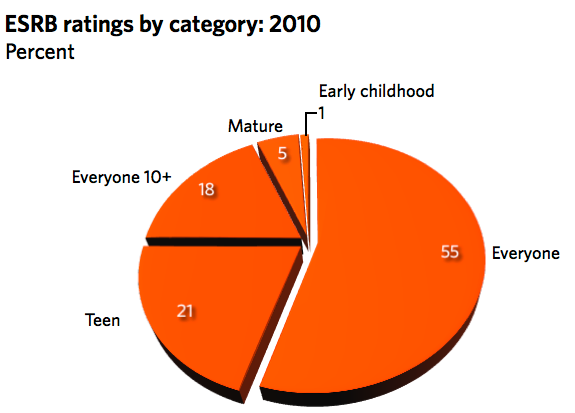 Five years ago this month, I penned a white paper on “Fact and Fiction in the Debate over Video Game Regulation” that I have been meaning to update ever since but just never seem to get around to it. One of the myths I aimed to debunk in the paper was the belief that most video games contain intense depictions of violence or sexuality. This argument drives many of the crusades to regulate video games. In my old study, I aggregated several years worth of data about video game ratings and showed that the exact opposite was the case: the majority of games sold each year were rating “E” for everyone or “E10+” (Everyone 10 and over) by the Entertainment Software Rating Board (ESRB).
 The Technology Liberation Front is the tech policy blog dedicated to keeping politicians' hands off the 'net and everything else related to technology.